| Piú viste |
AS09-22-3410.jpgAS 09-22-3410 - Coast-line57 visite
|
|

SOL999-2N215048276EFFAS00P1600L0M1.jpgOn the edge of 1000...Soles!57 visiteUn panorama ormai ricorrente e del tutto (almeno per gli Appassionati...) conosciuto: potremmo dare un nome ad ogni pietra (o "similpietra") e potremmo contare i vari pebbles (o "ciottoli") che si intravedono nel frame. Perchè? Perchè questa zona, ormai, la conosciamo come le nostre tasche: è il Winter Haven di Spirit!
Un Winter Haven che, tra non molto (finalmente!) verrà abbandonato per riprendere il viaggio...
|
|

V-838_Mon-01.jpgV-838 Monocerotis57 visite"...Optimus est orator qui dicendo animos audientium et docet, et delectat et permovet..."
(Cicerone)
"...Eccellente è quell'oratore che, parlando, insegna, diletta e commuove gli animi di coloro che ascoltano..."
|
|

MS_0735_6+7421-D-composite.jpgGalaxy Cluster MS0735.6+7421 in Camelopardus (the "Final Mosaic")57 visite"...Brevity, is the sister of Talent..."
Anton Chekhov (1860-1904)
|
|

MS_0735_6+7421-C-radio.jpgGalaxy Cluster MS0735.6+7421 in Camelopardus (the "Radio Image")57 visite"...Assassination is the extreme form of censorship..."
George Bernard Shaw (1856-1950) - "The Showing-up of Blanco Posnet" (1911)
|
|

MS_0735_6+7421-A-visiblelight.jpgGalaxy Cluster MS0735.6+7421 in Camelopardus (the "Visible Light Image")57 visite"...A pipe, for the hour of work; a cigarette, for the hour of conception; a cigar, for the hour of vacuity..."
George Gissing (1857-1903) - "Commonplace Book" (1962)
|
|

SNR-Cassiopeia_A-PIA01903.jpgSupernova Remnant Cassiopeia A57 visite"...Frequenter irrita est eius voluntas qui non quae facilia sunt adgreditur, sed vult facilia esse quae adgressus est..."
(Seneca)
"...Sovente è vana la volontà (di riuscire) non di chi intraprende imprese facili, bensì di colui che vuole essere facili (quando non lo sono) le attività già intraprese..."
|
|

Comets-Comet_SWAN-1.jpgThe SWAN Comet57 visiteComet SWAN, which unexpectedly flared up to naked-eye brightness, has been showing detail in its ion tail that might be described as ghostly. The ion tail is made of ionized gas, energized by ultraviolet light from the Sun and pushed outward by the solar wind. The solar wind itself is quite structured and sculpted by the Sun's complex and ever changing magnetic field. Following the wind, structure in Comet SWAN's tail can be seen to move outward from the Sun even alter its wavy appearance over time.
The blue color of the ion tail is dominated by recombining Carbon Monoxide atoms. The color of the coma surrounding the head of the comet is tinged green by slight amounts of the molecule cyanogen. This week (6-13 Nov. 2006) may be the best remaining chance for Northern Hemisphere observers to see the fading interplanetary snowball. SWAN has now past both the Earth and the Sun and will fade as it moves away from the Earth and heads out into the vast space between the stars.
|
|

Saturn-W00019554.jpgA "Slice" of Light...57 visiteCaption NASA:"W00019554.jpg was taken on November 06, 2006 and received on Earth November 06, 2006. The camera was pointing toward Saturn that, at the time, was approximately 1.284.897 Km away.
The image was taken using the CB2 and IRP90 filters and it has not been validated or calibrated".
|
|
as12_50_7431.jpgAS 12-50-7431 - The Moon, from VERY close...57 visite
|
|

O-Mariner9-00.jpgMars from Mariner 9: Canyons, troughs and cracks57 visitenessun commento
|
|
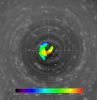
Saturn-PIA08334.jpgThe temperature of Saturn's "Stormy" South Pole57 visiteThe Cassini data presented in this view appear to confirm a region of warm atmospheric descent into the eye of a hurricane-like storm locked to Saturn's south pole. The view shows temperature data from the Cassini spacecraft composite infrared spectrometer overlaid onto an image from the imaging science subsystem wide-angle camera.
The composite infrared spectrometer data refer to a depth in Saturn's upper stratosphere where the pressure is 0.5 millibars (324 kilometers above the 1-bar level), a region higher than that imaged by the imaging camera and visual and infrared spectrometer during the same observation period. The composite infrared spectrometer data show a very small hot spot over the pole, similar in size to the "eye" of the storm seen in the imaging science subsystem images. See also Looking Saturn in the Eye and Saturn's Surprisingly Stormy South for related images.
The color scale at the bottom indicates the temperature in Kelvin corresponding to the colors of the temperature map. Numbers on the grid correspond to lines of latitude and longitude on the planet.
Infrared images taken through the Keck I telescope by ground-based observers had previously shown the south polar spot to be warm. Cassini's composite infrared spectrometer has confirmed this with higher resolution temperature maps of the area (like the map displayed here) and sees a temperature increase of about 2 Kelvin (4 degrees Fahrenheit) at the pole.
The temperatures are in the stratosphere and higher up than the clouds seen by the Cassini imaging and visual and infrared mapping spectrometer instruments, but they suggest that the atmosphere sinks over the south pole. Because the pressure increases with depth, the descending atmosphere compresses and heats up. The warmer temperatures over the south pole also indicate that the vortex winds are decaying with height in the stratosphere. The descent implied by the temperatures nicely supports the lower cloud altitudes observed by the imaging camera and visual and infrared spectrometer instruments at the pole.
The image and atmospheric data were acquired on Oct. 11, 2006, when Cassini was approximately 340,000 kilometers (210,000 miles) from Saturn. The wide-angle camera image was taken using a spectral filter sensitive to wavelengths of infrared light centered at 752 nanometers. The image has been contrast enhanced using digital image processing techniques. The unprocessed image shows an oblique view toward the pole, and was reprojected to show the planet from a perspective directly over the south pole. Scale in the original image was about 17 kilometers (11 miles) per pixel.
|
|
| 25353 immagini su 2113 pagina(e) |
 |
|
|
|
|
1534 | |
|
|
|
|





