| Piú viste |

SOL215-2P145448560EFF8500P2275L2M1.jpgUnusually-looking Outcrop near the "Mound" - Sol 21557 visitenessun commento
|
|

SOL223-2P146160126EFF8500P2289L6M1.jpgA new "very unusual" stone! (3)57 visiteEd infine, ad abundantiam, un'altro frame analogo ai precedenti, ripreso adottando un filtro ancora più scuro.
Le nostre considerazioni non cambiano: quella pietra, oltre ad avere caratteristiche incongruenti rispetto al resto del paesaggio, sembra essere "poggiata" in quel punto. Noi non crediamo che i "Marziani" ci stiano facendo degli scherzi: noi siamo solo e sempre più convinti che la storia geologica di Marte, così come è stata scritta sino ad ora, sia sostanzialmente errata e vada rivista.
|
|

Ganymede-V1-PIA02278_modest.jpgThe limb of Ganymede (from Voyager 1)57 visiteThis picture of Ganymede, Jupiter's largest satellite, was taken by Voyager 1 on the afternoon of March 5, 1979 from a range of 253.000 Km (about 151.800 miles). The picture is centered at 66° South Latitude and 3° Longitude and shows the south western limb region of Ganymede. The smallest features visible are about 2,5 Km (roughly 1,5 miles) across. The surface shows numerous impact craters, many of which have extensive bright ray systems. Light bands traversing the surface contain alternating bright and dark lines which probably represent deformation of the icy central material.
|
|

Triton-PIA02213_modest.jpgThe limb of Triton (natural colors - elab. NASA)57 visiteCaption NASA originale:"This natural color image of the limb of Triton was taken early in the morning of Aug. 25, 1989, when the Voyager 2 spacecraft was at a distance of about 210.000 Km (128.000 miles) from the icy satellite. The largest surface features visible area about 3 miles across. The picture is a composite of images taken through the violet, green and clear filters.
The image shows a geologic boundary between a rough, pitted surface to the right and a smoother surface to the left".
|
|

Saturn-HST-1996upto2000-PIA03156_modest.jpgSaturn from Hubble Space Telescope (1996 - 2000)57 visiteCaption NASA originale:"...Looming like a giant flying saucer in our outer solar system, Saturn puts on a show as the planet and its magnificent ring system nod majestically over the course of its 29-year journey around the Sun. These Hubble Space Telescope images, captured from 1996 to 2000, show Saturn's rings open up from just past edge-on to nearly fully open as it moves from autumn towards winter in its Northern Hemisphere..."
|
|
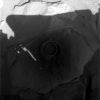
SOL231-2P146880766EFF8600P2576L2M1.jpgMartian terrain and a shadow57 visiteQuesta immagine del suolo di Marte è davvero preziosa, non solo perchè "scolpisce" (letteralmente) il contrasto luce/ombra che esiste sul Pianeta, ma anche perchè, trattandosi di una ripresa ravvicinata (ma non eccessivamente ravvicinata!) del suolo, ci consente di vedere ed apprezzare con sufficiente chiarezza la consistenza del medesimo così come apparirebbe ai nostri occhi "se fossimo là".
|
|

Saturn_s Clouds-V2-PIA01958_modest.jpgSaturn's Clouds from Voyager 257 visiteCaption NASA originale:"In this Voyager 2 observation of Saturn’s northern mid-latitudes is seen a strangely curled cloud attached by a thin ribbon to the bright white cloud region to the north. The cloud has been monitored for seven rotations around the planet. It appears to be forming a closed loop. Other discrete clouds are seen to the east. Also evident is the “ribbonlike” structure at 47 north latitude in the white cloud region. The spacecraft took this image from a distance of about 9.300.000 Km".
|
|

SOL233-2N147046135EFF8600P1554L0M1.jpgMartian Sky - Sol 23357 visiteUna riflessione: nei primi mesi delle Missioni Spirit ed Opportunity le immagini del cielo di Marte erano rarissime, quasi che il cielo di questo Pianeta non fosse un obbiettivo meritevole di attenzione e di studio. Poi, con il passare dei mesi, ecco che iniziamo a trovare, per ogni sol, svariate immagini che riprendono solo il cielo. Magnifico! Vorrà dire che chiariremo il "mistero" del suo vero colore? No: le immagini che puntano dirette al cielo di Marte (ma in cerca di cosa?) sono sempre tutte in b/n!
|
|
SOL237-2N147412222EFF8612P1881L0M1.jpgRocky Hills - Landscape (3) - Sol 23757 visitenessun commento
|
|
SOL239-2N147591040EFF8800P0650L0M1~0.jpgRocky Hills - Landscape (7) - Sol 23957 visitenessun commento
|
|

Saturn-N00016277.jpgSaturn, Moons and Stars57 visitenessun commento
|
|

ZA-Triton-PIA02247_modest.jpgFarewell Triton...57 visiteCaption NASA originale:"Voyager 2 obtained this parting shot of Triton, Neptune's largest satellite, shortly after closest approach to the moon and passage through its shadow on the morning of Aug. 25, 1989. The distance to Triton was 90.000 Km and the phase angle was 155°, so that only a thin crescent of Triton's south polar region can be seen. Because of the high phase angle, and perhaps because of scattering sunlight in Triton's hazy atmosphere, few surface features are also easily discernible". Un piccolo commento: non sembra anche a Voi di intuire una sottile somiglianza fra Tritone e Titano?...
|
|
| 25353 immagini su 2113 pagina(e) |
 |
|
|
|
|
1533 | |
|
|
|
|





