| Piú viste |
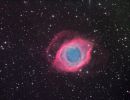
NGC-7293-4.jpgNGC 7293: The "Helix Nebula"57 visite"...Non so che cosa farmene di una Democrazia che non è capace di educare i giovani, di far rispettare le pur minime e più elementari Regole del Vivere Civile, di prevenire i crimini o, al limite, di sanzionarli (...) non so che farmene delle parole di circostanza che accompagnano alla tomba coloro che muoiono per stenti, o per troppo lavoro, o per assurdi eccessi di Fede in un'idea malintesa di Stato. (...)
Sui Giardini della Libertà che hanno edificato i nostri Padri, ed i Padri dei nostri Padri, attraverso ere di oscurità, di stenti, di sangue e di conquiste Sociali, ora si muovono ancora una volta delle vili orde di barbari, capaci solo di distruggere e di disprezzare; creature che nascono immuni da rimorsi e senso comune; esseri senza volto e senza ombra che agiscono nella costante impunità (...) individui che, protetti dalla paura e dall'ipocrisia, ammorbano la terra, l'aria e l'acqua..."
P.C. Floegers - "Conversations for Tomorrow"MareKromium
|
|
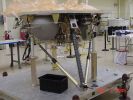
A-Phoenix-001.jpgThe Phoenix Lander: Hot-Fire Test Mock-Up57 visitenessun commentoMareKromium
|
|

A-Phoenix-000.jpgThe (fully assembled) Phoenix Mars Lander57 visitenessun commentoMareKromium
|
|
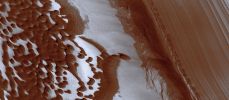
North_Polar_Regions-Chasma_Boreale-MGS-01.jpgBrown Dunes in Chasma Boreale (Enhanced Natural Colors; credits for the additional process. and color.: Dr Paolo C. Fienga - Lunexit Team)57 visitenessun commentoMareKromium
|
|
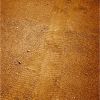
OPP-SOL1254-1P239512176EFF85W0P2351L7M1.jpgRover Tracks and bright "berries" all over... - Sol 1254 (False Colors; credits: Lunexit)57 visiteUna splendida immagine dei Berries che circondano Opportunity ci arriva (diremmo finalmente!) da Meridiani Planum, Sol 1254. Forse la tempesta di sabbia che aveva messo in pericolo la sopravvivenza dei MER si sta esaurendo e, forse, è ancora presto per dichiarare il cessato allarme.
Comunque sia, questa immagine (assieme a molte altre appena pervenute e da poco processate e colorizzate) ci dimostra che Opportunity è ancora in eccellente salute e riesce a fare il proprio lavoro egregiamente.
Noi - in tutta sincerità - non ne abbiamo mai dubitato.MareKromium
|
|
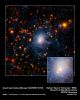
PIA09955_fig2.jpgFearsome Foursome (Figure 2)57 visiteFigure 2 is similar to figure 1 except the color blue represents X-ray light captured by NASA's Chandra X-ray Observatory. The colliding galaxies appear white in this picture because they are in areas where all the colors overlap.
The WIYN telescope, located near Tucson, Ariz., is owned and operated by the WIYN Consortium, which consists of the University of Wisconsin, Indiana University, Yale University, and the National Optical Astronomy Observatory.MareKromium
|
|
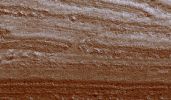
PSP_004708_1000_RED_browse-01.jpgFault in the South Polar Layered Deposits (EDM - Extremely Enhanced Natural Colors; credits for the additional process. and color.: Dr Paolo C. Fienga - Lunexit Team)57 visiteThe figure shown here is a cutout of the previous frame (1,8 Km across, or about 1,1 mile) showing a very interesting and smewhat rare feature: a fault. The fault is the thin, diagonal line that cuts through most of the image, from near the lower left corner to near the upper right corner. On each side of the fault, the layers that cross the fault are slightly off-set from one other; in other words, the layers don't line-up with each other anymore. The relationship between the angles at which the layers and fault are exposed and the movement along the fault is complex, but, in general, the layers on the left side of the fault are slightly lower than those on the right.MareKromium
|
|
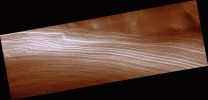
PSP_004708_1000_RED_browse-00.jpgFault in the South Polar Layered Deposits (CTX Frame - Extremely Enhanced Natural Colors; credits for the additional process. and color.: Dr Paolo C. Fienga - Lunexit Team)57 visiteThis image spans a section of the south polar layered deposits (SPLD). The SPLD are composed of layers of water ice mixed with impurities (mostly dust). The most similar terrestrial analog to the SPLD are ice sheets, like those covering most of Greenland and Antarctica.
Faults are created when rock (or, in this case, water ice) breaks due to some outside force and rocks (or ice) along either side of that break move in opposite directions. One of the most famous faults on Earth is the San Andreas Fault in California. There is a crack between the floor of the Pacific Ocean, plus a little bit of the California and Mexico coastline, and the rest of North America; the Pacific Ocean floor is moving northward along that crack, but North America is moving southward. Because the two sides are grinding against each other, they sometime stick together and then move again in jerky fashion, much like the way if you try to rub pieces of rough sand paper together. When movement along the fault occurs after a period of sticking together, this creates an earthquake.
For the case of this fault on Mars, it is unlikely that a "Marsquake" occurred when movement happened along this fault, because it is so small (over 1000 times shorter than the San Andreas Fault). This is interesting because faults are rare in the Martian polar layered deposits. The fault may have been created during widespread flow of the SPLD. Some of the stiffer ice could not flow and broke instead. Ice can only flow fast enough to create faults when it is relatively warm. Similarly, if you cool molasses enough, it becomes hard and doesn't flow. But the temperatures on Mars today are probably not warm enough to allow the creation of faults. This is why faults are so rare in the Martian ice. When were temperatures warm enough? This is still a mystery.
MareKromium
|
|
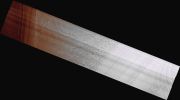
PSP_004664_0955_RED_browse.jpgOutcrops of Layers in the South Polar Layered Deposits57 visiteThis image spans a section of the South Polar Layered Deposits (SPLD). The SPLD are composed of layers of water ice mixed with impurities (probably mostly dust). The most similar terrestrial analog to the SPLD are ice sheets, like those covering most of Greenland and Antarctica.
The materials of ice sheets are deposited by freezing of atmospheric water vapor on dust particles and precipitation of those water/dust particles (snow), by direct condensation (freezing) of atmospheric water vapor onto the surface, and by fallout of dust. Together, these processes cause an ice sheet to undergo accumulation (build-up). Ablation (removal of material, also called erosion) of an ice sheet can also occur. If more accumulation happens than ablation, the ice sheet grows; if reversed, the ice sheet shrinks, as is the case for many of Earth’s glaciers due to global warming. Each year, the amount of accumulation and ablation varies, so layers of different thicknesses and different amounts of impurities (dust) will be deposited onto the ice sheet.
Volcanic eruptions anywhere on the planet can also potentially spew ash high into the atmosphere, where it can travel great distances and fall onto an ice sheet surface. Later accumulations of water ice can then trap this volcanic ash as a layer within the ice sheet. Thus, layers in an ice sheet can originate through a variety of means and occur at a variety of scales (thicknesses).
This particular image is interesting because many layers are exposed and because more than one outcrop (exposure of layering) is visible—at the top of the image and at the bottom. You can imagine the outcrops at the top and bottom of the image as if you are looking down on a staircase. The approximately horizontal lines are the edges of the layers (the risers), and the flat areas between them are the layer surfaces (the flat parts of the steps). The middle of the image is the top of the staircase. At the bottom, the staircase of layers goes down again.
The layers in this image are on the scale of meters (several to tens of feet) in thickness and are much thicker than one might expect from annual accumulation (which might be about 0.5 millimeters per year, or 0.02 inch per year). So the layers we see in this image may be packages of thinner, annual layers. The reason that we can distinguish between different packages of annual layers (in other words, the reason that we can see layering at this scale) is because the rates of accumulation and ablation change not only yearly, but also on much longer time scales. Imagine drilling into the SPLD and looking at the walls of the hole with a microscope. Within the large-scale layering we see in this image, we might see annual accumulation layers, dusty layers created during large dust storms, and maybe even volcanic ash layers.MareKromium
|
|

OPP-SOL795-1P198781216ESF6900P2673R2M1.jpgSunset on Mars, with "lights" in the Sky (1) - Sol 795 (possible natural colors - elab. Lunexit)57 visiteUn'ipotesi: e se le due "luci nel tramonto" fossero Deimos e Phobos (visibili grazie ad una esposizione leggermente più lunga la quale fu anche causa, come ovvio, dell'image artifact che domina la porzione superiore del Sole calante)?MareKromium
|
|

PSP_003252_1425_RED_browse-02.jpgBright Gully Deposit in Terra Sirenum (the "gully" - close-up; false colors)57 visiteThe bright gully deposit has a very fluid-like appearance, and has not been covered by other gullies or debris flows, indicating a young age. The brightness is a mystery; it could be due to minerals formed from water or ice.
Alternatively, the flow that made the gully may have removed a thin coating of relatively darker dust and soil, revealing a brighter substrate.
In any case, this feature is probably indicative of recent flow of water or water-rich material on Mars.MareKromium
|
|
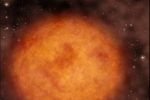
Mira-PIA09960.jpgMira: a real Shooting Star!57 visite"...Plus tibi Virtus tua dedit, quam Fortuna abstulit..."
(Cicerone)
"...La Virtù ti diede più di quanto la Sorte ti tolse..."MareKromium
|
|
| 25353 immagini su 2113 pagina(e) |
 |
|
|
|
|
1530 | |
|
|
|
|





