| Piú viste |

SOL549-2P175112058EFFAD00P2352L7M1.jpgThis is the world around Spirit... (5) - Sol 54957 visitenessun commento
|
|

SOL550-2N175194849EFFAD40P0665L0M1.jpgNew outcrop and Panorama (2) - Sol 55057 visitenessun commento
|
|

SOL550-2P175192740EFFAD24P2353L2M1.jpgBeautiful and strange rocks (1) - Sol 55057 visitenessun commento
|
|
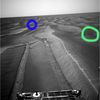
OPP-SOL531-1N175322095EFF57BHP1607L0M1.jpgSide-Winders, Troughs and Outcrops - Sol 531 (4)57 visiteCerchiatura Blu: rilievo anomalo ed indefinibile (potrebbe anche essere un photo-artifact)
|
|
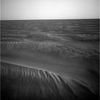
OPP-SOL531-1N175322203EFF57BHP1607L0M1.jpgSide-Winders, Troughs and Outcrops - Sol 531 (6)57 visitenessun commento
|
|

SOL551-2P175278415ESFAD40P2558R7M1.jpgDisquieting Rock... (2) - Sol 55157 visiteDati NASA ufficiali:"Right PanCam Non-linearized Sub-frame EDR acquired on Sol 551 of Spirit's mission to Gusev Crater at approximately 12:21:03 MLT, camera commanded to use Filter 7".
|
|
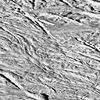
Enceladus-PIA06251.jpgEnceladus from about 208 Km57 visiteThis wide-angle view is one of the highest resolution images yet acquired by Cassini and shows what appears to be a geologically youthful, tectonically fractured terrain.
The image was taken during Cassini's very close flyby of Enceladus on July 14, 2005, from a distance of approx. 208 Km (such as about 129 miles) above Enceladus. Resolution in the image is about 37 mt (or 121 feet) per pixel. The image's contrast has been enhanced to improve the visibility of surface features.
|
|

Enceladus-PIA06250.jpgZooming-in on Enceladus57 visiteCaption NASA originale:"The tortured Southern Polar terrain of Enceladus appears strewn with great boulders of ice in these 2 fantastic views - the Highest Resolution images obtained so far by Cassini of any world.
This comparison view consists of a wide-angle camera image (left) for context, and a HR narrow-angle camera image (right). The 2 images were acquired at an altitude of approx. 208 Km, as Cassini made its closest approach yet to Enceladus. The wide-angle view shows what appears to be a geologically youthful, tectonically fractured terrain.
In the narrow-angle view, some smearing of the image due to spacecraft motion is apparent. Both of these views were acquired as Enceladus raced past Cassini's field of view near the time of closest approach. At the time, the imaging cameras were pointed close to the moon's limb (edge), rather than directly below the spacecraft. This allowed for less 'motion blur' than would have been apparent had the cameras pointed straight down. Thus, the terrain imaged here was actually at a distance of 319 kilometers (198 miles) from Cassini".
|
|
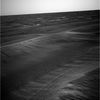
OPP-SOL536-1N175770788EFF57KRP1915L0M1.jpgPanorama - Sol 536 (2)57 visiteCaption NASA originale:"The Rover's Power Team reported a dust-cleaning event on Opportunity between Soles 524 and 526. Daily power output from solar panels increased from about 500 watt hours to about 650 watt hours".
Nota: questa informazione riportata dalla NASA, a nostro parere, non è reale. Abbiamo esaminato con ESTREMA attenzione le immagini dei Soles 524, 525 e 526 e, a quanto esse ci mostrano, intorno al Rover NON si è mosso un grano di sabbia che fosse uno (verificate, per esempio, lo stato delle tracce che sono state lasciate dalle ruote di Opportunity). Deduzione: se il "dust-cleaning event" di cui parla la NASA è un Dust-Devil, allora dobbiamo dedurre che esso è nato, si è sviluppato ed è morto SUL Rover, senza muoversi di un millimetro nello spazio ad esso circostante (ed è un'ipotesi così poco credibile da non meritare commenti). Lo scenario cambia se supponiamo che il Dust-Devil è capace di ripulire il Rover ma NON è in grado di modificare l'ambiente circostante.
|
|

Enceladus-PIA06433.jpgThe heat inside Enceladus...57 visiteThis image shows the warmest places in the South Polar Region of Enceladus. The unexpected temperatures were discovered by Cassini's Composite Infrared Spectrometer during a close flyby on July 14, 2005. The image shows how these temperatures correspond to the prominent, bluish fractures dubbed "Tiger Stripes". Such "warm" temperatures (91 and 89° Kelvin - about minus 296 and minus 299° Fahrenheit - are unlikely to be due to heating of the surface by the feeble sunlight striking Enceladus' South Pole. They are a strong indication that internal heat is leaking out of Enceladus and warming the surface along these fractures. Evaporation of this relatively warm ice probably generates the cloud of water vapor detected above Enceladus' South Pole by several other Cassini instruments. Scientists are unsure how the internal heat reaches the surface. The process might involve liquid water, slushy brine, or soft but solid ice.
|
|
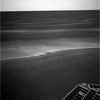
OPP-SOL534-1N175587911EFF57GMP1607L0M1.jpgBeside Still Waters... (2) - Sol 53457 visitenessun commento
|
|

OPP-SOL539-1P176037684EFF57LRP2445R2M1.jpgThe "Etched Terrain" (3) - Sol 53957 visitenessun commento
|
|
| 25353 immagini su 2113 pagina(e) |
 |
|
|
|
|
1529 | |
|
|
|
|





