| Piú viste |

HD-189733b-1.jpgExtra-Solar Planet HD 189733b57 visiteNASA's Hubble Space Telescope (HST) has made the first detection ever of an organic molecule in the atmosphere of a Jupiter-sized planet orbiting another star. This breakthrough is an important step in eventually identifying signs of life on a planet outside our Solar System.
The molecule found by Hubble is Methane, which under the right circumstances can play a key role in prebiotic chemistry — the chemical reactions considered necessary to form life as we know it.
This discovery proves that Hubble and upcoming space missions, such as NASA's James Webb Space Telescope, can detect organic molecules on planets around other stars by using spectroscopy, which splits light into its components to reveal the "fingerprints" of various chemicals.
"This is a crucial stepping stone to eventually characterizing prebiotic molecules on planets where life could exist," said Mark Swain of NASA's Jet Propulsion Laboratory (JPL), Pasadena, Calif., who led the team that made the discovery. Swain is lead author of a paper appearing in the March 20 (2008) issue of Nature.
The discovery comes after extensive observations made in May 2007 with Hubble's Near Infrared Camera and Multi-Object Spectrometer (NICMOS). It also confirms the existence of water molecules in the planet's atmosphere, a discovery made originally by NASA's Spitzer Space Telescope in 2007. "With this observation there is no question whether there is water or not — water is present", said Swain.
The planet now known to have Methane and water is located 63 Light-Years away in the constellation Vulpecula. Called HD 189733b, the planet is so massive and so hot it is considered an unlikely host for life. HD 189733b, dubbed a "hot Jupiter", is so close to its parent star it takes just over two days to complete an orbit. These objects are the size of Jupiter but orbit closer to their stars than the tiny innermost planet Mercury in our solar system.
HD 189733b's atmosphere swelters at 1700 degrees Fahrenheit, about the same temperature as the melting point of Silver.
Though the star-hugger planet is too hot for life as we know it, "this observation is proof that spectroscopy can eventually be done on a cooler and potentially habitable Earth-sized planet orbiting a dimmer red dwarf–type star," Swain said. The ultimate goal of studies like these is to identify prebiotic molecules in the atmospheres of planets in the "habitable zones" around other stars, where temperatures are right for water to remain liquid rather than freeze or evaporate away.
The observations were made as the planet HD 189733b passed in front of its parent star in what astronomers call a transit. As the light from the star passed briefly through the atmosphere along the edge of the planet, the gases in the atmosphere imprinted their unique signatures on the starlight from the star HD 189733.
The astronomers were surprised to find that the planet has more Methane than predicted by conventional models for "hot Jupiters".
"This indicates we don't really understand exoplanet atmospheres yet," said Swain. "These measurements are an important step to our ultimate goal of determining the conditions, such as temperature, pressure, winds, clouds, etc., and the chemistry on planets where life could exist. Infrared spectroscopy is really the key to these studies because it is best matched to detecting molecules", said Swain.
Swain's co-authors on the paper include Gautam Vasisht of JPL and Giovanna Tinetti of University College, London/European Space Agency.MareKromium
|
|
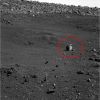
SOL524-2P172890954EFFAC00P2438L7M1-1.jpgExtremely unusual "Boulder" - Sol 524 (context frame; credits: Dr Gianluigi Barca57 visiteIl particolare evinto dal Dr Gianlui Barca in questo frame Spirit è di quelli che lasciano, se non altro - e come minimo -, piuttosto sorpresi: che la Natura si sbizzarrisca, infatti, attraverso la creazione di rilievi le cui forme, tavolta, sono incredibili ed inarrivabili anche per l'Immaginazione del più surreale e fantasioso degli Artisti è un fatto. Ma qui, su Marte (e lo diciamo scherzosamente come ovvio...), sembra proprio che si stia esagerando: andate a guardare l'extra-detail mgnf che segue...
Nota: per quanto attiene qualche nostra nota preliminare sul bizzarro macigno in oggetto (e scritta nel Giugno 2005), Vi rinviamo ai nostri primi (e sommari) commenti che potrete leggere nel quadro intitolato 'A "lonely, big and unusually-shaped" Boulder - Sol 524'.MareKromium
|
|
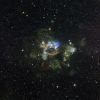
N-44.jpgThe N44 Complex57 visite"...I commune with my heart in the night; I meditate and search my Spirit..."
- Psalm 77:6MareKromium
|
|
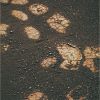
OPP-SOL541-1.jpgMartian Paving - Sol 541 (True Colors + MULTISPECTRUM; credits: Dr G. Barca & Lunexit)57 visitenessun commentoMareKromium
|
|
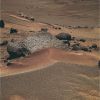
SOL582-1.jpgMarble-like Rocks in the Sand - Sol 582 (True Colors + MULTISPECTRUM; credits: Dr G. Barca & Lunexit)57 visitenessun commentoMareKromium
|
|

Craters-Pollack_Crater_and_White_Rock-20020419a-PCF-LXTT.jpgPollack Crater and "White Rock" (Slightly Saturated Absolute Natural Colors; credits for the additional process. and color.: Dr Paolo C. Fienga - Lunexit Team)57 visiteCaption NASA:"White Rock is the unofficial name for this unusual landform which was first observed during the Mariner 9 Mission in the early 70's. As later analysis of additional data sets would show, White Rock is neither white nor dense rock. Its apparent brightness arises from the fact that the material surrounding it is so dark. Images from the Mars Global Surveyor MOC camera revealed dark sand dunes surrounding White Rock and on the floor of the troughs within it.
Some of these dunes are just apparent in the THEMIS image. Although there was speculation that the material composing White Rock could be salts from an ancient dry lakebed, spectral data from the MGS TES instrument did not support this claim. Instead, the White Rock deposit may be the erosional remnant of a previously more continuous occurrence of air fall sediments, either volcanic ash or windblown dust.
The THEMIS image offers new evidence for the idea that the original deposit covered a larger area.
Approximately 10 Km to the South-East of the main deposit are some tiny knobs of similarly bright material preserved on the floor of a small crater. Given that the eolian erosion of the main White Rock deposit has produced isolated knobs at its edges, it is reasonable to suspect that the more distant outliers are the remnants of a once continuous deposit that stretched at least to this location.
The fact that so little remains of the larger deposit suggests that the material is very easily eroded and simply blows away".MareKromium
|
|
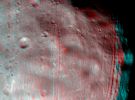
PSP_007769_9010_15.jpgPhobos in 3D (credits: NASA)57 visitenessun commentoMareKromium
|
|

SOL171-MI.jpgWatch Carefully! - Sol 171 (True Colors + MULTISPECTRUM; credits: Dr M. Faccin & Lunexit)57 visitenessun commentoMareKromium
|
|
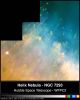
NGC-7293~1.jpgNGC 7293 - Cometary Knots in the Helix Nebula (HST)57 visite"...In scirpo nodum quaeris..."
(Plauto)
"...Cerchi il nodo nel giunco..."
(detto a proposito di coloro che, per motivi non comprensibili ai terzi, cercano - e, spesso, trovano! - le difficoltà anche nelle cose semplici)MareKromium
|
|
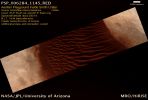
PSP_006284_1145_RED_abrowse-00.jpgLarge Dunefield inside Smith Crater (MULTISPECTRUM; credits: Lunexit)57 visiteThis image shows a Dark Dunefield in Smith Crater. The dark color of the dunes indicates that they are probably made of basaltic sand, a dark volcanic rock that is common on Mars. This is in contrast to dunes on Earth, which are dominated by quartz, a rare mineral on Mars.
The dunes here are “transverse dunes” that, based on analogy with similar features on Earth, form by winds that blow in a direction perpendicular to the crests. However, Secondary ripples on top of the dunes are oriented at right angles; that indicates a second wind regime that has redistributed the sand after the original dunes formed. The multiple orientations of the dunes may be partly caused by their location within the crater, whose own topography can act to redistribute regional wind patterns.
The dark streaks on the lighter terrain outside of the Dunefield are interpreted as DD tracks, where mini-tornadoes reveal darker ground beneath the bright dust of the surface.
Some long DD Tracks are visible in the southern part of the dune field and climb onto the troughs of the transverse dunes. There are also a few faded tracks at the northern part of the dune field.MareKromium
|
|
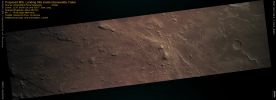
PSP_007481_1560_RED_abrowse.jpgProposed MSL Landing Site in Eberswalde Crater (MULTISPECTRUM; credits: Lunexit)57 visiteThis image covers a portion of Eberswalde Crater, which has an ancient deltaic depositional setting. Eberswalde is an approx. 65 Km diameter, closed basin crater. This image was targeted in the landing ellipse as a possible site for the 2009 Mars Science Laboratory Mission. The image shows resistant mounds and knobs as well as a scoured surface.
The CRISM instrument on board the Mars Reconnaissance Orbiter has detected Phyllosilicates (clays) in the bright layers in the crater. One of the ways clays form on Earth is when water erodes rock and makes fine particles which settle out of water; this often occurs in river deltas and lake beds.
The delta and meandering channels in Eberswalde Crater (to the West of the Landing Ellipse) and the detection of Phyllosilicates provides evidence for possible persistent aqueous activity on Mars.MareKromium
|
|
SHARAD-1.gifUnder the Ice... (1)57 visiteRadar Sounder Instruments orbiting Mars have looked beneath the Martian Surface and opened up the Third Dimension for Planetary Exploration.
The technique's success is prompting scientists to think of all the other places in the Solar System where they would like to use Radar Sounders.
The first Radar Sounder at Mars was the Mars Advanced Radar for Subsurface and Ionospheric Sounding (MARSIS) on the European Space Agency's Mars Express Orbiter. It has been joined by the complementary Shallow Subsurface Radar (SHARAD), operating at a different wavelength aboard NASA's Mars Reconnaissance Orbiter.
The data in this animation are from SHARAD.MareKromium
|
|
| 25353 immagini su 2113 pagina(e) |
 |
|
|
|
|
1526 | |
|
|
|
|





