| Piú viste |

KBO-2-Artist_Conception.jpgKuiper's Belt Object occulting a Star58 visiteNASA's Hubble Space Telescope has discovered the smallest object ever seen in Visible Light in the Kuiper Belt, a vast ring of icy debris that is encircling the outer rim of the Solar System, just beyond Neptune.
The needle-in-a-haystack object found by Hubble is only 3200 feet across and a whopping 4,2 Billion Miles away. The smallest Kuiper Belt Object (KBO) seen previously in reflected light is roughly 30 miles across, or 50 times larger.
This is the first observational evidence for a population of comet-sized bodies in the Kuiper Belt that are being ground down through collisions. The Kuiper Belt is therefore collisionally evolving, meaning that the region's icy content has been modified over the past 4,5 BYs.
The object detected by Hubble is so faint — at 35th magnitude — it is 100 times dimmer than what Hubble can see directly.
So then how did the space telescope uncover such a small body?MareKromium
|
|

30-Doradus.jpg30 Doradus and R-13658 visiteThe massive, young stellar grouping, called R136, is only a few million years old and resides in the 30 Doradus Nebula, a turbulent star-birth region in the Large Magellanic Cloud (LMC), a satellite galaxy of our Milky Way. Many of the stars are among the most massive known. Several of them are over 100 times more massive than our Sun. These hefty stars are destined to become supernovae in a few million years.
The image, taken by Hubble's Wide Field Camera 3, spans about 100 light-years. The nebula is close enough to Earth that Hubble can resolve individual stars, giving astronomers important information about the stars' birth and evolution.
The brilliant stars are carving deep cavities in the surrounding material by unleashing a torrent of ultraviolet light, and hurricane-force stellar winds (streams of charged particles), which are etching away the enveloping hydrogen gas cloud in which the stars were born. The image reveals a fantasy landscape of pillars, ridges, and valleys, as well as a dark region in the center that roughly looks like the outline of a holiday tree. Besides sculpting the gaseous terrain, the brilliant stars can also help create a successive generation of offspring. When the winds hit dense walls of gas, they create shocks, which may be generating a new wave of star birth.
The movement of the LMC around the Milky Way may have triggered the massive cluster's formation in several ways. The gravitational tug of the Milky Way and the companion Small Magellanic Cloud may have compressed gas in the LMC. Also, the pressure resulting from the LMC plowing through the Milky Way's halo may have compressed gas in the satellite. The cluster is a rare, nearby example of the many super star clusters that formed in the distant, early universe, when star birth and galaxy interactions were more frequent. Previous Hubble observations have shown astronomers that super star clusters in faraway galaxies are ubiquitous. The LMC is located 170,000 light-years away and is a member of the Local Group of Galaxies, which also includes the Milky Way.
The Hubble image was taken at infrared wavelengths (1.1 microns and 1.6 microns). Hubble sees through the dusty nebula, revealing many stars that cannot be seen in visible light. The large bright star just above the center of the image is in the 30 Doradus nebula. The Hubble observations of 30 Doradus were made October 20-27, 2009.MareKromium
|
|
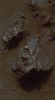
PSP_002101_1875_red-01.jpgMojave Crater Floor and Central Uplift (EDM - Natural Colors; credits: Lunexit)58 visiteThis HiRISE sub-image shows a portion of the Central Uplift structure in Mojave Crater.
Central Uplifts are a typical feature of large impact craters on the Earth, the Moon and Mars; craters larger than 6 or 7 Km in diameter on Mars typically form this mountain-like peak in the central portion of the crater interior.
This peak consists of rocks originating from several kilometers beneath the pre-impact surface. Mojave has a very prominent Central Uplift as it has a diameter of approx. 60 Km (about 37 miles).
In this image, Boulders as large as 15 mt (50 feet) across have been eroded from the massive uplifted rock and have rolled downslope.
Fine-grained Debris has also collected in the topographic lows and has been shaped by the wind into Dunes and Ripples. Notably absent from this image are the striking Drainage Channels and Alluvial Fans that are abundant on the Wall-Terraces and Ejecta of Mojave Crater (see PSP_001415_1875).
These features were likely formed by Surface Runoff of liquid water, which may have been released from the Subsurface during the impact event that formed Mojave.
Previously, it had been suggested that a brief, torrential downpour over Mojave Crater delivered the water. However, Mars Orbiter Camera's (MOC) images of Mojave's Central Uplift have previously shown no evidence for Surface Runoff, and the higher resolution of this HiRISE image (2.4 MB) confirms that this part of the Crater appears untouched by liquid water.
So the question remains: by what means was the water, in the form of Runoff, supplied to Mojave? This question, in addition to several others regarding this phenomenon, are currently being investigated by the HiRISE team and their collaborators.MareKromium
|
|
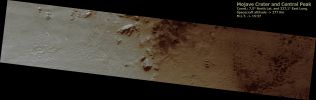
PSP_002101_1875_red-00~0.jpgMojave Crater Floor and Central Uplift (CTX Frame - Natural Colors; credits: Lunexit)58 visiteThis full HiRISE image shows that the Crater Floor - South of the Central Uplift - is densely pitted and fractured. These Pits, many of which are partially filled with dark sand, lack raised rims and a circular form.
This suggests that they are not impact craters. In fact, very few definite impact craters are seen on the Floor and Walls of Mojave, implying that it is incredibly young and relatively well preserved for a crater of its size.
HiRISE images covering Mojave Crater and the surrounding Region are yielding new insights into impact processes on Mars. MareKromium
|
|
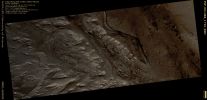
PSP_001488_1750_RED_abrowse.jpgEdge along Gale Craters's Interior Mound (Natural Colors; credits: Dr Paolo C. Fienga - Lunexit Team)58 visiteGale Crater is one of several craters around the Equator that show the presence of Light-Toned Layered Deposits (or LTLD). This HiRISE image covers the northern edge of the LTLD in the Central Mound of Gale Crater, as well as a small portion of the Crater Floor. The right side of the image shows a relatively flat surface with some Impact Craters.
Moving to the left (Southward), there is a large Canyon where Dark Sands have accumulated and formed Ripples and Dunes.
As one moves further to the South, the LTLD rises upward in topography and Layering is visible in some locations. The Surface of the LTLD is very fractured, producing meter-size blocks.
The fact that we don't see many loose rocks along the Surface suggests that the rocks are quickly being destroyed by winds due to their fragile nature.
Resistant Hills, on the other side, tend to be elongated, which is consistent with upslope or downslope winds eroding the rocks themselves.MareKromium
|
|
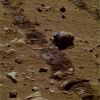
SOL203-PanCamA-LXTT.jpgBlueish Reflections in the Tracks - Sol 203 (Natural Colors; credits: Elisabetta Bonora - Lunexit Team)58 visitenessun commentoMareKromium
|
|

Saturnian_Sky.gifIn the Sky of Saturn (GIF-Movie; credits: Dr M. Faccin)58 visitenessun commentoMareKromium
|
|

ZZ-Mercury-Craters-Rembrandt_Crater-PIA12395.jpgLow Sun over Rembrandt Crater (possible Natural Colors; credits: Dr Paolo C. Fienga - Lunexit Team)58 visiteThis NAC image acquired during MESSENGER's third Fly-By of Mercury shows a view of the interior of Rembrandt Basin that emphasizes landforms. Rembrandt was discovered during the Mission's second Fly-By, in October 2008. Its large size (approx. 715 Km, or about 444 miles, in diameter), its relatively young age (as implied by the low number of superposed impact craters), and the radiating extensional and contractional fractures on its Floor, have made it a topic of special interest to the MESSENGER Science Team.
Earlier this year, an article devoted to the first study of the geology of Rembrandt was published in the Science magazine. During Mercury's Fly-By 3, Rembrandt was closer to the Terminator - such as the line between the sunlit dayside and dark nightside of the Planet - and the different viewing geometries between Fly-Bys 2 and 3 enabled a three-dimensional view of this unusual basin. The grazing angle of the light from the setting Sun in this particular NAC image accentuates the topography of the features on the Rembrandt's Floor, including the set of unusual Radiating Fractures.
Date Acquired: September 29, 2009
Image Mission Elapsed Time (MET): 162744327
Instrument: Narrow Angle Camera (NAC) of the Mercury Dual Imaging System (MDIS)
Resolution: 390 meters/pixel (0,24 miles/pixel)
Scale: The prominent crater at center left is about 44 Km (approx. 27 miles) in diameter
Spacecraft Altitude (distance from target): approx. 15.100 Km (about 9400 miles)
MareKromium
|
|

Prometheus-N00148968-N00148985-GB.gifPrometheus adrift... (GIF-Movie; credits: Dr G. Barca)58 visitenessun commentoMareKromium
|
|

Prometheus-091227-N00148969-EB.jpgPrometheus adrift... (possible Natural Colors; credits: Elisabetta Bonora - Lunexit Team)58 visiteNulla di artefatto o manipolato digitalmente, in questo frame prodotto dalla nostra Elisabetta Bonora!
La colorazione rosacea di Prometheus, infatti, potrebbe e dovrebbe dipendere, a nostro modo di vedere, dal Saturnshine (o "Chiaro di Saturno").
E non è neppure inutile rammentare che Prometheus non è la sola Luna Saturniana ad avere un colore simile!
Esso, infatti, forma uno splendido "Space Duo" con Hyperion la cui Superficie, sempre secondo la NASA (e ad eccezione di quanto contenuto nei bizzarri crateri che lo ricoprono quasi per intero), sarebbe di color rosa pallido, con sfumature grigie e bianco/verdastre.MareKromium
|
|

The_Rings-EB.jpgUp-Sun in the Space of Saturn (Natural Colors; credits: Elisabetta Bonora - Lunexit Team)58 visitenessun commentoMareKromium
|
|

Rhea-4229274308_c987cf73d9_o.jpgLarge Crater on Rhea (possible True Colors; credits: Dr M. Faccin - Lunexit Team)58 visitenessun commentoMareKromium
|
|
| 25353 immagini su 2113 pagina(e) |
 |
|
|
|
|
1523 | |
|
|
|
|





