| Piú viste |

OPP-SOL1329-1N246175827EFF8788P0775R0M1.jpgThe Beautiful Paving of Victoria - Sol 1329 (light-blue filter ON - possible natural colors - elab. Lunexit)57 visitenessun commentoMareKromium
|
|
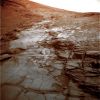
OPP-SOL1329-1N246175625EFF8788P1675R0M1.jpgThe Beautiful Paving of Victoria - Sol 1329 (light-blue filter OFF - possible natural colors - elab. Lunexit)57 visitenessun commentoMareKromium
|
|
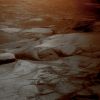
OPP-SOL1329-1P246170461ESF8754P2585L3M1.jpgThe "Inner Paving" and the "Red Sands" of Victoria - Sol 1329 (red-orange filter ON - possible natural colors - elab. Lunexit)57 visitenessun commentoMareKromium
|
|

PSP_005346_1755_RED_abrowse-01.jpgLow-Order Inverted Streams near Juventae Chasma (extra-detail mgnf)57 visiteThis subimage (approx. 1120 meters across) shows a juncture of 2 of the "Inverted Channels".
It is likely that the water flowed from the left to the right of the scene, because channels usually join rather than divert unless there is an obvious obstacle in the way.
No such obstacle is seen here, but one might have been present when the stream originally flowed.
However, there is no way of knowing this.MareKromium
|
|

PSP_005346_1755_RED_abrowse-00.jpgLow-Order Inverted Streams near Juventae Chasma (context frame - elab. Lunexit)57 visiteThis image shows plains North-West of Juventae Chasma, one of the Martian canyons that are part of the equatorial Valles Marineris System. The two most noticeable features in this scene are craters on mesas (plateaux) and raised, winding ridges. The raised ridges are "Inverted Channels". It is likely that liquid water, either pure or salt water, flowed through these channels. The channels are raised because streams transport sediment as they flow, deposit the heavier sediment on the stream floor, and, eventually fill in once their water supply dwindles. Over time, wind erosion modifies a landscape, and this has played an important role on these plains. It eroded the land around the channels leaving the remnant channels exposed and standing high. The channels did not erode as much since they were more resistant, possibly because the deposited sediment had cemented together.
The craters on mesas are also evidence of active wind erosion: when craters form, they eject material out onto the surrounding landscape.
It appears that several of the craters’ ejecta visible here cemented, making the ejecta more resistant to erosion and leaving them standing high as craters on plateaux.MareKromium
|
|

PSP_005381_0870_RED_abrowse.jpgSouth Polar Layered Deposits with Surface Modification (possible natural colors - elab. Lunexit)57 visiteThis image shows a scarp exposing the south polar layered deposits (SPLD). The polar layered deposits are thought to record recent climate variations on Mars, similar to ice ages on Earth.
Radar data indicate that the SPLD are ice-rich, with variations in dust contamination likely causing the layering visible here. HiRISE images of the SPLD will help to unravel Mars' climate history, but this image illustrates how this effort is complicated.
The development of surface features, by erosion, deposition, or modification of the surface, makes it difficult to determine the characteristics of the layers themselves. Some of the layers appear wavy, perhaps due to folding, flow, or uneven erosion since they were laid down. Short, branching, often radial channel systems are cut into the surface of the layers in places. These may be related to "spiders," thought to be formed as carbon dioxide gas flows along the surface when the seasonal polar cap sublimates in the spring. Pits and polygonal fractures are visible on the layers as well.
Apparently this exposure of SPLD is relatively old, as these features probably take many years to form. While these features are interesting in their own right, they disturb the SPLD outcrops and make it more difficult to measure the thickness of layers and compare them to other outcrops of SPLD.
MareKromium
|
|
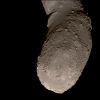
LLN-Itokawa-ST_2506694595_v.pngApproaching Itokawa (3 - natural colors; elab. Lunexit)57 visitenessun commentoMareKromium
|
|

Comets-Comet_Holmes-TView.jpgTelescopic View of the Comet Holmes57 visiteCaption NASA, da "NASA - Picture of the Day" del 29 Ottobre 2007:"What's happened to Comet Holmes? A normally docile comet discovered over 100 years ago, Comet 17P/Holmes suddenly became nearly one million times brighter last week, possibly over just a few hours. In astronomical terms, the comet brightened from magnitude 17, only visible through a good telescope, to magnitude 3, becoming visible with the unaided eye. Comet Holmes had already passed its closest to the Sun in 2007 May outside the orbit of Mars and was heading back out near Jupiter's orbit when the outburst occurred. The comet's sudden brightening is likely due to some sort of sunlight-reflecting outgassing event, possibly related to ice melting over a gas-filled cavern, or possibly even a partial breakup of the comet's nucleus. Pictured above through a small telescope, Comet Holmes appeared as a fuzzy yellow spot, significantly larger in angular size than Earth-atmosphere blurred distant stars. Although Comet Holmes' orbit will place it in northern hemisphere skies for the next two years, whether it will best be viewed through a telescope or sunglasses remains unknown".MareKromium
|
|

Quasar_MC2-1635+119-B.jpgQuasar MC2-1635+11957 visite"...Est quadam prodire tenus, si non datur ultra..."
(Orazio)
"...E' già buona cosa giungere sino ad un certo punto, se non è possibile andare oltre..." (trad. libera)MareKromium
|
|
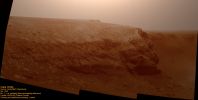
OPP-SOL1329-1193591285_32257-4_Sol1329B_P2379_L257atc-3.jpgCape Verde, according to Lunexit - Sol 132957 visiteLe "Verità", come abbiamo scritto qualche centinaio di volte, non la può conoscere ancora nessuno. Tuttavia, se non la "Verità", almeno alcuni frammenti di plausibilità, nel tempo e con il tempo (e la pazienza e la competenza...) possono essere trovati e proposti.
Questa è la nostra ultima elaborazione in "Possibili Colori Veri" di Cape Verde: essa è il frutto di un (ormai lungo) lavoro di confronti, riflessioni, tentativi e speculazioni.
E' giusta?
Non lo è?
Lo è solo in parte?
Non importa. Voi provate a confrontarla con le elaborazioni NASA degli ultimi 3 anni e poi decidete da soli.
La differenza sostanziale, a nostro parere, è solo una: la nostra elaborazione è il frutto di un percorso.
Magari errato in nuce, ma un percorso (guardate le nostre prime elaborazioni a colori per rendervene conto).
L'elaborazione NASA, invece, è solo un frame in b/n processato (MOOOOLTO alla svelta e moooolto alla buona...) con un programmino tipo Photo o Paintshop.
Tutto qui.MareKromium
|
|

Comets-Comet_Holmes-UV.gifComet 17-P-Holmes57 visiteCaption NASA, da "NASA - Picture of the Day" del 30 Ottobre 2007:"Go outside tonight and see Comet Holmes.
No binoculars or telescopes are needed -- just curiosity and a sky map.
Last week, Comet 17P/Holmes underwent an unusual outburst that vaulted it unexpectedly from obscurity into one of the brightest comets in recent years.
Sky enthusiasts from the Northern Hemisphere have been following the comet's progress closely. Pictured above Quebec, Canada, the coma of Comet Holmes has been noticeably expanding over the past few days. In the above picture, an image of Jupiter has been placed artificially nearby to allow for a comparison of angular sizes.
Jupiter has been scaled to the size it would appear at the current location of Comet Holmes. How Comet Holmes will further evolve is unknown, with one possibility being that the expanding gas cloud that started from its recent outburst will slowly disperse and fade".MareKromium
|
|

OPP-SOL1338-1P246971817EFF8788P2391L2M1.jpgThe "Inner Paving" and the "Red Sands" of Victoria - Sol 1338 (red-orange filter OFF - possible natural colors - elab. Lunexit)57 visitenessun commentoMareKromium
|
|
| 25353 immagini su 2113 pagina(e) |
 |
|
|
|
|
1521 | |
|
|
|
|





