| Piú viste |

PSP_005155_1030_RED_browse.jpgExposure of South Polar Layered Deposits57 visiteA complex geologic history is on display in this image of the South Polar Layered Deposits. These layered deposits are a mixture of dust and water-ice. Each layer is thought to record information about the state of the Martian climate at the time of its deposition.
The original stack of layered ice has eroded to produce a scarp that exposes the internal layers. Smooth material was then deposited to cover this scarp before being in turn eroded. Deposition on top of an eroded surface like this produces what geologists call an "unconformity in the stratigraphic record". Remnants of this smooth material can be seen on the left of the image and draping the layered scarp near the image center.
Although it looks, at first glance, like this material has flowed down the scarp, that is unlikely to have happened. The extremely cold temperatures at the Martian Poles mean that ice in general does not flow like we see it do here on Earth. There are also no indications of some of the geomorphologic features that flowing ice typically acquires (such as crevasses, compressional ridges or moraines).
MareKromium
|
|

PSP_005194_1070_RED_browse.jpgFaulting in the South Polar Layered Deposits57 visiteThe scarp shown in this image marks the edge of the Polar Layered Deposits. These layered deposits are a mixture of dust and water-ice. Each layer is thought to record information about the state of the Martian climate at the time of its deposition.
The polar layered deposits were once more extensive, but have been eroded back to their current size. Most of this erosion takes places at inclined scarps (such as this one) which retreat as icy material is ablated away.
Other processes are also operating on these deposits as exemplified by the fault that is visible on the left of the image. Layers appear offset from one side of the fault to another indicating that the layered deposits have been fractured into large blocks that have moved relative to each other. The source of the stress that caused this fracturing is unknown; some possible examples are subsidence of the underlying terrain or perhaps melting of a portion of the base of the ice-sheet.
This particular Region of the Layered Deposits (Ultimi Lingula) contains many examples of this brittle fracture (which is otherwise rare in these Deposits). Another less obvious fault lies near the center of the image at the base of the scarp. This fault does not break through, or even deform, the upper layers which may indicate that the fault occurred when only half the layered deposits had accumulated. These observations point to a history of faulting in this region that at least spans the age range of these Layered Deposits. MareKromium
|
|

PSP_004959_0865_RED_browse.jpgPolygonal Fracturing of South Polar Layered Deposits57 visiteThis image shows the South Polar Layered Deposits, with curving layer outcrops caused by erosion of valleys into the Deposits.
On closer inspection, polygonal (mostly rectangular) fractures are visible, mostly near the center of the image. Polygonal fractures are also observed in the North Polar Layered Deposits, but typically on a much smaller scale.
Here in the South, the fractures cross layer boundaries, while in the North the fractures are usually confined to a single layer.
Therefore, the fractures in the South Polar Layered Deposits formed after the surface was eroded to the configuration seen here, probably due to expansion and contraction of water ice below the surface.MareKromium
|
|
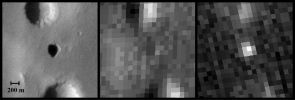
Volcanic_Features-Caverns-PIA09929-01.jpgOn the Northern Slope of Arsia Mons: candidate Cavern Entrance (Annie)57 visiteCaption NASA:"Each of the 3 images in this set covers the same patch of Martian Ground, centered on a possible cave skylight informally called "Annie" which has a diameter about double the length of a football field. The THEMIS camera on NASA's Mars Odyssey orbiter took all 3, gathering information that the hole is cooler than surrounding surface in the afternoon and warmer than the surrounding surface at night. This is thermal behavior that would be expected from an opening into an underground space.
The left image was taken in visible-wavelength light (fig. 1). The other 2 were taken in Thermal Infrared Wavelengths, indicating the relative temperatures of features in the image. The center image is from mid-afternoon. The hole is warmer than the shadows of nearby pits to the North and South, while cooler than sunlit surfaces. The thermal image at right was taken in the pre-dawn morning, about 4 M.L.T. .
At that hour, the hole is warmer than all nearby surfaces".
Nota Lunexit: ovviamente non era necessario nè uno scienziato nè un veggente per anticipare le mosse (di buon senso) della NASA, ma il fatto che i Tecnici di Pasadena abbiano effettivamente operato non solo delle riprese notturne di questa interessante Surface Feature, ma anche dei rilievi IR - come da noi suggerito ed anticipato, sebbene a proposito di un'altra (e forse più famosa) Candidate Cavern Entrance - ci ha dato, onestamente, una notevole soddisfazione!MareKromium
|
|

APOLLO_16_AS_16-121-19407.jpgAS 16-121-19407 - The Lobachevsky Anomaly (context frame)57 visiteImage Collection: 70mm Hasselblad
Mission: 16
Magazine: 121
Magazine Letter: PP
Latitude: 10,0° North
Longitude: 111,3° East
Camera Altitude: 115 Km
Film Type: SO-368
Film Width: 70 mm
Film Color: color
Feature(s): LOBACHEVSKIYMareKromium
|
|
SOL1331-2N244526560EFFAVAQP0516L0M1.jpgSolar Panels - Sol 133157 visitenessun commentoMareKromium
|
|
OPP-SOL383-4-PIA07428-5.jpgLow Sun with red-orange Sands and light blue-grey and slightly pink Sky - Sol 383 (elab. Lunexit)57 visiteInterpretazioni...MareKromium
|
|
OPP-SOL1308-1P243064411EFF86JZP2365R1M1-3.jpgVictoria's Paving (interpret. n° 4 - possible natural colors; elab. Lunexit) - Sol 130857 visitenessun commentoMareKromium
|
|
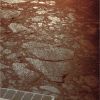
OPP-SOL1308-1P243064411EFF86JZP2365R1M1-2.jpgVictoria's Paving (interpret. n° 3 - possible natural colors; elab. Lunexit) - Sol 130857 visitenessun commentoMareKromium
|
|
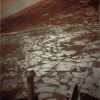
OPP-SOL1313-1N244745088EFF8700P1945R0M1-5.jpgFrom inside Victoria: the Beautiful Martian Paving (1) - Sol 131357 visiteForse la più "verosimile" immagine in Colori Naturali del Paving di Victoria che siamo stati capaci di produrre sino ad ora. Che ne dite?MareKromium
|
|
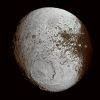
Japetus-PIA08384-2.jpgThe Other Side of Japetus (possible natural colors; elab. Lunexit)57 visitenessun commentoMareKromium
|
|

Japetus-PIA08381.jpgThe "Transition Region of Japetus" (possible natural colors - elab. Lunexit)57 visiteThe Transition Region from Saturn's moon Japetus' dark Leading Hemisphere to its bright Trailing Hemisphere is a complicated patchwork of craters and highlands, with low elevations filled in by dark material.
An explanation of the pattern visible here might be key to a full understanding of the bright/dark dichotomy on Japetus (about 1468 Km across).
The view is centered on the Equator and covers an area 711 Km wide by 417 Km tall (such as about 442 x 259 miles).
The giant Equatorial Ridge visible on the dark Leading Hemisphere is not present anymore in this Region. Instead, large, isolated mountains more than 10 Km tall are spread along the Equator. These mountains show bright western flanks, while the surrounding lowlands are generally dark.
This mosaic is an orthographic projection consisting of 21 image footprints across the surface of Japetus. The view is centered on terrain near 0,1° North Latitude and 199° West Longitude, in the quadrant of Japetus that faces away from Saturn. Image scale is approx. 83 meters (272 feet) per pixel. An orthographic view is most like the view seen by a distant observer looking through a telescope.
The clear spectral filter images in this mosaic were obtained with the Cassini spacecraft narrow- angle camera on Sept. 10, 2007, at distances ranging from 13.857 to 21.846 Km (such as about 8.610 to 13.574 miles) from Japetus.
MareKromium
|
|
| 25353 immagini su 2113 pagina(e) |
 |
|
|
|
|
1519 | |
|
|
|
|





