| Piú viste |
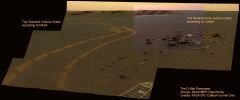
OPP-SOL1162-B_P2299_L257atc-1.jpgThe "D-Star Panorama" - Sol 1162 (approx. true colors; credits: NASA - inset: MULTISPECTRUM; credits: Lunexit)57 visiteAllora, Cari Amici, innanzitutto perdonateci.
Perdonateci perché volevamo davvero piantarla lì con la storia dei Colori di Marte ma...eccoci ancora qui, con un nuovo (senz'altro bellissimo e suggestivo) new frame NASA pubblicato nella notte del 2 Gennaio 2008, il quale ci riporta (un’ennesima volta) alla questione di partenza: qual è il "vero" colore di Marte?
La NASA, a dire il vero, sta incominciando a dimostrare - se non altro - una certa coerenza; le sue ricostruzioni in approx. true colors, infatti, ormai sembrano volerci dire solo una cosa: la Dominante Cromatica della Regione di Meridiani Planum, VISTA DAL SUOLO, è il "verde scuro", con tracce giallastro/arancio.
Verde scuro.
A nostro avviso però - detto con umiltà ma ex informata scientia - questa "Dominante NASA" adottata per Meridiani è il prodotto di una clamorosa distorsione.
Una distorsione non solo e non tanto occorsa nelle modalità di colorizzazione del frame quanto, piuttosto, nelle modalità di diffusione dei dati.
Non Vi sarà difficile ricordare, ad esempio, il "Lion King Panorama" (eravamo nei pressi della Landing Zone di Opportunity, a qualche centinaio di metri dal Cratere Endurance – frame pubblicato nella Sez. Mars in Colors). Ebbene, in quello (splendido) frame, il deserto di Meridiani veniva mostrato dalla NASA - sempre in approx. true colors - di un color rosso/arancio vivo.
Altri frames colorati dalla NASA - e giunti in seguito - ci hanno fatto vedere come le sabbie di Meridiani presentino un "color ross/arancio-mattone" quale dominante; ed anche le foto orbitali a colori della Regione di Meridiani ci dicono che essa (al pari di quasi tutte le Regioni Equatoriali e presso-Equatoriali di Marte) è una Regione a Dominante Arancio-Giallo-Marrone.
Ed il "verde"? Zero.
Come fare a spiegare ed a spiegarVi, quindi, il senso (logico e cromatico) di questo New Color Deal della NASA?
Insomma: se le elaborazioni in approx. true colors degli Amici di Pasadena sono corrette adesso, allora - e non ci piove su questo - dovevano essere sbagliate prima.
D'altra parte, se esse erano corrette prima, allora quelle di adesso sono clamorosamente sballate.
Questa è semplice Logica, NON Polemica.
Ciò premesso, noi ci aspettavamo qualche chiarimento; qualche (anche piccola) delucidazione...E invece nulla.
I colori "Approssimativamente Veri" della NASA, a quanto pare, sono SEMPRE GIUSTI, sia quando ci mostrano Marte arancione, sia quando ce lo fanno vedere giallo, o rosso, o - come adesso - verde scuro.
E allora? E allora (e perdonateci l'ironia...) se il colori della NASA sono sempre giusti (pur nella loro radicale incoerenza), vuol dire che siamo noi a vedere male.
Siamo tutti daltonici? Siete anche Voi tutti daltonici?
Volete contribuire con un parere su quest'ultimissima versione di Marte?
Noi non sappiamo più cosa dire e quindi, speriamo agendo dignitosamente, ci permettiamo solo di inserire, nel mega-frame NASA, un piccolo inset con la nostra colorizzazione MULTISPECTRUM. Certo, forse anche il nostro MULTISPECTRUM sarà sbagliato (e, talvolta, fornisce risultati incoerenti) ma, se non altro, noi applichiamo un Metodo coerente e cerchiamo un confronto e qualche risposta sensata.
Peccato che alla NASA non abbiano MAI un attimo di tempo per spiegare a degli ignoranti come noi quale sia il "senso" (ammesso che un "senso" esista) delle loro colorizzazioni...
Molto interessanti – e questo è detto senza alcuna ironia – sono le ulteriori informazioni dedotte nella Captino NASA originale, che riportiamo integralmente.
E adesso (se volete…) a Voi la parola!
Caption NASA:"NASA's twin Mars Exploration Rovers have been getting smarter as they get older. This view from Opportunity shows the tracks left by a drive executed with more onboard autonomy than has been used on any other drive by a Mars rover.
Opportunity made the curving, 15,8-meter (52-foot) drive during its 1160th Martian Day, or Sol (such as April 29, 2007). It was testing a navigational capability called "Field D-star" which enables the Rover to plan optimal long-range drives around any obstacles in order to travel the most direct safe route to the drive's designated destination. Opportunity and its twin, Spirit, did not have this capability until the third year after their January 2004 landings on Mars. Earlier, they could recognize hazards when they approached them closely, then back away and try another angle, but could not always find a safe route away from hazards. Field D-Star and several other upgrades were part of new onboard software uploaded from Earth in 2006.
The Sol 1160 drive by Opportunity was a Martian field test of Field D-Star and also used several other features of autonomy, including visual odometry to track the Rover's actual position after each segment of the drive, avoidance of designated keep-out zones, and combining information from two sets of stereo images to consider a wide swath of terrain in analyzing the route.
Two days later, on Sol 1162 (May 1, 2007), Opportunity was still at the location it reached during that drive, and the Rover’s Pancam took the exposures combined into this image.
Victoria Crater is in the background, at the top of the image.
The Sol 1160 drive began at the place near the center of the image where tracks overlap each other. Tracks farther away were left by earlier drives nearer to the northern rim of the Crater. For scale, the distance between the parallel tracks left by the Rover's wheels is about 1 meter (39 inches) from the middle of one track to the middle of the other. The rocks in the center foreground are roughly 7 to 10 centimeters (3 to 4” – inches) tall. The Rover could actually drive over them easily, but for this test, Settings in the onboard hazard-detection software were adjusted to make these smaller rocks be considered dangerous to the Rover. The patch of larger rocks to the right was set as a keep-out zone. The location from which this image was taken is where the rover stopped driving to communicate with Earth. A straight line from the starting point to the destination would be 11 meters (36 feet).
Opportunity plotted and followed a smoothly curved, efficient path around the rocks, always keeping the rover in safe areas.
This view combines separate images taken through the PanCam filters centered on wavelengths of 753 nanometers, 535 nanometers and 432 nanometers to produce an approximately true-color panorama".
MareKromium
|
|

as08-14-2400.JPGAS 08-14-2401 - The Dark Side of the Moon (4 - natural colors; credits: Lunexit)57 visiteImage Collection: 70mm Hasselblad
Mission: 8
Magazine: 14
Magazine Letter: B
Latitude: approx. 3,0° South
Longitude: approx. 155,5° West
Lens Focal Length: 250 mm
Description: NEAR TERMINATOR; FARSIDE
Film Type: SO-368
Film Width: 70 mm
Film Color: color
MareKromium
|
|

as10-29-4175.JPGAS 10-29-4175 - Reflections in the window57 visiteImage Collection: 70mm Hasselblad
Mission: 10
Magazine: 29
Magazine Letter: P
Latitude: 1,0° South
Longitude: 161,7° East
Film Type: 3400
Film Width: 70 mm
Film Color: black & white
Feature(s): CRATER VENING MEINESZMareKromium
|
|
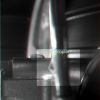
SOL002-2.jpgIs that a "Water Droplet"?!? - Sol 2 (detail - credits: Dr Marco Faccin)57 visiteCaption NASA:"Microscopic Imager Non-linearized Full frame EDR acquired on Sol 2 of Spirit's mission to Gusev Crater at approximately 14:47:12 Mars Local Solar Time; Microscopic Imager dust cover commanded to be NULL or N/A".MareKromium
|
|
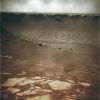
OPP-SOL1402-1N252648246EFF8826P0655L0M1-2.jpgVictoria, under clouds of Dust and Fogs... - Sol 1402 (MULTISPECTRUM; credits: Lunexit)57 visitenessun commentoMareKromium
|
|

Centaurus_A.jpgActive Galaxy "Centaurus A"57 visite"...Ego vero nihil impossibile arbitror; sed utcumque Fata decreverint, ita cuncta mortalibus provenire..."
(Apuleio)
"...Io credo che nulla vi sia (a questo Mondo) di (realmente) impossibile; tuttavia, qualsiasi evento gli Dei abbiano decretato che debba accadere, accadrà..." (trad. libera)MareKromium
|
|

SOL977.gifVideo Signal from Mars - Sol 977 (credits: Dr M. Faccin)57 visiteRingraziando il Dr Faccin per questa intrigante GIF-Animation, ci e Vi poniamo una domanda: ma da Marte arrivano solo "stills" (fotografie) oppure anche "filmati" veri e propri?
La risposta definitiva al riguardo, ovviamente, non ce l'abbiamo, però abbiamo un "segnale"...MareKromium
|
|

Galaxies-PIA10221.jpgGalaxies of all shapes host Black-Holes57 visite"...Nobody would try anything new if they knew all the consequences of their inventions.
Therefore, all the so-called "Progress" must be based on faulty assumptions..."
Scott Adams - "Build a Better Life by stealing Office Supplies"MareKromium
|
|
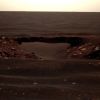
OPP-SOL389-2.jpgNaturaliste Crater (natural but strongly enhanced colors + MULTISPECTRUM - credits: Dr G. Barca & Lunexit)57 visitenessun commentoMareKromium
|
|

ZO-Mercury02_Messenger.jpgMessenger's First Look at Mercury's Previously Unseen Side57 visiteCaption NASA:"This image was taken on January 14, 2008, by NASA's MESSENGER Spacecraft at a distance of approx. 17.000 miles following the Spacecraft's closest approach to Mercury. The image shows features as small as 6 miles in size.
Similar to previously mapped portions of Mercury, this Hemisphere appears heavily cratered. It also reveals some unique and distinctive features.
On the upper right is the giant Caloris basin, including its western portions never before seen by spacecraft. Formed by the impact of a large asteroid or comet, Caloris Basin is one of the largest, and perhaps one of the youngest basins in the Solar System". MareKromium
|
|
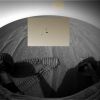
OPP-SOL072-1F134588979EFF0992P1201R0M1.jpgImage artifact or UFO? - Sol 72 (credits: Dr M. Faccin)57 visiteDalla grande pazienza e dall'ottimo "occhio" del nostro Caro Amico, Dr Marco Faccin, un nuovo enigma per gli amanti di Ufologia: il dettaglio che appare nel Cielo di Meridiani e che viene isolato, magnificato e contrastato nell'inset è, effettivamente, un OVNI, oppure è solo un image-artifact (un microgranulo di polvere o, magari, un vizio dell'ottica usata da Opportunity o, perchè no?, la conseguenza di una modesta attenuazione e/o di una piccola perdita di segnale occorsa durante la trasmissione dell'immagine da Marte alla Terra)?
Voi che dite?MareKromium
|
|

as15-86-11688.JPGAS 15-86-11688 - Station 7 Boulder57 visitenessun commentoMareKromium
|
|
| 25353 immagini su 2113 pagina(e) |
 |
|
|
|
|
1515 | |
|
|
|
|





