| Piú viste |
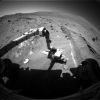
SOL825-2F199603929EDNAR00P1131R0M1.jpgDark Sky over Spirit - Sol 82557 visiteCaption NASA:"Right Front HazCam Non-linearized Downsampled EDR acquired on Sol 825 of Spirit's mission to Gusev Crater at approximately 12:25:51 MLT".
Siamo poco oltre il mezzogiorno (ora locale), ma il Cielo di Marte ci appare limpido e molto scuro, così come dovrebbe essere il cielo di un pianeta la cui atmosfera è oltremodo rarefatta. Ma noi sappiamo, attraverso quello che ci mostrano tanti altri frames, sia in b/n, sia a colori, che la realtà è diversa e che il Cielo di Marte, in realtà, non è affatto buio come appare in questo ed in altri frames similari.
Un'immagine che deve far riflettere.
|
|
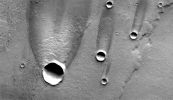
Aeolian_Features-Windstreaks-PIA08422-00.jpgBeautiful Windstreaks (Original NASA/JPL/ASU b/w Frame)57 visiteCaption NASA originale:"This group of Windstreaks is located on Lava Flows, West of Arsia Mons".
Image information: VIS instrument;
Latitude: 11,0° South;
Longitude: 219,5° East;
Resolution: 18 meter/pixel.
|
|

SOL813-PIA08423-8.jpgWhen the Sun goes down... (8) - Sol 81357 visitenessun commento
|
|

Volcanic_Features-Channels-Tharsis_Region-00.JPGChannels on Lava Flows in Tharsis (Original NASA/MGS/MSSS b/w Frame)57 visiteCaption NASA originale:"This MGS-MOC image shows ancient, Dust-covered Lava Flows and remains of leveed Lava Channels located on a Plain North/West of Jovis Tholus.
Jovis is a relatively small volcano in the Tharsis Region of Mars".
Location near: 22,4° North Lat. and 122,0° West Long.
Image width: ~3 Km (~1,9 mi)
Illumination from: lower left
Season: Northern Winter
|
|

24-Mare Humorum-3.jpgMare Humorum (3)57 visitenessun commento
|
|

Cepheus A-1.jpgCepheus A: Star Formation Region57 visite"...Non basta la luce di queste stelle. Non basta neppure la luce di tutte queste stelle per illuminarmi il cammino..."
P.C. Floegers - "Conversations"
|
|
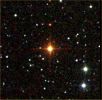
IRAS-05316+1757atlas-1.jpgCarbon Star IRAS 05316+175757 visite"...Modica voluptas laxat animos et temperat..."
(Seneca)
"...Un moderato piacere (può) rilassare e rafforzare l'animo..."
|
|

W 40-1.jpgA cradle of young, new Stars57 visite"...Non omne quod licet, honestum est..."
(Regolae Juris)
"...Non tutto ciò che è (tecnicamente) lecito (ossìa non espressamente proibito dalla Legge) è anche onesto..."
|
|

Comets-Schwassmann_Wachmann_1-06.jpgComet Schwassmann-Wachmann 3 and M 5757 visiteMoving rapidly through planet Earth's night sky, Fragment "C" of crumbling comet 73P/Schwassmann-Wachmann 3 passed almost directly in front of M 57 - the "Ring Nebula" - and faint spiral galaxy IC 1296 on May 8, 2006. In fact, in this gorgeous view, the bright head of mentioned Fragment "C" is separated by only about 0,1° from M 57, with the tail apparently engulfing nebula and galaxy.
Recorded from Elizabeth, Illinois, USA, this picture corresponds to the cosmic scene only 30 minutes after yesterday's picture of the approaching alignment. The relative motion of the comet against the background stars and nebulae is easy to see when comparing the two images. This comet's fragments will be near their closest approach in the coming days, about 10 MKM away, and none pose any danger to our fair planet.
|
|

Comets-Schwassmann_Wachmann_1-08.jpgComet Schwassmann-Wachmann 3: the whole "crumbling" Comet (2)57 visitenessun commento
|
|
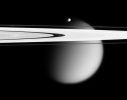
Saturn&Titan-PIA07786.jpgSo close and yet so far...57 visiteThe Cassini spacecraft delivers this stunning vista showing small, battered Epimetheus and smog-enshrouded Titan, with Saturn's A and F Rings stretching across the scene. The prominent dark region visible in the A-Ring is the Encke Gap, in which the moon Pan and several narrow ringlets reside. Moon-driven features that mark the A-Ring are easily seen to the left and right of the Encke Gap. The Encke Gap is about 325 Km (approx. 200 miles) wide. Pan is approx. 26 Km (about 16 miles) across. In an optical illusion, the narrow F-Ring, outside the A-Ring, appears to fade across the disk of Titan. A couple of bright clumps can be seen in the F-Ring. Epimetheus is approx. 116 Km (about 72 miles) across and giant Titan is roughly 5.150 Km (about 3.200 miles) across.
The image was taken in visible light with the Cassini spacecraft narrow-angle camera on April 28, 2006, at a distance of approx. 667.000 Km(about 415.000 miles) from Epimetheus and 1,8 MKM (about 1,1 MMs) from Titan. The image captures the illuminated side of the rings. The image scale is 4 kilometers (2 miles) per pixel on Epimetheus and 11 kilometers (7 miles) per pixel on Titan.
|
|

Japetus-PIA08177.jpgThe darkest moon is there...57 visiteA distant glimpse of Japetus reveals details within the dark terrain of the Cassini Regio, including an impact basin at top that is roughly 400 Km (about 250 miles) wide.
Researchers remain unsure about the mechanism that has darkened the Leading Hemisphere.
This view looks toward the Southern Hemisphere on the leading side of Japetus (1.468 Km, or about 912 miles across). North is up.
The image was taken in visible light with the Cassini spacecraft narrow-angle camera on April 4, 2006, at a distance of approx. 1,4 MKM (such as about 900.000 miles) from Japetus.
The image scale is roughly 9 Km (about 6 miles) per pixel.
|
|
| 25353 immagini su 2113 pagina(e) |
 |
|
|
|
|
1514 | |
|
|
|
|





