| Piú viste |

SOL1178-2P230941980ESFAT48P2592L2M1.jpgErratic boulder - Sol 117857 visiteLa presenza, in questo frame ed in molti altri relativi alla medesima zona, di sabbie e polveri che, in sede di colorizzazione, appaiono di color bianco, continua a lasciarci sorpresi e perplessi.
Si tratta sempre di sali e solfati? Secondo noi no.
Potrebbe trattarsi, infatti, di sabbie cristalline - ricche di quarzi, ad esempio - oppure (ma per essere più attendibili ci servirebbe sapere almeno l'ora dello scatto...) di un sottile strato di brina ghiacciata che ricopre tutta l'area ripresa.
Ricordate i frames Viking nei quali veniva immortalata una "brinata" mattutina? Ebbene l'effetto che stiamo ottenendo attraverso la colorizzazione dei frames Spirit ci sembra davvero molto simile.MareKromium
|
|
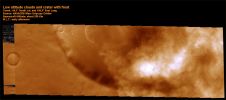
Craters-Unnamed_Crater_with_Frost-00-PCF-LXTT.JPGClouds over "Frosty" Crater (CTX Frame - False Colors; credits for the additional process. and color.: Dr Paolo C. Fienga - Lunar Explorer Italia)57 visiteIl dettaglio della nuvola che scivola sul cratere senza nome situato a Sud-Est del bacino di impatto denominato "Hellas" è molto bello, ma non fermiamoci al dettaglio artistico ed osserviamo il margine interno del cratere posto alla Vostra Sx: le tracce di brina sono evidenti.
E non è tutto: osservate il fondo del cratere. C'è qualcosa che lo "allaga", in parte? Sicuramente non si tratta solo di fango (è l'albedo del dettaglio che ce lo dice).
La nostra prima ipotesi è che, sul fondo di questo cratere senza nome, vi possa essere un discreto quantitativo di ghiaccio d'acqua il quale è talmente trasparente, da permetterci di riuscire a vedere anche i minuscoli crateri che giacciono al di sotto di esso.
La seconda ipotesi, meno immaginifica ma, forse, più realistica, è che sul fondo del cratere vi sia un deposito sottile, ma abbondante, di brina ghiacciata.
Caption NASA:"The dust storm season in the Southern Hemisphere of Mars is well underway. This image of an unnamed crater South-East of Hellas Basin shows the encroachment of a storm in the region".MareKromium
|
|

NGC-2808-0.jpgNGC 2808 - Globular Star Cluster57 visiteAstronomers have long thought that globular star clusters had a single "baby boom" of stars early in their lives and then settled into a quiet existence.
New observations by NASA's Hubble Space Telescope, however, are showing that this idea may be too simple. The Hubble analysis of the massive globular cluster NGC 2808 provides evidence that star birth went "boom, boom, boom," with three generations of stars forming very early in the cluster's life.
"We had never imagined that anything like this could happen," said Giampaolo Piotto of the University of Padova in Italy and leader of the team that made the discovery. "This is a complete shock."
Globular clusters are the homesteaders of our Milky Way Galaxy, born during our galaxy's formation. They are compact swarms of typically hundreds of thousands of stars held together by gravity.
"The standard picture of a globular cluster is that all of its stars formed at the same time, in the same place, and from the same material, and they have co-evolved for billions of years," said team member Luigi Bedin of the European Space Agency, the European Organization for Astronomical Research in the Southern Hemisphere (ESO), in Garching, Germany, and the Space Telescope Science Institute in Baltimore, Md. "This is the cornerstone on which much of the study of stellar populations has been built. So we were very surprised to find several distinct populations of stars in NGC 2808. All of the stars were born within 200 million years very early in the life of the 12.5-billion-year-old massive cluster."
Finding multiple stellar populations in a globular cluster so close to home has deep cosmological implications, the researchers said.
"We need to do our best to solve the enigma of these multiple generations of stars found in these Hubble observations so that we can understand how stars formed in distant galaxies in our early universe," Piotto explained.
The astronomers used Hubble's Advanced Camera for Surveys to measure the brightness and color of the cluster stars. Hubble's exquisite resolution allowed the astronomers to sort out the different stellar populations. The Hubble measurements showed three distinct populations, with each successive generation appearing slightly bluer. This color difference suggests that successive generations contain a slightly different mix of some chemical elements.
"One assumption, although we have no direct proof," said team member Ivan King of the University of Washington in Seattle, "is that the successively bluer color of the stellar populations indicates that the amount of helium increases with each generation of stars. Perhaps massive star clusters like NGC 2808 hold onto enough gas to ignite a rapid succession of stars."
The star birth would be driven by shock waves from supernovae and stellar winds from giant stars, which compress the gas and make new stars, King explained. The gas would be increasingly enriched in helium from previous generations of stars more massive than the Sun.
Astronomers commonly assume that globular clusters produce only one stellar generation, because the energy radiating from the first batch of stars would clear out most of the residual gas needed to make more stars. But a hefty cluster like NGC 2808, which is two to three times more massive than a typical globular cluster, may have enough gravity to hang onto that gas, which has been enriched by helium from the first stars. Of the about 150 known globular clusters in our Milky Way Galaxy, NGC 2808 is one of the most massive, containing more than 1 million stars.
Another possible explanation for the multiple stellar populations is that NGC 2808 may only be masquerading as a globular cluster. The stellar grouping may have been a dwarf galaxy that was stripped of most of its material due to gravitational capture by our galaxy.
Omega Centauri, the only other stellar system Piotto's group found to have multiple generations of stars, is suspected to be the remnant core of a dwarf galaxy, Bedin said.
Although the astronomers' search is only in its infancy, they say multiple stellar populations may be a typical occurrence in other massive clusters.
"No one would make the radical step of suggesting that previous work on other clusters is no longer valid," King said. "But this discovery shows that the study of stellar populations in globular clusters now opens up in a new direction."
The team plans to use ESO's Very Large Telescope in Chile to make spectroscopic observations of the chemical abundances in NGC 2808, which may offer further evidence that the stars were born at different times and yield clues to how they formed. They also will use Hubble to hunt for multiple generations of stars in about 10 more hefty globular clusters.
The team's results have been accepted for publication in the Astrophysical Journal Letters.
MareKromium
|
|

OPP-SOL1162-1P231354624EFF82K5P2413R2M1.jpgThe pink, morning Sky of Mars (3) - Sol 116257 visitenessun commentoMareKromium
|
|

OPP-SOL1162-1N231354440EFF82K5P0755R0M1.jpgThe pink, morning Sky of Mars (1) - Sol 116257 visitenessun commentoMareKromium
|
|
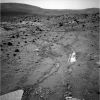
SOL1184-2N231477051EFFATACP1920R0M1.jpgWhite "splat" near Spirit - Sol 118457 visitenessun commentoMareKromium
|
|
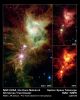
NGC-2264.jpgNGC 2264 - The "Snowflake Cluster" versus the "Cone Nebula"57 visiteCaption NASA:"Strange shapes and textures can be found in the neighborhood of the Cone Nebula.
These patterns result from the tumultuous unrest that accompanies the formation of the open cluster of stars known as NGC 2264, the Snowflake Cluster. To better understand this process, a detailed image of this Region was taken in two colors of infrared light by the orbiting Spitzer Space Telescope (SST). Bright stars from the Snowflake cluster dot the field. These stars soon heat up and destroy the gas and dust mountains in which they formed. One such dust mountain is the famous Cone Nebula, visible in the above image on the left, pointing toward a bright star near the center of the field.
The entire NGC 2264 Region is located about 2500 LY away toward the constellation of the Unicorn (Monoceros)".MareKromium
|
|

Dunes-Migrating_Dunes-PCF-LXTT.JPGUnnamed Southern Crater with Migrating Dunefield (Extremely Saturated and Enhanced Natural Colors; credits for the additional process. and color.: Dr Paolo C. Fienga - Lunexit Team)57 visitenessun commentoMareKromium
|
|

as15-96-13013.JPGAS 15-96-13013 - Autolycus Crater57 visiteImage Collection: 70mm Hasselblad
Mission: 15
Magazine: 96
Magazine Letter: Q
Latitude: 30,5° North
Longitude: 1,5° East
Film Type: SO-368
Film Width: 70 mm
Film Color: color
Feature(s): AUTOLYCUS CraterMareKromium
|
|

as15-93-12717.JPGAS 15-93-12717 - Gruithuisen "B"57 visiteImage Collection: 70mm Hasselblad
Mission: 15
Magazine: 93
Magazine Letter: P
Latitude: 36,0° North
Longitude: 40,5° West
Film Type: SO-368
Film Width: 70 mm
Film Color: color
Feature(s): GRUITHUISEN "B"MareKromium
|
|

as15-93-12704.JPGAS 15-93-12704 - The "Herschel" Legacy57 visiteImage Collection: 70mm Hasselblad
Mission: 15
Magazine: 93
Magazine Letter: P
Latitude: 38,0° North
Longitude: 33,0° West
Film Type: SO-368
Film Width: 70 mm
Film Color: color
Feature(s): HERSCHEL "C", HERSCHEL "U" and HERSCHEL "V"MareKromium
|
|

Saturn-PIA08936.jpgA Planetary "Smile", from Saturn...57 visiteCaption NASA:"Brooding Saturn seems to be missing its rings, but their shadows on the Planet betray their presence. The inner rings are in fact contained within this scene, but they are so tenuous as to be nearly invisible.
This view looks toward the unilluminated side of the Rings from about 52° above the Ring-Plane. Some motion is apparent in Saturn's clouds between the exposures used to create this color composite, as evidenced by the 'rainbow' effect seen here and there across the face of the Planet.
Images taken using red, green and blue spectral filters were combined to create this natural color view. The images were taken with the Cassini spacecraft wide-angle camera on April 5, 2007 at a distance of approx. 1,5 MKM (about 900.000 miles) from Saturn.
Image scale is roughly 84 Km (about 52 miles) per pixel".MareKromium
|
|
| 25353 immagini su 2113 pagina(e) |
 |
|
|
|
|
1511 | |
|
|
|
|





