| Piú viste |

PHOE-SOL142-lg40602-40603-40604-2.jpgThe "Trenches" - Sol 142 (Superdefinition and possible True Colors; credits: Dr G. Barca)57 visitenessun commentoMareKromium
|
|

PHOE-SOL143-lg40998-40999-41000-2.jpgInside the "Icy Trench"... - Sol 143 (Superdefinition and possible True Colors; credits: Dr G. Barca)57 visitenessun commentoMareKromium
|
|
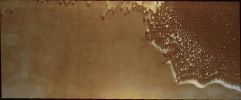
North_Polar_Features-The_Erg-PCF-LXTT-5.jpgVastitas Borealis and the North Polar Erg (Absolute Natural Colors; credits for the additional process. and color.: Dr Paolo C. Fienga - Lunexit Team)57 visiteCoord.: 76,5° North Lat. and 295,6° East Long.MareKromium
|
|

Comets-Comet_Holmes-UZ_PIA11228-2.jpgComet 17-P Holmes now in the Outer Solar System57 visiteSpitzer's infrared picture at left hand side of this frame reveals fine dust particles that make up the Outer Shell, or "Coma", of the Comet. The Nucleus of the Comet is within the bright whitish spot in the center, while the yellow area shows solid particles that were blown from the Comet in the explosion.
The Comet is headed away from the Sun, which lies beyond the right-hand side of these pictures.
The contrast-enhanced picture on the right shows the Comet's Outer Shell, and strange "filaments", or "Streamers", of dust. The Streamers and shell are a yet another mystery surrounding Comet Holmes. Scientists had initially suspected that the Streamers were small dust particles ejected from fragments of the Nucleus, or from hyerpactive jets on the Nucleus, during the October 2007 explosion.
If so, both the Streamers and the Shell should have shifted their orientation as the Comet followed its orbit around the Sun.
Radiation pressure from the Sun should have swept the material back and away from it. But pictures of Comet Holmes taken by Spitzer over time show the Streamers and Shell in the same configuration, and not pointing away from the Sun. The observations have left astronomers stumped.
The horizontal line seen in the contrast-enhanced picture is a trail of debris that travels along with the Comet in its orbit.
The Spitzer picture was taken with the Spacecraft's multiband imaging photometer at an infrared wavelength of 24 microns.MareKromium
|
|
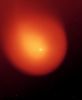
Comets-Comet_Holmes-UZ_PIA11228-1.jpgComet 17-P Holmes now in the Outer Solar System (IR)57 visiteNASA's Spitzer Space Telescope captured the picture of comet Holmes in March 2008, 5 months after the comet suddenly erupted and brightened a millionfold overnight. The contrast of the picture has been enhanced (see the next frame) to show the anatomy of the comet.
Every 6 years, comet 17P/Holmes speeds away from Jupiter and heads inward toward the Sun, traveling the same route typically without incident. However, twice in the last 116 years, in November 1892 and October 2007, comet Holmes mysteriously exploded as it approached the Asteroid Belt. Astronomers still do not know the cause of these eruptions.
Nota Lunexit: la "causa" di queste repentine eruzioni della Cometa 17-P Holmes le quali avvengono - guarda caso - durante il transito della medesima attraverso la Fascia degli Asteroidi potrebbe essere RAGIONEVOLMENTE rinvenuta nella verificazione di impatti con corpi erranti di piccole/piccolissime dimensioni (l'occorrere di impatti con uno o più oggetti di dimensioni medie o medio/grandi porterebbe inevitabilmente alla frammentazione/distruzione completa del nucleo di 17-P Holmes ed alla sua relativa e definitiva sparizione). Che gli "outbursts" possano essere (anche) l'ovvia conseguenza di un impatto ad altissima velocità è stato recentemente dimostrato dall'esperimento (come ricorderete contestatissimo) effettuato dalla NASA sulla Cometa Tempel-1, la quale fu centrata da un'ogiva metallica e, all'atto dello "scontro spaziale", aumentò la sua luminosità in maniera agevolmente percepibile anche da Terra.MareKromium
|
|

North_Polar_Features-The_Erg-PCF-LXTT-1.jpgBarchan Dunes in the North Polar Erg (Absolute Natural Colors; credits for the additional process. and color.: Dr Paolo C. Fienga - Lunexit Team)57 visitenessun commentoMareKromium
|
|
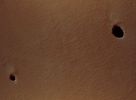
PSP_009488_1745_RED_abrowse-01.jpgMartian Caves (edm n. 1 - possible natural colors; credits: Lunexit)57 visiteThe pair of Pit Craters visible here are the smallest “anomalous” pits known to exist at this time. These have either vertical or sub-vertical interior walls (sub-vertical means that they are not visible from a nearly overhead viewing perspective), and each pit is deep enough that sunlight does not hit the floor when the Sun is at or near the Zenith.
Unfortunately, the only thermal-infrared camera currently orbiting Mars cannot resolve features this small, so the temperature characteristics of these pits must remain unknown for now, underscoring the need for a high-resolution thermal instrument on future missions.
Intriguingly, when pit craters on Earth have similar characteristics to the pair shown here, they often have cave entrances in their bases connecting to large underground networks. Current investigations are determining whether the anomalous Martian Pits may be shown to contain such entrances.MareKromium
|
|

Dunes-Dunefield_in_Nereidum_Montes-20071214a-PCF-LXTT.jpgDark Dunefield in Western Nereidum Montes (Natural Colors; credits for the additional process. and color.: Dr Paolo C. Fienga - Lunexit Team)57 visitenessun commentoMareKromium
|
|
PHOE-SOL146-lg41553-41554-41555-2.jpgNumbers! - Sol 146 (Superdefinition and possible True Colors; credits: Dr G. Barca)57 visitenessun commentoMareKromium
|
|

PSP_009739_2580_RED_abrowse-2.jpgResidual Ice (edm - natural colors; credits: Lunexit)57 visiteIl dettaglio, palese tanto nella versione in b/n del frame, quanto in quella a colori naturali, è stato individuato dal bravissimo Dr Barca e, inizialmente, ci ha fatto pensare ad una possibile estrusione d'acqua la quale, poco dopo essere stata "espulsa", si è rapidamente congelata.
Ma sbagliavamo, poichè non si tratta, a nostro parere, del residuo di un fenomeno estrusivo.
Non lo è, perchè le estrusioni d'acqua (e fango) si manifestano - di solito, e "visivamente" - con accumuli caotici di blocchi di ghiaccio sporco di varie dimensioni intorno ad un'area di ghiaccio più limpido la quale è compatta e posizionata centralmente rispetto agli altri blocchi e blocchetti (provate a visualizzare, per capire bene, la conseguenza di uno "spruzzo" - tipo geyser - di acqua e fango, con l'acqua che poi gela rapidamente).
In Islanda, se volete, si può vedere qualcosa di simile.
Nel nostro caso di specie, comunque, si può dire che la posizione del dettaglio in oggetto è indicativa di un'area su cui si trova del semplice ghiaccio "sporco" (ghiaccio d'acqua, a giudicare dall'albedo e dal colore) residuale, sfuggito al disgelo grazie alla protezione offertagli dalla duna che lo sovrasta.
La configurazione delle dune che caratterizzano la zona, inoltre, ci dice che l'area gelata è posizionata su una superficie decisamente più bassa rispetto al Datum medio della regione, e quindi con niente (o poco) Sole che scioglie e niente (o poco) vento che "gratta & smuove".
Un accumulo di ghiaccio, quindi, destinato a "sopravvivere" MOLTO a lungo!...MareKromium
|
|

OPP-SOL1676-1P276984064EFF91DUP2362L2M2.jpgVictoria Crater Panorama - Sol 1676 (Tri-chromatic Version; credits: Dr G. Barca & Lunexit)57 visitenessun commentoMareKromium
|
|

NGC-6357.jpgPismis 24: Open Star Cluster57 visite"...The unfolding of your words gives Light; it imparts understanding to the simple..."
- Psalm 119:130MareKromium
|
|
| 25353 immagini su 2113 pagina(e) |
 |
|
|
|
|
1507 | |
|
|
|
|





