| Piú viste |
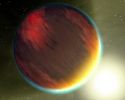
HD189733b-PIA09200.jpgJust like Jupiter...57 visiteThis artist's concept shows a cloudy Jupiter-like planet that orbits very close to its fiery hot star. NASA's Spitzer Space Telescope was recently used to capture spectra, or molecular fingerprints, of two "hot Jupiter" worlds like the one depicted here. This is the first time a spectrum has ever been obtained for an exoplanet, or a planet beyond our solar system.
The ground-breaking observations were made with Spitzer's spectrograph, which pries apart infrared light into its basic wavelengths, revealing the "fingerprints" of molecules imprinted inside. Spitzer studied two planets, HD 209458b and HD 189733b, both of which were found, surprisingly, to have no water in the tops of their atmospheres. The results suggest that the hot planets are socked in with dry, high clouds, which are obscuring water that lies underneath. In addition, HD209458b showed hints of silicates, suggesting that the high clouds on that planet contain very fine sand-like particles.
Capturing the spectra from the two hot-Jupiter planets was no easy feat. The planets cannot be distinguished from their stars and instead appear to telescopes as single blurs of light. One way to get around this is through what is known as the secondary eclipse technique. In this method, changes in the total light from a so-called transiting planet system are measured as a planet is eclipsed by its star, vanishing from our Earthly point of view. The dip in observed light can then be attributed to the planet alone.
This technique, first used by Spitzer in 2005 to directly detect the light from an exoplanet, currently only works at infrared wavelengths, where the differences in brightness between the planet and star are less, and the planet's light is easier to pick out. For example, if the experiment had been done in visible light, the total light from the system would appear to be unchanged, even as the planet disappeared from view.
To capture spectra of the planets, Spitzer observed their secondary eclipses with its spectrograph. It took a spectrum of a star together with its planet, then, as the planet disappeared from view, a spectrum of just the star. By subtracting the spectrum of the star from the spectrum of the star and planet together, astronomers were able to determine the spectrum of the planet itself.
Neither of the parent stars for HD 209458b or HD 189733b can be seen with the naked eye. HD 209458b is located about 153 light-years away in the constellation Pegasus, while HD 189733b is about 62 light-years away in the constellation Vulpecula. Both planets zip around their stars in very tight orbits; HD 209458b circles once every 3.5 days, while HD 189733b orbits once every 2.2 days.
Of the approximately 200 known exoplanets, there are 12 besides HD 209458b and HD 189733b whose orbits are inclined in such a way that, from our point of view, they pass in front of their stars. At least three of these transiting exoplanets are bright enough to follow in the footsteps of HD 209458b and HD 189733 and reveal their infrared spectra to Spitzer. Astronomers hope to use Spitzer's spectrograph in the future to study HD 209458b and HD 189733b again in much greater detail, and to examine some of the other candidates for the first time.
|
|

Spectrum-PIA09196.jpgHow to get a Spectrum of an Alien World57 visiteThis diagram illustrates how astronomers using NASA's Spitzer Space Telescope can capture the elusive spectra of hot-Jupiter planets. Spectra are an object's light spread apart into its basic components, or wavelengths. By dissecting light in this way, scientists can sort through it and uncover clues about the composition of the object giving off the light.
To obtain a spectrum for an object, one first needs to capture its light. Hot-Jupiter planets are so close to their stars that even the most powerful telescopes can't distinguish their light from the light of their much brighter stars.
But, there are a few planetary systems that allow astronomers to measure the light from just the planet by using a clever technique. Such "transiting" systems are oriented in such a way that, from our vantage point, the planets' orbits are seen edge-on and cross directly in front of and behind their stars.
In this technique, known as the secondary eclipse method, changes in the total infrared light from a star system are measured as its planet transits behind the star, vanishing from our Earthly point of view. The dip in observed light can then be attributed to the planet alone.
To capture a spectrum of the planet, Spitzer must observe the system twice. It takes a spectrum of the star together with the planet (first panel), then, as the planet disappears from view, a spectrum of just the star (second panel). By subtracting the star's spectrum from the combined spectrum of the star plus the planet, it is able to get the spectrum for just the planet (third panel).
This ground-breaking technique was used by Spitzer to obtain the first-ever spectra of two planets beyond our solar system, HD 209458b and HD 189733b. The results suggest that the hot planets are socked in with dry clouds high up in the planet's stratospheres. In addition, HD 209458b showed hints of silicates, indicating those high clouds might be made of very fine sand-like particles.
|
|
as15-91-12386.jpgAS 15-91-12386 - Lunar Basin with channels57 visitenessun commento
|
|

as11-36-5336.jpgAS 11-36-5336 - Earth's going away...57 visitenessun commento
|
|

as15-94-12773.jpgAS 15-94-12773 - The Moon is not too far away... (2)57 visitenessun commento
|
|

as15-94-12772.jpgAS 15-94-12772 - The Moon is not too far away... (1)57 visitenessun commento
|
|

Psp_001481_2410_red-01.jpgEolian and Periglacial Activities in Vastitas Borealis (polygons)57 visiteThe polygons shown in this image's subset, which covers approximately 400 x 250 mt (350 x 225 yards), are in the order of 10 mt (0.9 yards) across; in some cases they are delimited by aligned rocks. Similar features in both shape and scale are found in Terrestrial Periglacial Regions such as Antarctica, where ice is present at or near the surface.
Antarctica's polygons and rock alignments are produced by repeated expansion and contraction of the soil-ice mixture due to seasonal temperature oscillations; dry soil falling into the cracks form sand wedges and amplify this effect. This results in polygonal networks of stress fractures and in the resurfacing and sorting of rocks along these fractures.
|
|

as10-27-3906.jpgAS 10-27-3906 - Approaching the Terminator57 visitenessun commentoMareKromium
|
|
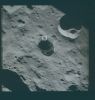
as16-113-18294.jpgAS 16-113-18294 - Casper and the Moon57 visiteCaption NASA:"Pre-landing photo of the CSM (Casper) from the LM (Orion) and, in the background on the Lunar Surface, hilly terrain near the Northwestern rim of Valier".MareKromium
|
|
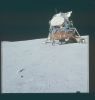
as16-113-18329.jpgAS 16-113-18329 - Orion's Portrait57 visiteCaption NASA:"119:33:46 MT - Charlie Duke's 4 o'clock pan, rightward of 18328, showing John Young on the Rover, preparing to drive around the back of the LM to the MESA".
MareKromium
|
|
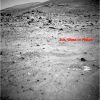
SOL1116-2N225441725EFFASR6P1992L0M1-00.jpgIce, Glass or Metal? (1 - gray scale) - Sol 111657 visiteGrazie ancora una volta al nostro carissimo Amico e Partner, Dr Gianluigi Barca, per questo nuovo Mistero (forse) Marziano.
Il rilievo superficiale controverso lo trovate alla Vostra Dx, indicato dalla freccia. Di che cosa si tratta? Escludiamo, per ovvie ragioni di logica, tecnica ed anche di buon senso, il photoartifact. Cosa resta? Resta una (pseudo)roccia la cui albedo è straordinaria e del tutto incongrua rispetto all'albedo-media del paesaggio che la circonda.
Forse un cristallo gigante, forse un estruso di ghiaccio o forse...forse qualcosa d'altro.
Una nota: il frame originale NASA è di qualità davvero orrenda.
Noi lo abbiamo ripulito al meglio delle nostre capacità e possibilità e la nostra opera di "pulizia digitale", e questo lo diciamo per correttezza ed onestà intellettuale, può avere - sebbene solo minimamente - inciso sulla texture apparente del rilievo anomalo "smussandolo ed arrotondandolo", ma NON HA inciso sulla sua luminosità apparente.
Per il resto, giudicate Voi.MareKromium
|
|

as16-113-18357.jpgAS 16-113-18357 - The "Central Station"57 visiteCaption NASA:"Rightward of 18356, across the Central Station toward Smoky Mountain".MareKromium
|
|
| 25353 immagini su 2113 pagina(e) |
 |
|
|
|
|
1505 | |
|
|
|
|





