| Piú viste |

New_View_of_Dark_Pit_on_Arsia_Mons_(PSP_004847_1745)-1.jpgDark Pit on Arsia Mons (edm - credits: Dr G. Barca)57 visiteDark Pits on some of the Martian Volcanoes have been speculated to be entrances into Caves. A previous HiRISE image, looking essentially straight down, saw only darkness in this Pit.
This time the Pit was imaged from the West.
Since the picture was taken at about 14:30 M.L.T., the Sun was also shining from the West. We can now see the Eastern Wall of the pit catching the Sunlight.
This confirms that this Pit is essentially a Vertical Shaft cut through the Lava Flows on the flank of the Volcano. Such Pits form on similar Volcanoes in Hawaii and are called "Pit Craters".
They generally do not connect to long open caverns but are the result of deep underground collapse.MareKromium
|
|
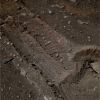
SOL1910-GB-LXT.jpgColourful Surface and Bright Rover Track - Sol 1910 (Natural Colors; credits: Dr G. Barca & Lunar Explorer Italia)57 visitenessun commentoMareKromium
|
|
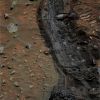
SOL1137-GB-LXT.jpgColourful Surface with Dark Rover Track - Sol 1137 (Natural Colors; credits: Dr G. Barca & Lunar Explorer Italia)57 visitenessun commentoMareKromium
|
|

Prometheus-PIA11531.jpgPrometheus57 visiteCaption NASA:"The moon Prometheus and a bit of Saturn's Northern Hemisphere are both brilliantly lit by the Sun here, making the A-Ring seem dim in comparison.
The bright limb of Saturn's Northern Hemisphere can be seen through the A-Ring in the lower left of the image.
Prometheus (about 86 Km, or approx. 53 miles across) orbits in the Roche Division between Saturn's A and F-Ring.
For a similar view of Pandora, another of the F-Ring's Shepherding Moons, see PIA09899.
This view looks toward the sunlit side of the Rings, from about 20° below the Ring-Plane.
The image was taken in Red Light with the Cassini Spacecraft narrow-angle camera on May 25, 2009. The view was acquired at a distance of approx. 694,000 Km (about 431.000 miles) from Prometheus and at a Sun-Prometheus-Spacecraft, or Phase, Angle of 49°.
Image scale is roughly 3,6 Km (about 2,2 miles) per pixel".MareKromium
|
|

Janus-PIA11534.jpgCraters on Janus (possible Natural Colors; credits: Lunexit)57 visiteCaption NASA:"From hundreds of thousands of kilometers away, the Cassini Spacecraft spies craters on the Surface of the moon Janus.
This view looks toward the Saturn-facing side of Janus (about 179 Km, or approx. 111 miles across). North on Janus is up and rotated 27° to the right. The image was taken in Green Light with the Cassini Spacecraft narrow-angle camera on May 25, 2009.
Scale in the original image was roughly 4 Km (approx. 2,5 miles) per pixel. The image has been magnified by a factor of two and contrast-enhanced to aid visibility.
The view was acquired from a distance of approx. 730.000 Km (such as about 454.000 miles) from Janus and at a Sun-Janus-Spacecraft, or Phase, Angle of 38°".MareKromium
|
|

ZZ-Mercury-Craters-Lermontov_Crater-PIA12116.jpgLermontov Crater (possible Natural Colors; credits: Lunar Explorer Italia)57 visiteLermontov Crater was first observed by Mariner 10 and seen more recently by MESSENGER during its second flyby of Mercury. The Crater fFloor is somewhat brighter than the exterior surface and is smooth with several irregularly shaped depressions.
Such features, similar to those found on the floor of Praxiteles Crater (see PIA12040), may be evidence of past explosive volcanic activity on the Crater Floor. Lermontov appears reddish in enhanced-color views (see PIA11411), suggesting that it has a different composition from the surrounding surface.
Lermontov is named for Mikhail Yurevich Lermontov, a nineteenth-century Russian poet and painter who died from a gunshot suffered in a duel.
Date Acquired: October 6, 2008
Image Mission Elapsed Time (MET): 131771953
Instrument: Narrow Angle Camera (NAC) of the Mercury Dual Imaging System (MDIS)
Resolution: 250 meters/pixel (0,16 miles/pixel)
Scale: Lermontov’s diameter is about 152 Km (approx. 94 miles)
Spacecraft Altitude: about 10.000 Km (approx. 6200 miles)
Nota Lunexit: curiosamente, dopo il nostro Color Processing, non è Lermontov ad apparire "rossiccio", a fronte di terreni circostanti grigiastri, bensì l'esatto contrario! Curioso...MareKromium
|
|

OPP-SOL1037-GB.jpgRelatively clean Solar Panel - Sol 1037 (Natural Colors; credits: Dr G. Barca)57 visitenessun commentoMareKromium
|
|

Rhea-PIA11537.jpgRhea and two "Possible Companions"57 visiteCaption NASA:"A couple of craters share a crescent of Lit Terrain on Saturn's moon Rhea.
Lit Terrain seen here is on the Trailing Hemisphere of Rhea. This view is centered on 48° North Latitude, 234° West Longitude. The North Pole is on the Terminator, about one-quarter of the way inward from the top of the image.
The image was taken in Visible Violet Light with the Cassini Spacecraft narrow-angle camera on June 3, 2009. The view was obtained at a distance of approx. 1,4 MKM (such as about 870.000 miles) from Rhea and at a Sun-Rhea-Spacecraft, or Phase, Angle of 121°.
Image scale is roughly 8 Km (about 5 miles) per pixel".MareKromium
|
|
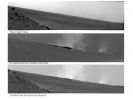
SOL1919-PIA12120.jpgHuge Dust Devil Northwest of Spirit - Sol 191957 visiteCaption NASA:"Researchers used the NavCam on NASA's Mars Exploration Rover Spirit to look for Dust Devils near the Rover during the Mission's 1919th Sol (May 27, 2009). This shot from that day's sequence, presented here with three different levels of processing, caught a large Dust Devil about 1,5 Km (a little less than 1 mile) North-West of Spirit.
The top frame is the original image, the middle frame has been processed enhance the visibility of the Dust Devil, and the bottom frame is a merged version. The image was taken in the early afternoon (note: such as in that period of time comprised between 12:30 and 15:30) from Spirit's position at the "Troy" sand trap beside "Home Plate", looking northwest across the floor of Gusev Crater.
The large Dust Devil shows a typical central core (brightest area) surrounded by a more diffuse sand and dust "skirt" about 415 mt (such as about 1350 feet) across. The Dust Devil is moving toward the North-East (toward the right in this image) at about 0,75 meter-per-second (meaning 1,7 miles-per-hour).
This Dust Devil is some 20 times larger than the average Dust Devil on Earth. A smaller Dust Devil is seen on the right leading the larger DD.
More than 650 DDs have been recorded by Spirit since its operation began in 2004. The Mission is currently in its third "season" for DDs on Mars, which typically begin in Martian Spring".MareKromium
|
|
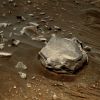
SOL1942-GB-LXT.jpgThe "Unopened Flower"... - Sol 1942 (Natural Colors; credits: Dr G. Barca)57 visitenessun commentoMareKromium
|
|
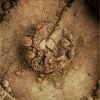
OPP-SOL1918-MI-GB-LXT.jpgDeep inside "The Mark" - Sol 1918 (Superdefinition and Natural Colors; credits: Dr G. Barca & Lunar Explorer Italia)57 visiteEd anche questa elaborazione è "Arte", a tutti gli effetti: Complimentissimi al nostro Dr Barca!MareKromium
|
|

Craters-UnnamedCraterinPlanumChronium-20090729a-01.jpgExhumed Crater in Planum Chronium (edm - Natural Colors; credits: Lunexit)57 visitenessun commentoMareKromium
|
|
| 25353 immagini su 2113 pagina(e) |
 |
|
|
|
|
1495 | |
|
|
|
|





