| Piú viste |
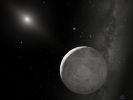
Xena.jpgXena: another "Tenth Planet"? (2003 UB313)57 visiteNASA's Hubble Space Telescope has resolved the Tenth Planet, now nicknamed Xena, for the first time and has found that it is only just a little larger than Pluto.
Though previous ground-based observations suggested that Xena was about 30% greater in diameter than Pluto, Hubble observations taken on Dec. 9 and 10, 2005, yield a diameter of 1.490 miles (with an uncertainty of 60 miles) for Xena. Pluto's diameter, as measured by Hubble, is 1.422 miles. Xena is the large object at the bottom of this artist's concept. A portion of its surface is lit by the Sun, located in the upper left corner of the image. Xena's companion, Gabrielle, is located just above and to the left of Xena.
|
|

SOL809-2P198179866ESFAR00P2533R2M1.jpgSinking Mars... (2) - Sol 80957 visiteCaption NASA originale:"Right PanCam Non-linearized Sub-frame EDR acquired on Sol 809 of Spirit's mission to Gusev Crater at approximately 11:21:04 MLT.
Camera commanded to use Filter 2 (754 nm)".
|
|
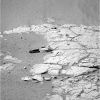
OPP-SOL791-1P198407290EFF68Q9P2572R1M1.jpgRazor-blades & recent water... (1) - Sol 79157 visiteCracks and fins in the sand in an American desert look very similar to features seen on Mars and may indicate the recent presence of water at the surface, according to a new study by researcher Greg Chavdarian and Dawn Sumner, associate professor of geology at UC Davis.
"Recent, as in ongoing now" Sumner said. Images from MER Opportunity show patterns of cracks across the surface of boulders and outcrops. Some of these cracks are associated with long, thin fins that protrude from the surface. Those features look very similar to cracks and fins that form on the sulfate-rich sands at White Sands National Monument in New Mexico. The Desert National Park has a similar geological environment to the area of Mars visited by Opportunity, Sumner said. Chavdarian spent weeks surveying the features at White Sands for an undergraduate research project. He conducted lab experiments to try and reproduce the effects. He found that the cracks at White Sands only form and grow in damp (--- umida) sand, especially during the wet months of the winter.
|
|

OPP-SOL792-1N198499844EFF68VNP0695R0M1.jpgPanorama (1) - Sol 79257 visitenessun commento
|
|

Hills-Knob-Elysium_Planitia-PIA08079-00.jpgBizarre "Knob" in Elysium Planitia (Original NASA/JPL/ASU b/w Frame)57 visiteImage information: VIS instrument;
Latitude: 1,1° South;
Longitude: 156,0° East;
Resolution: 18 meter/pixel.
|
|
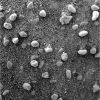
SOL812-2M198450826EFFAR00P2936M2M1.jpgThe "texture" of the soil... - Sol 81257 visiteCaption originale:"Microscopic Imager Non-linearized Full frame EDR acquired on Sol 812 of Spirit's mission to Gusev Crater at approximately at approximately 12:37:18 MLT.
Microscopic Imager dust cover commanded to be OPEN".
|
|

Dactyl.JPGDactyl57 visitenessun commento
|
|
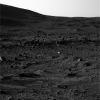
SOL813-2P198554476EFFAR00P2408R1M1.jpgFoggy horizon... (4) - Sol 81357 visitenessun commento
|
|

Saturn-PIA08159.jpgCrescent Moons (1)57 visiteCaption NASA originale:"The tilted crescent of Saturn displays lacy cloud bands here along with a bright Equatorial Region and threadlike ring shadows on the Northern Hemisphere. Three moons are visible here: Mimas (397 Km, or about 247 miles across) at left and faint, is aligned with the Ring-Plane. At right are Rhea (1.528 Km, or about 949 miles across, at top) and Tethys (1.071 Km, or 665 miles across, below Rhea).
The image was taken in polarized infrared light with the Cassini spacecraft wide-angle camera on March 11, 2006, at a distance of approximately 2,8 MKM (approx. 1,8 MMs) from Saturn.
The image scale is roughly 166 Km (about 103 miles) per pixel".
|
|

South_Polar_Features-Swiss_Cheese_Terrain-00.JPGEarly Fall at the South Pole57 visiteCaption NASA originale:"This MGS-MOC image shows a portion of the South Polar Residual Cap. The darkened edges of the pits and mesas are evidence of the removal — by sublimation — of frozen CO2 during the recent Martian Summer.
Summer ended and Autumn began in January 2006, shortly before this image was acquired".
Location near: 86,8° South; 90,5° West
Image width: ~3 Km (~1,9 mi)
Illumination from: upper left
Season: Southern Summer
|
|

OPP-SOL795-1P198781216ESF6900P2673R2M1.jpgSunset on Mars, with "lights" in the Sky (1) - Sol 79557 visiteCaption originale:"Right PanCam Non-linearized Sub-frame EDR acquired on Sol 795 of Opportunity's mission to Meridiani Planum at approximately 17:54:32 MLT.
Camera commanded to use Filter 2 (754 nm)".
Nota: dopo svariati mesi di indifferenza, ecco un paio di nuovi frames relativi ad un tramonto Marziano. Come sempre, la qualità delle immagini non è eccezionale (anzi...), ma quello che ci stupisce in queste sequenze, è la (quasi) costante apparizione di corpi luminosi (oggetti reali o ancora photoartifacts?) nel Cielo di Marte, nei pressi dell'orizzonte.
Che cosa stiamo guardando?
|
|

OPP-SOL795-1P198781230ESF6900P2673R4M1.jpgSunset on Mars, with "lights" in the Sky (2) - Sol 79557 visiteCaption NASA originale:"Right PanCam Non-linearized Sub-frame EDR acquired on Sol 795 of Opportunity's mission to Meridiani Planum at approximately 17:54:45 MLT.
Camera commanded to use Filter 4 (864 nm)".
|
|
| 25353 immagini su 2113 pagina(e) |
 |
|
|
|
|
1490 | |
|
|
|
|





