| Piú viste |

Itokawa-09.jpgSurface details (2)57 visiteA) Morphological and geological discoveries about Itokawa: the a-priori theoretical assumption that small near-Earth asteroids should have geologically homogeneous features was completely overturned by the observation of a wide variety of surface features and types at Itokawa. The surface is covered with huge boulders and, for the first time, naked surfaces not covered with regolith have been exposed. Previously visited asteroidswere covered with thick regolith, thus Itokawa’s surface is like nothing that has seen before, which is quite fortunate for the Hayabusa Mission. The opportunity to observe the true asteroid surface, which isusually concealed from view, advancesour understanding of spectroscopic observations of asteroids taken from Earth, and allows us to expand our knowledge of near Earth asteroids.
|
|

Itokawa-12.jpgNear Infrared Spectra of Candidates for Sampling Sites57 visiteIn view of the scientific results described above, JAXA has determined the landing/sampling sites candidates and the descent target point for rehearsal, along with their planned dates and times.
The landing/sampling sites must be free of obstacles and smooth enough to ensure safety, a top priority, while at the same time the surface inclination and the ground station coverage for Hayabusa must be taken into account. Taking these issues into consideration, the candidate
sites and schedule were determined.
The first site candidate is the regolith expanse in the middle of Itokawa, known as the MUSES-SEA Area and the second candidate site is the Woomera desert at the tip end of Itokawa, where the terrain is broad and flat. The rehearsal target is the area located close to the spin axis, a little east of the first site. The date and time of the planned events
(JST) are as follows:
1. Rehearsal Descent: Nov. 4, '05 - h.14:00
2. 1st Touch-down: Nov. 12, '05 - h. 15:00
3. 2nd Touch-down: Nov. 25., '05 - h. 15:00
|
|
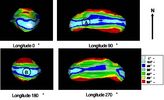
Itokawa-13.jpgGravity and Slope Map57 visiteThe purpose of the Rehearsal Descent is, first of all, to make sure that the proximity laser range finder works as intended, as its function has not been calibrated during cruise. The second purpose is to confirm whether the target marker image can be extracted against the asteroid surface, using onboard image processing that illuminates it using flash lamps onboard the spacecraft. The third purpose is to deploy and place the hopping robot MINERVA on the asteroid surface. Deploying MINERVA conflicts with the touch-down sequence, so it will be separated in advance of the sampling runs.
In conjunction with this very big challenge, JAXA is also starting a nation-wide campaign called ‘You Name the Landing Site’. The names assigned to the sites may not be officially registered by the IAU as the sites are very small. However, JAXA, as a finder, declares that the sites will be given those selected names.
|
|

OPP-SOL649-1N185808433EFF64I6P0705L0M1.jpgNice Panorama (3) - Sol 64957 visitenessun commento
|
|

Eta Carinae-3D.jpgEta Carinae (3D)57 visite"...Remember that women, children and revolutionists hate irony, which is the negation of all Faith, of all Devotion, of all Action..."
Joseph Conrad (1857-1924) - "Under Western Eyes"
|
|

L-Itokawa.jpgThe Target Marker separated from Hayabusa (close-up)57 visiteThe Target Marker that separated from Hayabusa carried the names of 880.000 people who participated in the campaign from the World.
It was placed in the South-West area of the MUSES-Sea.
When it hit to the surface, the descent speed was about 9 cm/sec. The Target Marker was specifically designed and fabricated with an aluminum shell filled with polyimide balls (so to absorb kinetic energy through multi-collisions). This design is capable to dramatically suppress the bouncing of the probe and its function has been tested and verified via drop tower tests in a vacuum chamber on Earth.
The Target Marker (è il minuscolo punto luminoso - cerchiato in nero - che si vede accanto all'ombra di Hayabusa nel close-up di Sx) was illuminated by onboard flash lamps every 2' (...).
|
|

OPP-SOL644-Scylla_Pcam_Ncam_comp-B644R1_br2.jpgScylla - Sol 64457 visiteThese images were acquired by NASA's MER Opportunity using its Pan Cam on Sol 644 (Nov. 15, 2005) and its NavCam on Sol 645 (Nov. 16, 2005- color image). The view looks towards the East, covering a large wind-blown ripple called "Scylla" other nearby ripples and patches of brighter rock strewn with dark cobbles. PanCam bands L4 (601-nnmts wavelength), L5 (535 nnmts) and L6 (482 nnmts) correspond to red, green and blue bands in the false-color image shown in the upper left. The blue-tinted colors associated with the scours and ripple crests are probably due to the presence of basaltic sands mixed with hematite-rich spherules. Color patterns on the larger ripple flanks are caused by different amounts of reddish dust. The larger ripple flanks have an intricate mixture of erosional scours and secondary ripples extending downward from the main ripple crests, suggesting that these ripples have most recently encountered a period of wind erosion and transport of their outer layers.
|
|

Rhea-N00043425.jpgSlopes, Valleys and Craters57 visiteN00043425.jpg was taken on November 26, 2005 and received on Earth November 28, 2005. The camera was pointing toward Rhea that, at the time, was approximately 691 Km away.
The image was taken using the CL1 and CL2 filters.
|
|

Rhea-N00043397.jpgSteep Scarps, Craters and Peaks57 visiteN00043397.jpg was taken on November 26, 2005 and received on Earth November 27, 2005. The camera was pointing toward Rhea that, at the time, was approximately 65.083 Km away.
The image was taken using the CL1 and GRN filters.
|
|

Rhea-N00043395.jpgLittle "White Rayed Splat"57 visiteN00043395.jpg was taken on November 26, 2005 and received on Earth November 27, 2005. The camera was pointing toward Rhea that, at the time, was approximately 65.528 Km away.
The image was taken using the CL1 and CL2 filters.
|
|

Enceladus-PIA07759.jpgThe "Fountains" of Enceladus57 visite"...this greatly enhanced and colorized image shows the enormous extent of the fainter, larger-scale component of the plume..."
Nota: dal tenore del commento NASA, oltre ad una leggera sorpresa, non pare trasparire alcunchè. Allora: se abbiamo capito bene c'è qualcosa che viene "spruzzato" nel cielo dalla superficie di Encelado e che forma una sorta di "fontana" di corpuscoli che si disperdono nello spazio.
Qualcosa di incredibile e di assolutamente "alieno" (nel senso di lontano dal nostro modo di vedere e di immaginare le cose) sta accadendo, ma la NASA si limita a darci un commentino secco e asciutto, come la risposta ad un quesito di Scienze Planetarie che verrebbe data al Professore da uno studente non troppo preparato. Abbiamo letto, recentemente, della costante caduta di interesse da parte dell'opinione pubblica in generale e dei giovani in particolare verso lo Spazio e l'esplorazione del Sistema Solare. Onestamente, visto l'atteggiamento costantemente bolso di ESA e NASA, non ce ne meravigliamo...
|
|

Enceladus-PIA07760.jpgThe "Fountains" of Enceladus57 visiteA fine spray of small, icy particles emanating from the warm, geologically unique province surrounding the South Pole of Enceladus was observed in a Cassini narrow-angle camera image of the crescent moon taken on Jan. 16, 2005. Taken from a high phase angle of 148° - a viewing geometry in which small particles become much easier to see - the plume of material becomes more apparent in images processed to enhance faint signals.
Imaging scientists have measured the light scattered by the plume's particles to determine their abundance and fall-off with height. Though the measurements of particle abundance are more certain within 100 Km of the surface, the values measured there are roughly consistent with the abundance of water ice particles made by other Cassini instruments (reported in 09/2005) at altitudes as high as 400 Km above the surface.
At present, it is not clear if the plume particles emanating from the south pole arises because of water vapor escaping from warm ice that is exposed to the surface. Another possibility is that at some depth beneath the surface, the temperatures are hot enough for water to become liquid, which then, under pressure, escapes to the surface like a cold Yellowstone geyser.
The image at the left was taken in visible green light. A dark mask was applied to the moon's bright limb to make the plume feature easier to see.
The image at the right has been color-coded to make faint signals in the plume more apparent. Images of other moons, such as Tethys and Mimas, taken in the last 10 months from similar lighting and viewing geometries, and with identical camera parameters, were closely examined to demonstrate that the plume towering above Enceladus' south pole is real and not a camera artifact.
The images were acquired at a distance of about 209,400 kilometers (130,100 miles) from Enceladus. Image scale is about 1 kilometer (0.6 mile) per pixel.
|
|
| 25353 immagini su 2113 pagina(e) |
 |
|
|
|
|
1484 | |
|
|
|
|





