| Piú viste |

ZS-Mercury-PIA11077.jpgFaults in Caloris Basin57 visiteAs the youngest large impact basin known on Mercury, the Caloris Basin has landforms that are better preserved than in older basins, which have been more modified by impact cratering.
This figure, recently published in Science magazine, shows a map of many linear features within Caloris Basin that formed when the near-surface rocks were subjected to large horizontal forces. The Caloris Basin contains hundreds of extensional troughs, mapped as black lines, where the surface has been pulled apart and faulted.
Pantheon Fossae (located inside the white box of the top map and shown in detail in the bottom image) has over 200 such troughs in a radiating pattern, but near the outer edges of the basin interior troughs are seen in patterns broadly concentric to Caloris Basin. The Caloris Basin interior also has been deformed by many wrinkle ridges, mapped as red lines, formed when the surface was compressed or shortened horizontally. Relationships between the extensional troughs and contractional wrinkle ridges provide information about the evolution of the Caloris basin and Mercury's interior.
Date Acquired: January 14, 2008
Instrument: Narrow Angle Camera (NAC) of the Mercury Dual Imaging System (MDIS)
Scale: Caloris Basin is about 1550 Km (approx. 960 miles) in diameter. The crater Apollodorus near the center of Pantheon Fossae is about 41 Km (approx. 25 miles) in diameter. MareKromium
|
|
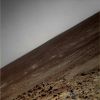
SOL1559-1~0.jpgGusev's Skyline - Sol 1559 (natural colors; credits: Dr G. Barca & Lunexit)57 visitenessun commentoMareKromium
|
|

The_Rings-PIA10470.jpgGravitational Interactions or just Evidence of a recent Collision?57 visiteCaption NASA:"The three bright, finger-like jets of material seen here suggest that a small object has collided with the core of Saturn's F-Ring. Cassini Spacecraft imaging scientists have shown that the F-Ring shepherd moon Prometheus influences the structure of the Ring in 2 ways: 1) by creating streamer-channel features as it closely approaches (and partially passes into) the Ring (see PIA08397) and 2) by perturbing the orbits of small objects within the F-Ring Region which then exert their own influence on nearby Ring particles, as seen here.
These small, embedded objects could be temporary clumps of particles, but scientists think at least one of the objects could be a more permanent moonlet.
This view looks toward the sunlit side of the Rings from about 40° below the Ring-Plane. The image was taken in visible light with the Cassini Spacecraft narrow-angle camera on Aug. 20, 2008. The view was obtained at a distance of approx. 685.000 Km (such as about 426.000 miles) from Saturn and at a Phase Angle of 40°.
The image scale is about 5 Km per pixel".MareKromium
|
|
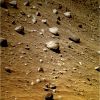
SOL1637-1.jpgRocks' Parade - Sol 1637 (natural colors; credits: Dr G. Barca)57 visitenessun commentoMareKromium
|
|

SOL1643-1.jpgMartian Balance... - Sol 1643 (natural colors; credits: Dr G. Barca)57 visitenessun commentoMareKromium
|
|

PSP_006677_1475_RED_abrowse~0.jpgStreamlined Features near Hale Crater (natural colors; credits: Lunexit)57 visiteThis image contains streamlined features located North-West of Hale Crater, a 120 x 150 Km diameter impact crater that is possibly the youngest of its size on Mars.
A streamlined feature is one that is raised, possessing sharp edges. It is narrower at the downstream end because of the flow that carved it. Any fluid — lava, water, mud, and even flowing ice — can form streamlined features. Many portions of the image are filled with craters, while others are rather smooth.
The streamlined features in this image tend to be smoother, suggesting they are relatively young.
Their origin might be related to the impact that formed the crater.
MareKromium
|
|
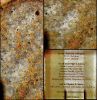
PHOE-SOL111-MF-LXT.jpgIn Loving Memory... - Sol 111 (natural colors; credits: Dr M. Faccin)57 visiteUna splendida combinazione fra alcuni dettagli (microscopici) della polvere di Vastitas ed una targa "In Memoria", su cui un pò di quella polvere ha già iniziato a posarsi.
Insomma: un pò di Scienza ed un pò di Spiritualità, su Marte come sulla Terra, non guastano davvero mai...MareKromium
|
|

SOL1654-1.jpgGusev's Skyline - Sol 1654 (natural colors; credits: Dr G. Barca & Lunexit)57 visitenessun commentoMareKromium
|
|

SOL1651-1.jpgGusev's Skyline - Sol 1651 (natural colors; credits: Dr G. Barca & Lunexit)57 visitenessun commentoMareKromium
|
|

SOL489-MF.jpgSunset - Sol 489 (True Colors; credits: Dr M. Faccin)57 visite...Capolavoro!...MareKromium
|
|
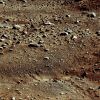
PHOE-SOL115-lg33948-33951-33952-2.jpgThe Surface of Vastitas Borealis - Sol 115 (Superdefinition and possible True Colors; credits: Dr G. Barca)57 visitenessun commentoMareKromium
|
|

PHOE-SOL117-PIA11191.jpg"Headless": just like NASA... - Sol 11757 visiteCaption NASA:"The Robotic Arm on NASA's Phoenix Mars Lander slid a rock out of the way during the mission's 117th Sol (such as Sept. 22, 2008) to gain access to soil that had been underneath the rock.The Lander's Surface Stereo Imager took the two images for this stereo view later the same day, showing the rock, called "Headless", after the arm pushed it about 40 cm (16") from its previous location.
"The rock ended up exactly where we intended it to", said Matt Robinson of NASA's Jet Propulsion Laboratory, RA flight software lead for the Phoenix team.
The RA had enlarged the trench near Headless 2 days earlier in preparation for sliding the rock into the trench. The trench was dug to about 3 cm (1,2") deep. The ground surface between the rock's prior position and the lip of the trench had a slope of about 3° downward toward the trench.
Headless is about the size and shape of a VHS videotape".MareKromium
|
|
| 25353 immagini su 2113 pagina(e) |
 |
|
|
|
|
1481 | |
|
|
|
|





