| Piú viste |

m10_aom_3_2.jpgTerraced Mercurian Craters (HR)57 visiteThis crater (about 98 km diameter) illustrates the narrow hummocky rim facies, radial ridges and surrounding extensive field of secondary craters.
The well-developed interior terraces and central peaks are typical for Mercurian Craters in this size range.
Note that the smaller craters in the foreground (25-Km diameter) also are terraced.
This image(FDS 80)was taken during the spacecraft's first encounter with Mercury.
|
|

m10_aom_3_11.jpg57 visitenessun commento
|
|

M 42-PIA08656.jpgOrion's "Sword"57 visiteThis image composite outlines the region near Orion's sword that was surveyed by NASA's Spitzer Space Telescope (white box). The view on the left (figure 1) is from a visible-light telescope, and the view on the right (figure 2) shows infrared light captured by a previous infrared mission, the Infrared Astronomical Satellite.
The Orion nebula, our closest massive star-making factory, is the brightest spot near the hunter's sword. On a dark night, it can appear to the naked eye as a fuzzy star, and it looks like a ghostly blob through a pair of binoculars. The Orion constellation is one of the most prominent winter constellations, and can be seen from all northern latitudes starting in the fall.
Spitzer used its infrared eyes to probe the dusty clouds of a region called Orion cloud A. outlined here in the hockey stick-shaped box (see PIA08655). This giant cloud stretches almost a quarter of the length of the constellation, an area equivalent to 18 full moons. The small box within the hockey stick shows the location of another image released by Spitzer (see PIA08653), which mainly features the Orion nebula itself.
The bright spot that shows up in the infrared view in the area of Orion's belt is known as Orion cloud B. Together, Orion clouds A and B make up the Orion cloud complex. In a survey of this entire complex, Spitzer unearthed 2,300 stars circled by disks of planet-forming dust and 200 stellar embryos too young to have developed disks.
The Infrared Astronomical Satellite was a joint effort between NASA, the Science and Engineering Research Council, United Kingdom and the Netherlands Agency for Aerospace Programmes, the Netherlands. Spitzer has extended the legacy of the satellite by providing much better resolution and sensitivity.
The visible-light image comes courtesy of Howard McCallon of the Infrared Processing and Analysis Center at the California Institute of Technology of Pasadena.
|
|

APOLLO 12 AS 12-47-6988.jpgAS 12-47-6988 - ALSEP deployment57 visiteCaption NASA originale:"centered on Pete at the MESA. Note the color/shadow chart hanging at the edge of the MESA. The ALSEP deployment tapes are hanging from the left side of the spacecraft. The S-Band is at the right side of the picture".
|
|
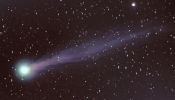
Comets-Comet_SWAN-2.jpgComet SWAN57 visiteCaption NASA originale:"Near its closest approach to planet Earth, comet SWAN (C/2006 M4) brightened unexpectedly earlier this week, becoming visible to naked-eye observers under dark night skies. Telescopic observers also noticed dramatic changes in the comet's colorful coma and tail, seen in this view recorded on October 25th, 2006.
To make the picture, images totaling eight minutes in exposure time were stacked and centered on the comet as it moved relatively quickly against the background star field. The picture covers about 1° of the sky.
Northern Hemisphere observers should still find the comet an easy binocular target in the early evening, even though moonlight will increase the overall sky brightness in the next few days.
Look toward the North-Western horizon and the Constellation Hercules".
|
|
APOLLO_09_AS_09-20-3060.jpgAS 09-20-3060 - Looking out57 visite
|
|

AS09-22-3400.jpgAS 09-22-3400 - Red-Lands... (3)57 visite
|
|

AS09-22-3474.jpgAS 09-22-3474 - A coast-line trough a mistaken picture57 visite
|
|
AS09-22-3410.jpgAS 09-22-3410 - Coast-line57 visite
|
|

SOL999-2N215048276EFFAS00P1600L0M1.jpgOn the edge of 1000...Soles!57 visiteUn panorama ormai ricorrente e del tutto (almeno per gli Appassionati...) conosciuto: potremmo dare un nome ad ogni pietra (o "similpietra") e potremmo contare i vari pebbles (o "ciottoli") che si intravedono nel frame. Perchè? Perchè questa zona, ormai, la conosciamo come le nostre tasche: è il Winter Haven di Spirit!
Un Winter Haven che, tra non molto (finalmente!) verrà abbandonato per riprendere il viaggio...
|
|

V-838_Mon-01.jpgV-838 Monocerotis57 visite"...Optimus est orator qui dicendo animos audientium et docet, et delectat et permovet..."
(Cicerone)
"...Eccellente è quell'oratore che, parlando, insegna, diletta e commuove gli animi di coloro che ascoltano..."
|
|

MS_0735_6+7421-D-composite.jpgGalaxy Cluster MS0735.6+7421 in Camelopardus (the "Final Mosaic")57 visite"...Brevity, is the sister of Talent..."
Anton Chekhov (1860-1904)
|
|
| 25353 immagini su 2113 pagina(e) |
 |
|
|
|
|
1480 | |
|
|
|
|





