| Piú viste |

OPP-SOL505-2.jpgRover Tracks - Sol 505 (possible True Colors; credits: Dr G. Barca)57 visitenessun commentoMareKromium
|
|
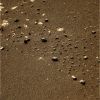
OPP-SOL550-1.JPGBerries and Pebbles - Sol 550 (possible True Colors; credits: Dr G. Barca & Lunexit)57 visitenessun commentoMareKromium
|
|

OPP-SOL0028-3dmicro.jpgMartian "Eggs" - Sol 28 (Hi-Def3-D - credits and Copyright: Dr G. Barca and Lunar Explorer Italia)57 visiteGuardando un'elaborazione come questa, la domanda sorge davvero spontanea: ma come fanno gli Scienziati NASA ad escludere CATEGORICAMENTE la possibilità (remota sinchè si vuole, ma non assurda!) che i Martian Berries possano effettivamente essere delle Forme Vitali Locali?!?MareKromium
|
|

PSP_006968_1735_RED_abrowse~0.jpgMound of Layers in East Candor Chasma (MULTISPECTRUM; credits: Lunexit)57 visiteThis image shows the Northern portion of East Candor Chasma, part of the Valles Marineris Canyon System. In the center of the image is a light-toned mound that has dozens of layers exposed along its edge. As the upper layers weather and break apart into smaller grains, these grains subsequently fall down the edge, burying layers beneath and producing triangular-shaped debris aprons.
The color image of the mound doesn’t show any significant color variations between the different layers.
However, another instrument on MRO called CRISM (Compact Reconnaissance Imaging Spectrometer for Mars) has observed compositional differences between the layers and these results have been helpful in deciphering the origin of these layers.
This deposit is one of several examples exhibiting sulfate-rich layers with alternating hydration states. Cliff-forming Kieserite-rich layers alternate with slope-forming polyhydrated sulfate layers. (Kieserite is a mineral containing Magnesium).
The apparent lack of slumping, channels, cross-bedding or bed truncation supports quiescent water or deposition from the air as the most likely origin for the layers.MareKromium
|
|

PSP_006969_1725_RED_abrowse-00.jpgThe Floor of Noctis Labyrinthus (context frame - MULTISPECTRUM; credits: Lunexit)57 visiteThis image shows part of Noctis Labyrinthus, the “Labyrinth of the Night.” This is a system of connecting troughs which form a maze-like network at the western end of Valles Marineris, the giant canyon system of Mars.
The individual troughs are usually kilometers across; this image shows part of the floor of one of the troughs, with some intriguing fine-scale features.
Near the center of the image, the floor is broken up into many small knobs and hills, probably eroded remnants of a larger geologic unit.MareKromium
|
|
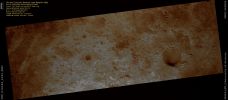
PSP_010183_2035_RED_abrowse-00.jpgColourful old Bedrock near Mawrth Vallis (possible True Colors; credits: Lunexit)57 visiteThis image covers part of a proposed Rover Landing Site in the Mawrth Vallis Region of Mars.
Polygonal fracture patterns (similar to a tiled floor) are visible on the surfaces of some of these rocks, and yellow/brown ridges protruding from the Surface may be composed of hard minerals or cemented sediments formed when water flowed through fractures in the ancient Bedrock. Dark gray-bluish dunes or ripples of wind-blown sand are also visible on the Surface here.
Elsewhere in the image, exposures of the light-toned rocks in the steep walls of impact craters reveal that these rocks are finely layered, similar to sedimentary rocks on Earth. The orbiting Infrared Spectrometers OMEGA and CRISM have demonstrated that these layered rocks contain Clay (---> argilla/minerali argillosi) minerals, which can only form in the presence of water.
The different colors of the rocks typically reflect differences in composition, suggesting that multiple styles or episodes of water activity may be recorded in the rock record here.
These characteristics have made Mawrth Vallis a prime candidate Landing Site for future Mars Rover Missions, including NASA’s Mars Science Laboratory due to launch in 2009.MareKromium
|
|
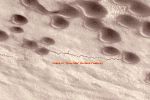
PSP_010169_2650_RED_abrowse-03~0.jpgDunes and other Surface Features in Chasma Boreale (edm n. 3 - false colors; credits: Lunexit)57 visiteAllora? Lo vedete il "possible North Polar drainage channel"? Notate come sia diverso dai soliti "cracks" e "fissures" del suolo? Osservatene bene i bordi e quindi provate a fare un confronto fra questo frame e qualche drainage channel Terrestre o di Titano: le somiglianze ci sono, e sono evidenti.
Verificare per credere!MareKromium
|
|

M-076-2.jpgM 76 - The "Little Dumbbell Nebula"57 visite"...Etiam qui leviter credit, deceptus saepe recedit..."
(antico proverbio)
"...Anche colui che misura la sua fiducia (ossìa ne concede poca) spesso rimane ingannato..."MareKromium
|
|

OPP-SOL1691-1P278319688EFF92X2P2373R1M1.jpgOn the way to the South: Sand Ripples - Sol 1691 (tri-chromatic version; credits: Lunexit)57 visiteCaption NASA:"Each day, Opportunity picks a route through two kinds of Martian terrain -- one hard and smooth, the other soft and sandy. Paving the way are flat-lying rocks formed long ago with help from liquid water. Threatening to bury the Rover's wheels are waves upon waves of sand ripples. Both features fill the region that separates the Mars Rover from Endeavour Crater.
In recent weeks, Opportunity has been putting the pedal to the metal.
Since leaving "Victoria Crater", Opportunity has driven almost a mile. Ahead are more miles of similar terrain and interesting things to see. Scientists expect to encounter younger rocks the farther South the Rover travels. They expect to find small rocks ejected onto the landscape when nearby craters were formed. To reach all these things, the Rover must avoid sand traps as much as possible, making the rippled terrain the road not traveled".MareKromium
|
|

OPP-SOL1715-1P280448066ESF94B2P2590R1M1.jpgSigns of an ancient Tide? (5) - Sol 1715 (natural colors; credits: Lunexit)57 visitenessun commentoMareKromium
|
|
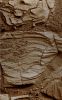
OPP-SOL1715-1P280448066ESF94B2P2590R1M1-2.jpgSigns of an ancient Tide? (4) - Sol 1715 (possible True Colors; credits: Dr G. Barca & Lunexit)57 visitenessun commentoMareKromium
|
|
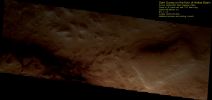
Dunes-Dunefield_in_Hellas_Basin-20080118a-PCF-LXTT.jpgDark Dunefield in Hellas Basin (Darkened Natural Colors; credits for the additional process. and color.: Dr Paolo C. Fienga - Lunexit Team)57 visitenessun commento
MareKromium
|
|
| 25353 immagini su 2113 pagina(e) |
 |
|
|
|
|
1479 | |
|
|
|
|





