| Piú viste |

Landslides-Melas_Chasma-20071114a-PCF-LXTT.jpgLandslide in Melas Chasma (Enhanced Natural Colors; credits for the additional process. and color.: Dr Paolo C. Fienga - Lunexit Team)57 visitenessun commentoMareKromium
|
|

Landslides-Melas_Chasma-20080204a-PCF-LXTT.jpgHuge Landslide in Melas Chasma (Enhanced Absolute Natural Colors; credits for the additional process. and color.: Dr Paolo C. Fienga - Lunexit Team)57 visiteCaption NASA:"This landslide in Melas Chasma is so large that a single THEMIS VIS image can cover only a portion of the deposit.
This image clearly shows the sub-radial grooves typical of the surface of landslides on Mars".
MareKromium
|
|
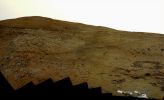
SOL1599-PIA11049-1.jpgSouthern Half of Spirit's 'Bonestell' Panorama - Sol 1599 (natural colors; credits: Lunexit)57 visiteThis 180-degree panorama shows the southward vista from the location where Spirit is spending its third Martian winter inside Mars' Gusev Crater. The rover's overwintering location is on the northern edge of a low plateau informally called "Home Plate," which is about 80 meters or 260 feet in diameter.
This view combines 168 different exposures taken with Spirit's panoramic Camera (Pancam)—42 pointings with 4 filters at each pointing. Spirit took the first of these frames during the mission's 1,477th Martian day, or sol, (February 28, 2008) two weeks after the rover made its last move to reach the location where it would stop driving for the winter. Solar energy at Gusev Crater is so limited during the Martian winter that Spirit does not generate enough electricity to drive, nor even enough to take many images per day. The last frame for this mosaic was taken on Sol 1599 (July 2, 2008). The rover team plans for Spirit to finish taking images for the northern half of the scene during the Martian spring.
The northwestern edge of Home Plate is visible in the right foreground. The blockier, more sharply shadowed texture there is layered sandstone whose layering is tilted inward toward the edge of the Home Plate platform. A dark rock on top of Home Plate in that area is a porous volcanic basalt unlike rocks nearby. The northeastern edge of Home Plate is visible in the left foreground. Spirit first climbed onto Home Plate on that region, in early 2006.
Rover tracks from driving by Spirit are visible on Home plate in the center and right of the image. These were made during Spirit's second exploration on top of the plateau, which began when Spirit climbed onto the southern edge of Home Plate in September, 2007.
MareKromium
|
|
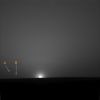
PHOE-SOL090-PIA11054-1.jpgStar-like Objects in the Morning Lights - Sol 9057 visitenessun commentoMareKromium
|
|
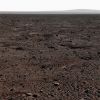
PHOE-SOL091-lg25384-25452-25674-2.jpgVastitas' Horizon - Sol 91 (Superdefinition and natural colors; credits: Dr G. Barca & Lunexit)57 visitenessun commentoMareKromium
|
|
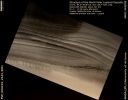
PSP_009293_2645_RED.jpgStructure of the North Polar Layered Deposits (natural colors; credits: Lunexit)57 visiteThe North Polar Layered Deposits on Mars are thought contain a record of global climate changes, similar to ice ages on Earth. This image shows that the geologic history of the NPLD has been complex enough to form angular unconformities.
An angular unconformity represents a gap in the geologic record, where erosion has removed material followed by deposition of more material on the eroded surface. In this image, the angular unconformities are recognized by the truncation, or cutting off of layers, for example right of center and at bottom center.
Also visible in this image are numerous streaks, perhaps caused by recent redistribution of frost by winds.MareKromium
|
|

OPP-SOL1130-1.jpgVictoria's Paving - Sol 1130 (True Colors; credits: Dr G. Barca)57 visitenessun commentoMareKromium
|
|
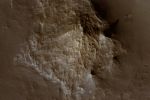
PSP_009161_1450_RED-01.jpgLong Shadows over Ariadnes Colles (edm - natural colors; credits: Lunexit)57 visiteThis edm shows one of the hills in detail.
The hill appears criss-crossed by long fractures and most of them made apparent by the shadows they cast.
The shadows indicate that the fractures “stick out” from their surroundings, and hence that they are more resistant to erosion. In terrestrial environments this occurs when fluids flow along the fractures, leaving behind cementing minerals or when fractures are filled by igneous materials.MareKromium
|
|
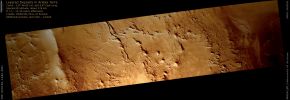
PSP_009180_1840_RED.jpgLayered Deposits within Unnamed Crater in Arabia Terra (natural colors; credits: Lunexit)57 visiteArabia Terra is an area of Mars that has an abundance of Layered Deposits within Impact Craters.
The Region of Arabia has plateau material that is thought to be part of the ancient highland crust that is Noachian in age according to Martian timescale. Thus, the layered deposits may represent some of the earliest eroded and infilled materials on Mars.
In this Unnamed Crater, we see layering exposed along the margins of a scarp-like bench.
The layering is of particular interest because on Earth, they may represent multiple sequences of deposited material or some geologic process (subaerial or subaqueous) that has modified and/or deposited material on the surface in some constant fashion.
If the layered sequences are consistently the same, we can infer that the conditions of their deposition were the same for some period of time. If the layers changed in some way (e.g., thickens and thins), then we can infer that some condition(s) caused this to happen.
From these observations and analyses, scientists can attempt to quantify and reconstruct what the ancient conditions were like in this Region of Mars.MareKromium
|
|

APOLLO_15_AS_15-95-12953.jpgAS 15-95-12953 - Prinz "A"57 visiteCoord.: 26,5° North Lat. and 44,0° West Long.MareKromium
|
|
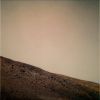
SOL1428-1.jpgSkyline - Sol 1428 (True Colors; credits: Dr G. Barca & Lunexit)57 visitenessun commentoMareKromium
|
|
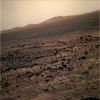
SOL1422-1.jpgGusev's Landscape - Sol 1422 (natural colors; credits: Dr G. Barca)57 visitenessun commentoMareKromium
|
|
| 25353 immagini su 2113 pagina(e) |
 |
|
|
|
|
1478 | |
|
|
|
|





