| Piú viste |
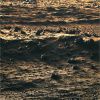
SOL1147-0.jpgLong Shadows in the Evening Hours near Home Plate (1) - Sol 1147 (True Colors + MULTISPECTRUM; credits: Dr Marco Faccin & Lunexit)57 visitenessun commentoMareKromium
|
|

Gravitational_Lensing-01.jpgGravitational Lensing and "Light Distortion"57 visite"...Noi continuiamo a definire, reputare e trattare il Tempo e lo Spazio come ed in quanto Misure Lineari.
Questo, a mio parere, equivale a dire che non solo le nostre "basi" sono fatiscenti, ma altresì che noi non abbiamo la minima idea di che cosa il Tempo e lo Spazio sìano effettivamente...
Comunque sia, dobbiamo aspettare. La Verità, nella Vita come nella Scienza, alla fine si automanifesta e si dimostra da sola, nonostante tutto e tutti..."
Paolo C. Fienga (appunti)MareKromium
|
|
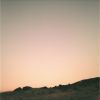
SOL579-1.jpgSkyline... - Sol 579 (True Colors + MULTISPECTRUM; credits: Dr G. Barca & Lunexit)57 visitenessun commentoMareKromium
|
|

PSP_007547_1895_RED_abrowse-01.jpgRolling Rocks inside Shalbatana Vallis (EDM - False Colors; credits: Dr Paolo C. Fienga - Lunexit Team)57 visiteIn this extra-detail mgnf, the left frame shows boulders moving in two directions, indicating that they had different sources.
The right frame shows a boulder about 4 meters in diameter in the bottom left, having left a track that begins in the upper right. This boulder rolled down the hill, appears to have jumped the crater, bounced a few times, and then rolled to a halt.MareKromium
|
|

PSP_007653_2010_RED_abrowse-00.jpgBright on Dark (MULTISPECTRUM; credits: Lunexit)57 visiteThis image reveals bright Slope Streaks in Bahram Vallis, a long sinuous valley that winds across North-Eastern Lunae Planum and Xanthe Terra to the circum-Chyrse basin.
Typically, dark and light-toned Slope Streaks appear together on light-toned slopes. This scene is a rare case in which only bright streaks are visible on a dark surface. Slope Streaks generally start at a point source and widen downslope as a single streak or branch into multiple streaks. Some of the Slope Streaks show evidence that downslope movement is being diverted around obstacles, such as large boulders, and a few appear to originate at boulders or clumps of rocky material.
Many hypotheses have been proposed for the formation of slope streaks including dry avalanching, geochemical weathering, liquid stains or flows, and moisture wickering. Recent observations from HiRISE images have revealed that the interior of Slope Streaks is lower in elevation than the surroundings indicating that material must have been removed and then deposited in the formation of the streak.
Slope Streak formation is among the few known processes currently active on Mars. Where they appear together, dark Slope Streaks cross cut and lie on top of the older and lighter-toned streaks leading to the belief that lighter-toned streaks are dark streaks that have lightened with time as new dust settled on their surface. Over the course of several years, MOC images from this Region did not reveal any new dark or light-toned Slope Streaks suggesting that streak formation is not currently active here.
HiRISE will continue to monitor this Region for new slope streaks and changes in tone of old streaks.MareKromium
|
|

HD-189733b.jpgHD-189733b - Exoplanet in Vulpecula57 visite"...Saepe condita luporum fiunt rapinae vulpium..."
(Proverbio Medioevale)
"...Sovente le volpi riescono a sottrarre anche le prede nascoste dai lupi..." (trad. libera)MareKromium
|
|
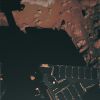
SOL236.jpgEvening Shadow... - Sol 236 (natural colors + MULTISPECTRUM; credits: Dr M. Faccin & Lunexit)57 visitenessun commentoMareKromium
|
|

NGC-2808-1.jpgNGC 2808 - Omega Centauri (Globular Star Cluster)57 visite"...In culpa est animus, qui se non effugit unquam..."
(Orazio)
"...Un animo consapevole non può sfuggire a se stesso..." (trad. libera)
Nota per i Lettori: ho tradotto "in culpa" come se stesse a significare "nella consapevolezza". Non è una svista, ma una semplice interpretazione personale.MareKromium
|
|

Craters-Pollack_Crater_and_White_Rock-20020419a-PCF-LXTT.jpgPollack Crater and "White Rock" (Slightly Saturated Absolute Natural Colors; credits for the additional process. and color.: Dr Paolo C. Fienga - Lunexit Team)57 visiteCaption NASA:"White Rock is the unofficial name for this unusual landform which was first observed during the Mariner 9 Mission in the early 70's. As later analysis of additional data sets would show, White Rock is neither white nor dense rock. Its apparent brightness arises from the fact that the material surrounding it is so dark. Images from the Mars Global Surveyor MOC camera revealed dark sand dunes surrounding White Rock and on the floor of the troughs within it.
Some of these dunes are just apparent in the THEMIS image. Although there was speculation that the material composing White Rock could be salts from an ancient dry lakebed, spectral data from the MGS TES instrument did not support this claim. Instead, the White Rock deposit may be the erosional remnant of a previously more continuous occurrence of air fall sediments, either volcanic ash or windblown dust.
The THEMIS image offers new evidence for the idea that the original deposit covered a larger area.
Approximately 10 Km to the South-East of the main deposit are some tiny knobs of similarly bright material preserved on the floor of a small crater. Given that the eolian erosion of the main White Rock deposit has produced isolated knobs at its edges, it is reasonable to suspect that the more distant outliers are the remnants of a once continuous deposit that stretched at least to this location.
The fact that so little remains of the larger deposit suggests that the material is very easily eroded and simply blows away".MareKromium
|
|
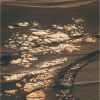
OPP-SOL569-1.jpgRover Tracks and Martian Paving - Sol 569 (True Colors + MULTISPECTRUM; credits: Dr G. Barca & Lunexit)57 visitenessun commentoMareKromium
|
|

SOL1287-0.jpgRobotic Arm At Work! - Sol 1287 (True Colors; credits: Dr M. Faccin)57 visitenessun commentoMareKromium
|
|
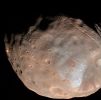
PSP_007769_9015_IRB.jpgPhobos (Natural Colors; credits: NASA)57 visitePhobos, and the second Martian moon, Deimos, are interesting for several reasons. Both objects are small, with average diameters of just 22 and 12 Km, respectively.
At this size, their gravity is insufficient (less than 1/1000th of Earth) to pull them into spherical shapes, in contrast to the larger moons and planets in the Solar System.
Both moons are tidally locked to Mars, meaning, like our own moon relative to Earth, they present the same side to Mars all the time. The small size and composition (determined from spectroscopy) of Phobos and Deimos make them very similar to some asteroids.
Most asteroids are located in a belt between Mars and Jupiter, with others having orbits that cross that of Mars. Therefore, it is possible that Phobos and Deimos are captured asteroids.
Other hypotheses are that they formed with Mars in the early Solar System, or are composed of material blasted off of Mars by impacts.MareKromium
|
|
| 25353 immagini su 2113 pagina(e) |
 |
|
|
|
|
1477 | |
|
|
|
|





