| Piú viste |

Enceladus-PIA11562.jpgEnceladus, in the distance (Natural Colors; credits: Lunexit)57 visiteCaption NASA:"Cassini Spacecraft looks toward the varied Surface of the Trailing Hemisphere of Saturn's moon Enceladus. North on Enceladus (about 504 Km, or approx. 313 miles across) is up. For a more detailed view of this Hemisphere, see also PIA08353.
The image was taken in Visible Light with the Cassini spacecraft narrow-angle camera on June 25, 2009. The view was acquired at a distance of approx. 594.000 Km (about 369.000 miles) from Enceladus and at a Sun-Enceladus-Spacecraft, or Phase, Angle of 66°.
Image scale is roughly 4 Km (about 2,5 miles) per pixel".MareKromium
|
|
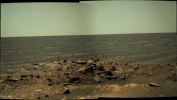
OPP-SOL1950-GB-LXT1.jpgPossible Secondary Crater near Victoria Crater (Resolution Crater) - Sol 1950 (Photo-composite Panorama - Natural Colors/Blue-Green Filters ON; credits: Dr. G. Barca & Lunexit)57 visitenessun commentoMareKromium
|
|

OPP-SOL1985-GB-LXT4.jpgExploring "Block Island" - Sol 1985 (Natural Colors; credits: Dr G. Barca & Lunexit)57 visitenessun commentoMareKromium
|
|

SOL1949-2N299416410EFFB1E5P2741R0M1-3.jpgSunset - Sol 1949 (Natural Colors; credits: Dr G. Barca)57 visitenessun commentoMareKromium
|
|
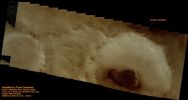
Craters-Unnamed_Crater-Terra_Sirenum-20090901a.jpgUnnamed Crater with Dunefield in Terra Cimmeria (Natural Colors; credits: Lunar Explorer Italia)57 visitenessun commentoMareKromium
|
|

FreedomInTheEnd.jpgFreedom, in the End... (by Roberto Tremolada)57 visitenessun commentoMareKromium
|
|
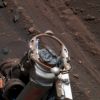
SOL2016-GB3.jpgSpirit and Surface - Sol 2016 (possible True Colors; credits: Dr G. Barca)57 visitenessun commentoMareKromium
|
|
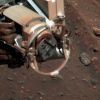
SOL2016-GB2.jpgSpirit and Surface - Sol 2016 (possible True Colors; credits: Dr G. Barca)57 visitenessun commentoMareKromium
|
|
SOL2016-GB1.jpgSpirit and Surface - Sol 2016 (possible True Colors; credits: Dr G. Barca)57 visitenessun commentoMareKromium
|
|

SOL538-MI-MF.jpgSmall Cable on the Solar Panel - Sol 538 (Superdefinition and Natural Colors; credits: Dr M. Faccin & Lunexit)57 visiteDetto con sincerità (ed Umiltà), oltre ai complimenti di rito al Grande Marco Faccin, invitiamo la NASA a produrre qualcosa di equivalente, in Superdefinizione e Colori Naturali...MareKromium
|
|
SOL2014-MF-LXT-pancam_spirit.jpgSmall Ripple and Pebbles - Sol 2014 (Superdefinition and Natural Colors; credits: Dr M. Faccin & Lunexit)57 visitenessun commentoMareKromium
|
|

Triton-PIA12184.jpgVolcanic Plains on Triton (possible Natural Colors; credits: Lunexit)57 visiteCaption NASA:"This view of the Volcanic Plains of Neptune's moon Triton was produced using topographic maps derived from images acquired by NASA's Voyager Spacecraft during its August 1989 flyby, 20 years ago this week (August 2009).
Triton, Neptune's largest moon, was the last solid object visited by the Voyager 2 Spacecraft on its epic 10-year tour of the Outer Solar System.
This regional view shows a variety of Terrains on Triton, including the smooth Volcanic Plains in the foreground, formed by icy lavas. Parts of this Surface have been eroded, forming mounds and depressions with relief of tens to a few hundred meters (several hundred feet). The round pits and mounds across the center of the scene are probably volcanic explosion or collapse craters, the largest of which (at bottom center) is approx. 250 meters deep (820 feet) and approx. 15 Km (about 9 miles) across.
Many of these pits are aligned in chains similar to those seen in basaltic volcanic areas on Earth, such as Craters of the Moon National Monument in Idaho, except the lavas on Triton are water and other ices that erupted onto the Surface.
In the distance is one of two large walled smooth plains of unknown origin. These plains are roughly 200 Km (about 124 miles) across.
The Surface of Triton is very rugged, scarred by rising blobs of ice (Diapirs), Faults and Volcanic Pits and Lava Flows composed of water and other ices. The Surface is also extremely young and sparsely cratered. It may even be younger than the Surface of Europa, one of the first objects visited by the Voyager Spacecraft and could be geologically active today.
Although locally very rugged, Triton has no large mountains or deep basins and regional relief is low, a consequence of its high internal heat and the low strength of most ices. This scene is on the order of 500 Km (about 310 miles) across and is taken from a new flyover movie across the Equatorial Regions of Triton commemorating the Voyager 20-year anniversary of this flyby.
Vertical relief has been exaggerated by a factor of 25 to aid interpretation".MareKromium
|
|
| 25353 immagini su 2113 pagina(e) |
 |
|
|
|
|
1476 | |
|
|
|
|





