| Piú viste |
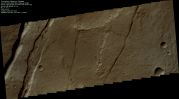
Troughs-Sirenum_Fossae-20091207a.jpgTroughs in Sirenum Fossae (Enhanced Natural Colors; credits: Lunexit)57 visitenessun commentoMareKromium
|
|

OPP-SOL2086-1M313384416EFFA9SGP2903M2M1.jpgThe Sky above Opportunity... - Sol 2086 (Natural Colors; credits: Lunexit)57 visiteNota Lunexit: la "chiazza scura" che vedete sulla Dx del frame è un artefatto derivante, con ogni probabilità, da un accumulo di polveri (o da un fenomeno di opacizzazione causato da profondo usura) sulla lente della NavCam. L'artefatto è "emerso" a seguito del procedimento di colorizzazione Multispettrale (diciamo che è l'equivalente meccanico di una - brutta- "cataratta").MareKromium
|
|

Daphnis-PIA11637.jpgHeavy Disturbances57 visiteCaption NASA:"This Cassini image, which at first appears to show a serene scene, in fact reveals dramatic disturbances created in Saturn's A-Ring by its moon Daphnis.
Near the center of the image, tiny Daphnis (about 8 Km across) appears as a bright dot in the Keeler Gap near the edge waves it has created in the A-Ring. The moon has an inclined orbit and its gravitational pull both perturbs the orbits of the particles of the A-Ring forming the Keeler Gap's edge and sculpts the edge into waves having both horizontal (radial) and out-of-plane components. Material on the inner edge of the gap orbits faster than the moon so that the waves there lead the moon in its orbit. Material on the outer edge moves slower than the moon, so waves there trail the moon.
Epimetheus (approx. 113 Km, or about 70 miles across) orbits beyond the F-Ring at the bottom of the image. Bright specks in the image are background stars.
This view looks toward the Northern, sunlit side of the Rings, from about 11° above the Ring-Plane.
The image was taken in Visible Light with the Cassini Spacecraft narrow-angle camera on Sept. 24, 2009. The view was obtained at a distance of approx. 1,8 MKM (about 1,1 MMs) from Daphnis.
Image scale is roughly 11 Km (a little less than 7 miles) per pixel".MareKromium
|
|
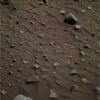
SOL2081-GB.jpgPebbles and small Sandy Dunes near Spirit - Sol 2081 (Natural Colors; credits: Dr G. Barca)57 visitenessun commentoMareKromium
|
|
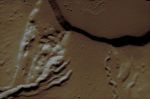
Volcanoes-Ceraunius_Tholus-00.jpgFeatures of Ceraunius Tholus (Absolute Natural Colors; credits for the additional process. and color: Dr Paolo C. Fienga - Lunexit Team)57 visiteCaption NASA originale:"This image shows part of the Summit Caldera of Ceraunius Tholus. Channels are common on the flanks of this Volcano".
Coord.: 23,9° North Lat. and 262,7° East Long.MareKromium
|
|
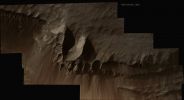
PSP_001456_1695_RED_abrowse-01.jpgLight Layered Deposits in Valles Marineris Region (EDM - Superdef. + Natural Colors; credits: Dr M. Faccin & Lunexit)57 visiteL'estrazione del dettaglio in formato JP2 e Superdefinizione è del Dr Faccin; la colorizzazione Multispettrale e la calibrazione sono del Dr Fienga. A nostro parere, il risultato si commenta da solo...MareKromium
|
|
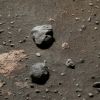
OPP-SOL2074-GB.jpgTiny Rocks and Pebbles near Opportunity - Sol 2074 (Natural Colors; credits: Dr G. Barca)57 visitenessun commentoMareKromium
|
|

PSP_001602_1700_red-00~0.jpgThe "Central Uplift" of Oudemans Crater (CTX Frame - possible Natural Colors; credits: Lunexit)57 visiteBased on estimates of the depth of excavation for a crater the size of Oudemans, these Layers originated from just as deep as those exposed in Valles Marineris and possibly deeper.
A comparison of the Layers in Valles Marineris and in the Oudemans Central Uplift may prove that they are similar rock types that share the same mode of origin. The fact that these Layers are so well intact gives planetary scientists specific clues regarding the Subsurface and history of the general area.
Additionly, three other craters, Martin (21,2° S and 290,7° E), Mazamba (27,3° S and 290,2° E) and a yet unnamed crater (28,4° S and 305° E) also possess finely Layered Materials in their Central Uplift features and lie within the circum-Tharsis Region.
The preservation of the layering and geographical occurrence of these 4 craters suggests that they could be ash layers deposited from numerous episodes from the Tharsis Volcanoes.
Voluminous volcanic episodes could have produced large volumes of Layered Rock that could have been rapidly buried and protected from cratering.MareKromium
|
|

Channel-ScamanderVallis-20070920a.jpgSinuous Channel in Scamander Vallis: image taken in September, 20th, 200757 visitenessun commentoMareKromium
|
|

Comets-Comet_Hyakutake.jpgComet Hyakutake57 visiteDa "NASA - Picture of the Day" del giorno 16 Dicembre 2009:"In 1996, an unexpectedly bright comet passed by planet Earth. Discovered less than two months before, Comet C/1996 B2 Hyakutake came within only 1/10th of the Earth-Sun distance from the Earth in late March. At that time, Comet Hyakutake, dubbed the Great Comet of 1996, became the brightest comet to grace the skies of Earth in 20 years. During its previous visit, Comet Hyakutake may well have been seen by the stone age Magdalenian culture, who 17.000 years ago were possibly among the first humans to live in tents as well as caves.
Pictured above near closest approach as it appeared on 1996 March 26, the long Ion and Dust Tails of Comet Hyakutake are visible flowing off to the left in front of a distant star field that includes both the Big and Little Dippers.
On the far left, the blue Ion Tail appears to have recently undergone a magnetic disconnection event. On the far right, the Comet's green-tinted Coma obscures a dense nucleus of melting dirty ice estimated to be about 5 Km across. A few months later, Comet Hyakutake began its long trek back to the outer Solar System.
Because of being gravitationally deflected by massive planets, Comet Hyakutake is not expected back for about 100.000 years...".MareKromium
|
|
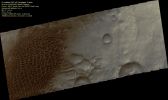
Dunes-20091211a.jpgSand-Sheet and Dunefield (Natural Colors; credits: Lunexit)57 visitenessun commentoMareKromium
|
|

OPP-SOL1160-MF1.jpgSmall Ejecta Crater near Victoria - Sol 1160 (CTX Frame - Absolute Natural Colors; credits for the additional process. and color.: Dr Marco Faccin)57 visiteIl fascino dei Crateri da Impatto (Primari e Secondari) è, a nostro avviso, indiscutibile: sono delle configurazioni del suolo alle quali, sulla Terra, NON siamo decisamente abituati...
Ed il fascino di questi rilievi, va detto, aumenta esponenzialmente allorchè i loro dettagli (anche quelli più piccoli) vengono esaminati in maniera attenta ed approfondita.
E questo è quanto fatto dal nostro Marco Faccin (sempre eccezionale e sempre "On the Edge", quando si tratta di ipotizzare la Natura dei rilievi ripresi ed esaminati): andate a vedere, infatti, che cosa appare nell'EDM che raffigura una modestissima porzione della Superficie circostante questo picclo Ejecta Crater, situato a poche centinaia di metri dal "Gigante" Victoria...MareKromium
|
|
| 25353 immagini su 2113 pagina(e) |
 |
|
|
|
|
1474 | |
|
|
|
|





