| Piú viste |

ESP_021915_1005-PCF-LXTT-1.jpgPromethei Planum (CTX Frame n.1 - Absolute Natural Colors; credits for the additional process. and color.: Dr Paolo C. Fienga - Lunexit Team)214 visiteAcquisition Date: March, 31st, 2011
Mars Local Time (M.L.T.): 15:55 (Middle Afternoon)
Latitude (centered): 79,5° South
Longitude (East): 109,4°
Range to target site: 249,2 Km
Original image Scale Range: 49,9 cm/pixel (with 2 x 2 binning) so objects ~150 cm across are resolved
Map Projected Scale: 50 cm/pixel
Map projection: POLAR STEREOGRAPHIC
Emission Angle: 3,5°
Phase Angle: 57,4°
Solar Incidence Angle (S.I.A.): 60°, with the Sun about 30° above the Local Horizon
Solar Longitude: 264,8° - Northern AutumnMareKromium
|
|
OPP-SOL474-1R170271407EFF55IZP1314L0M1-PCF-LXTT-1.jpgDeep Rover Tracks - Sol 474 (Enhanced Absolute Natural Colors; credits for the additional process. and color.: Dr Paolo C. Fienga - Lunexit Team) 214 visitenessun commentoMareKromium
|
|
vo2_413b83-PCF-LXTT.jpgFrame Viking Orbiter 2 n. 413b83 (Natural Colors; credits for the additional process. and color.: Dr Paolo C. Fienga - Lunexit Team)214 visitenessun commentoMareKromium
|
|

PSP_008710_1710_red-PCF-LXTT.jpgLava Flows in Tharsis Region (Enhanced Absolute Natural Colors; credits for the additional process. and color.: Dr Paolo C. Fienga - Lunexit Team)214 visiteThis image shows a relatively dark Lava Flow on the Tharsis Volcanic Plains, East of Arsia Mons.
The entire Region is composed of a thick stack of volcanic flows. The Lava Flow in the Northern part of the image (Sx) is distinctly darker than its surroundings, which are buried under a layer of dust.
Most of the image has a fluffy, blurry texture. This is the mantle of dust or volcanic ash that commonly coats Volcanic Regions on Mars. The Dark Flow is buried by this material along its South-Eastern boundary; it appears that the mantle is being stripped off of the flow surface. Perhaps this flow is somewhat smooth at a fine scale and traps relatively little dust.
This flow is probably young. The Western Edge of the "Dark Region" does appear to be the edge of the Lava flow, indicating that this flow is relatively high-standing. This could make it more exposed to the wind and allow the mantle to be stripped. MareKromium
|
|
Elysium_Planitia-M1103342.jpgFeatures of Elysium Planitia (Absolute Natural Colors; credits for the additional process. and color.: Dr Paolo C. Fienga - Lunexit Team)214 visitenessun commentoMareKromium
|
|

ESP_024094_1330-PCF-LXTT-00.jpgFeatures of Asimov Crater (CTX "A" - Enhanced Absolute Natural Colors; credits for the additional process. and color.: Dr Paolo C. Fienga - Lunexit Team) 214 visiteMars Local Time: 14:31 (Early Afternoon)
Coord. (centered): 46,8° South Lat. and 5,1° East Long.
Spacecraft altitude: 254,0 Km (such as about 158,8 miles)
Original image scale range: 25,4 cm/pixel (with 1 x 1 binning) so objects ~ 76 cm across are resolved
Map projected scale: 25 cm/pixel
Map projection: EQUIRECTANGULAR
Emission Angle: 6,1°
Sun-Mars-Spacecraft (or "Phase") Angle: 54,4°
Solar Incidence Angle: 58° (meaning that the Sun is about 32° above the Local Horizon)
Solar Longitude: 1,7° (Northern Spring)
Credits: NASA/JPL/University of Arizona
Additional process. and coloring: Dr Paolo C. Fienga - Lunar Explorer ItaliaMareKromium
|
|
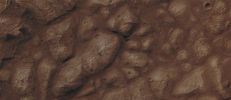
ESP_024048_1425-PCF-LXTT-05.jpgChaos Terrain (CTX "B" - Natural Colors; credits for the additional process. and color.: Dr Paolo C. Fienga - Lunexit Team)214 visiteMars Local Time: 14:24 (Early Afternoon)
Coord. (centered): 37,3° South Lat. and 178,7° East Long.
Spacecraft altitude: 253,4 Km (such as about 158,4 miles)
Original image scale range: 50,7 cm/pixel (with 2 x 2 binning) so objects ~ 1 mt and 52 cm across are resolved
Map projected scale: 50 cm/pixel
Map projection: EQUIRECTANGULAR
Emission Angle: 0,3°
Sun-Mars-Spacecraft (or "Phase") Angle: 50,1°
Solar Incidence Angle: 50° (meaning that the Sun is about 40° above the Local Horizon)
Solar Longitude: 359,9° (Northern Winter)
Credits: NASA/JPL/University of Arizona
Additional process. and coloring: Dr Paolo C. Fienga - Lunar Explorer ItaliaMareKromium
|
|
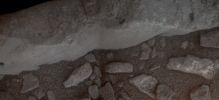
OPP-SOL2676-MF-LXTT.jpgClose View of the Surface of Meridiani Planum - Sol 2676 (an Image-Mosaic in RAW Natural Colors; credits for the additional process. and color.: Dr Marco Faccin - Lunexit Team)214 visitenessun commentoMareKromium
|
|

ESP_024584_1655-PCF-LXTT-00.jpgProximities of the Valles Marineris Canyon System (CTX Frame "A" - Absolute Natural Colors; credits for the additional process. and color.: Dr Paolo C. Fienga - Lunexit Team)214 visiteMars Local Time: 14:30 (early afternoon)
Coord. (centered): 14,2° South Lat. and 302,2° East Long.
Spacecraft altitude: 266,9 Km (such as about 166,8 miles)
Original image scale range: 53,4 cm/pixel (with 2 x 2 binning) so objects ~ 1 mt and 60 cm across are resolved
Map projected scale: 50 cm/pixel
Map projection: EQUIRECTANGULAR
Emission Angle: 6,4°
Phase Angle: 49,1°
Solar Incidence Angle: 44° (meaning that the Sun is about 46° above the Local Horizon)
Solar Longitude: 20,1° (Northern Spring)
Credits: NASA/JPL/University of Arizona
Additional process. and coloring: Lunar Explorer ItaliaMareKromium
|
|
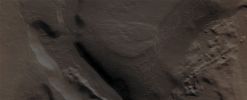
ESP_024500_2135-PCF-LXTT.jpgFeatures of Nilosyritis Planum (Absolute Natural Colors; credits for the additional process. and color.: Dr Paolo C. Fienga - Lunexit Team)214 visiteMars Local Time: 14:26 (early afternoon)
Coord. (centered): 33,0° North Lat. and 71,6° East Long.
Spacecraft altitude: 297,1 Km (such as about 185,7 miles)
Original image scale range: 29,7 cm/pixel (with 1 x 1 binning) so objects ~ 89 cm across are resolved
Map projected scale: 25 cm/pixel
Map projection: EQUIRECTANGULAR
Emission Angle: 14,0°
Phase Angle: 30,2°
Solar Incidence Angle: 43° (meaning that the Sun is about 47° above the Local Horizon)
Solar Longitude: 17,0° (Northern Spring)
Credits: NASA/JPL/University of Arizona
Additional process. and coloring: Lunar Explorer ItaliaMareKromium
|
|
SOL0059-NLA_400158041EDR_D0040000NCAM00508M-PCF-LXTT-IPF-01.jpgThe "Foggy" Inner Rim of Gale Crater - Sol 59 (Calibrated Absolute Natural Colors; credits for the additional process. and color.: Dr Paolo C. Fienga - Lunar Explorer Italia - Italian Planetary Foundation)214 visiteFrame taken at 12:15:15 Mars Local Solar TimeMareKromium
|
|

90235276_1573801446076975_3852277152716161024_n.jpgWhat came out of there?!? (Credits: MarsSurfaceAnomalies.com)214 visiteIntrigante. Un "guscio" vuoto e con frattura che "SEMBRA" tradire - se guardate bene - un impatto avvenuto dall'interno (insomma: qualcosa è "uscita" di lì). Alien, once again. Questa immagine è davvero interessante, ma ancora e sempre decontestualizzata ed introvabile nei frame originali. Per cui...MareKromium
|
|
| 25353 immagini su 2113 pagina(e) |
 |
|
|
|
|
147 | |
|
|
|
|





