| Piú viste |
SOL1254-2N237599908EFFAUCMP1936R0M1.jpgFoggy days over Gusev Crater... - Sol 125457 visitenessun commentoMareKromium
|
|
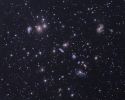
HerculesGCluster-A2151LRGB.jpgThe "Hercules' Galaxy Cluster"57 visite"...Ed è per questo che mi chiamano cinico.
Per questo mi dicono che sono freddo come il marmo di una tomba.
Solo perchè - e non senza sforzi!... - riesco a vedere la Realtà per ciò che è. Davvero.
Senza maschere.
Senza finzioni.
Senza illusioni.
Vedere ed interpretare le cose che accadono per quello che esse sono realmente, eliminando le facili speculazioni emotive, la retorica, l'ipocrisia, il quieto vivere, e tutto quanto costituisce ciò che io chiamo "Scudo dell'Io", significa essere VIVI.
Significa non aver svenduto la propria Anima al miglior offerente.
Significa avere ancora sangue nelle vene, carne sopra le ossa e pensieri nella mente.
Significa essere Uomini.
Significa, in ultima analisi, "essere liberi".
Ma l'ipocrisia...L'ipocrisia che ci avvolge, dolce, suadente e sottile, coprendo le nostre miserie con una coltre di confortevole nebbia, chiama "lupi" coloro che comprendono la Realtà.
Bene.
E allora, come lessi da qualche parte, "Se io sono realmente un lupo, guardati dalle mie zanne!"...".
P.C. Floegers - "Conversations for Tomorrow"MareKromium
|
|

South_Polar_Features-Defrosting_Dunes-2005_06-PCF-LXTT.jpgDefrosting Dunes (Natural Colors; credits for the additional process. and color.: Dr Paolo C. Fienga - Lunexit Team)57 visitenessun commentoMareKromium
|
|

The_Rings-PIA08988.jpgBright Region in the C-Ring57 visiteCaption NASA:"This bright, isolated plateau in the middle of the C-Ring displays interesting internal variations in brightness. The plateau is not high in terms of elevation, but rather in terms of its particle density (seen here as brightness), which is several times higher than the surrounding Ring Structure.
Ring scientists are working to understand what produces the sharp boundaries of the plateau features, as well as the nature of the internal variations in brightness.
This view looks toward the sunlit side of the Rings from about 18° below the Ring-Plane.
The image was taken in visible light with the Cassini spacecraft narrow-angle camera on June 12, 2007 at a distance of approx. 230.000 Km (about 143.000 miles) from Saturn. Image scale is roughly 1 Km (3353 feet) per pixel".MareKromium
|
|
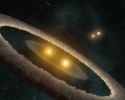
HD98800-PIA09939.jpgEvidence for Strange Stellar Family57 visiteThis artist concept depicts a Quadruple-Star System called HD 98800. The System is approx. 10 MY old, and is located 150 LY away in the constellation TW Hydrae.
HD 98800 contains four stars, which are paired off into doublets, or binaries.
The stars in the binary pairs orbit around each other, and the two pairs also circle each other like choreographed ballerinas. One of the stellar pairs, called HD 98800B, has a disk of dust around it, while the other pair does not.
Although the four stars are gravitationally bound, the distance separating the two binary pairs is about 50 astronomical units (AU) -- slightly more than the average distance between our sun and Pluto.
Using NASA's Spitzer Space Telescope, scientists finally have a detailed view of HD 98800B's potential planet-forming disk. Astronomers used the telescope's infrared spectrometer to detect the presence of two belts in the disk made of large dust grains. One belt sits approx. 5.9 AU away from the central binary, or about the distance from the sun to Jupiter, and is likely made up of asteroids and comets. The other belt sits at 1.5 to 2 AU, comparable to the area where Mars and the asteroid belt sit, and is made up of sand-sized dust grains.
MareKromium
|
|
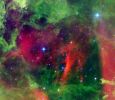
NGC-2237_and_NGC-2244.jpgHot Stars in the Rosette Nebula57 visiteWinds and radiation from massive hot stars in the Rosette Nebula have cleared the natal gas and dust from the center of the nearby star-forming region. They also pose a danger to planet forming disks around young, cooler stars in the neighborhood. This Spitzer Space Telescope (SST) infrared image of dust clouds near the Rosette's central region, shows the cleared-out cavity.
The view spans about 45 LY at the the nebula's estimated distance of 5.200 LY. MareKromium
|
|

as17-153-23589.jpgAS 17-153-23589 - Wallace Crater57 visiteImage Collection: 70mm Hasselblad
Mission: 17
Magazine: 153
Magazine Letter: MM
Revolution: 39
Latitude: 20,4° North
Longitude: 8,3° West
Lens Focal Length: 80 mm
Camera Altitude: 103 Km
Sun Elevation (on Local Horizon): 1°
Mission Activity: REV 39
Film Type: SO-368
Film Width: 70 mm
Film Color: colorMareKromium
|
|
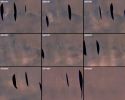
OPP-SOL1235-PIA-00937.jpgSeries of Storms Shrouds Mars in Dust (2) - NASA/JPL/Malin Space Science Systems57 visiteThis sequence of Mars Reconnaissance Orbiter (MRO) Mars Color Imager (MARCI) daily mosaics shows some of the dust storm activity that occurred near the Mars Exploration Rover (MER) Opportunity landing site between 21 June 2007 and 18 July 2007. The Opportunity rover is located near the martian prime meridian and equator. The top and middle rows of images show the first six days of dust storm activity near the rover site as dust advanced from the west to the south and passed south of the rover over the course of a week. By the end of that first week, storm activity strengthened and continued to move east, eventually passing over nearly half of the martian southern hemisphere. Other storms spawned by this atmospheric disturbance affected the MER Spirit rover on the other side of the planet, while new storms developed, approached, and affected Opportunity. The bottom three images show dust activity over the MER Opportunity site on 3, 14, and 18 July. By 19 July, most of the martian surface was obscured by the dust lofted from these storms. As with previous large dust-raising events on Mars, once the active storms die down, many weeks to months will pass before the dust settles out and the atmosphere clears. The white circle indicates the location of the Opportunity landing site, the black gaps are caused by slewing the spacecraft east or west to image specific science targets, and north in each picture is toward the top, west is to the left.
MareKromium
|
|
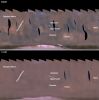
OPP-SOL1235-PIA-00936.jpgSeries of Storms Shrouds Mars in Dust (1) - NASA/JPL/Malin Space Science Systems57 visiteSince late June 2007, Mars has been having a series of regional dust storms. The dust raised by these individual storms has obscured most of the planet over the past few weeks. The two maps shown here are mosaics of images acquired by the Mars Reconnaissance Orbiter (MRO) Mars Color Imager (MARCI) on two days separated by about 3 and a half weeks. The first, on 22 June, shows that there was a dust storm occurring near the east end of the Valles Marineris trough system (left of the label for "Opportunity" in the map). This was the first in the series of storms. The second mosaic shows how Mars appeared on 17 July, after dust was lofted high into the atmosphere by several regional storms and countless smaller, local dust storms.
Each map was constructed from 13 pole-to-pole image swaths at red, green, and blue wavelengths acquired by the MRO MARCI. The maps are simple cylindrical projections, with north at the top and south at the bottom. Each image swath was acquired at about 3 p.m. local time on Mars over the course of 13 orbits. The black gaps occur in the MARCI data at places where the MRO spacecraft was slewed east or west to point its instruments at a specific target of scientific interest. The north polar region is not shown because winter began on 4 July and the north polar region is in wintertime darkness. Key features labeled on the maps include the Tharsis Montes and Olympus Mons volcanoes, the Hellas impact basin, Noachis Terra, Sinus Meridiani, and the two Mars Exploration Rover (MER) landing sites, Opportunity and Spirit. The dust storms, and the planet-encircling dust veil they generated, has greatly reduced the amount of sunlight available to run the two solar-powered rovers.
MareKromium
|
|
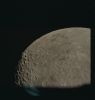
as17-152-23298.jpgAS 17-152-23298 - Mare Australe and Humboldt (elab. in true colors by Lunexit)57 visitenessun commentoMareKromium
|
|

Titan-Regions-Adiri_Region-PIA08995.jpgFlying over Adiri57 visiteCaption NASA:"Within the windswept wastes of Titan's Equatorial Dune Desert lies the 1.700-Km (1.050-mi) wide bright Region called Adiri, seen here at center.
The intrepid Huygens probe landed off the North-Eastern edge of Adiri in January 2005.
This view looks toward the Anti-Saturn side of Titan (5.150 Km, or about 3.200 miles across) -- the side that always faces away from Saturn as the moon orbits. North on Titan is up and rotated 26° to the right.
The image was taken using a spectral filter sensitive to wavelengths of infrared light centered at 939 nanometers. The view was acquired with the Cassini spacecraft wide-angle camera on June 14, 2007 at a distance of approx. 157.000 Km (about 98.000 miles) from Titan. Image scale is roughly 9 Km (about 6 miles) per pixel".MareKromium
|
|

as17-152-23328.jpgAS 17-152-23328 - Lunar Maria: Crisium and Tranquillitatis (elab. in true colors by Lunexit)57 visitenessun commentoMareKromium
|
|
| 25353 immagini su 2113 pagina(e) |
 |
|
|
|
|
1469 | |
|
|
|
|





