| Piú viste |
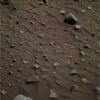
SOL2081-GB.jpgPebbles and small Sandy Dunes near Spirit - Sol 2081 (Natural Colors; credits: Dr G. Barca)57 visitenessun commentoMareKromium
|
|
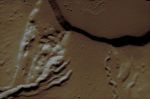
Volcanoes-Ceraunius_Tholus-00.jpgFeatures of Ceraunius Tholus (Absolute Natural Colors; credits for the additional process. and color: Dr Paolo C. Fienga - Lunexit Team)57 visiteCaption NASA originale:"This image shows part of the Summit Caldera of Ceraunius Tholus. Channels are common on the flanks of this Volcano".
Coord.: 23,9° North Lat. and 262,7° East Long.MareKromium
|
|
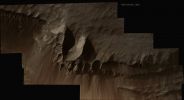
PSP_001456_1695_RED_abrowse-01.jpgLight Layered Deposits in Valles Marineris Region (EDM - Superdef. + Natural Colors; credits: Dr M. Faccin & Lunexit)57 visiteL'estrazione del dettaglio in formato JP2 e Superdefinizione è del Dr Faccin; la colorizzazione Multispettrale e la calibrazione sono del Dr Fienga. A nostro parere, il risultato si commenta da solo...MareKromium
|
|
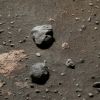
OPP-SOL2074-GB.jpgTiny Rocks and Pebbles near Opportunity - Sol 2074 (Natural Colors; credits: Dr G. Barca)57 visitenessun commentoMareKromium
|
|

PSP_001602_1700_red-00~0.jpgThe "Central Uplift" of Oudemans Crater (CTX Frame - possible Natural Colors; credits: Lunexit)57 visiteBased on estimates of the depth of excavation for a crater the size of Oudemans, these Layers originated from just as deep as those exposed in Valles Marineris and possibly deeper.
A comparison of the Layers in Valles Marineris and in the Oudemans Central Uplift may prove that they are similar rock types that share the same mode of origin. The fact that these Layers are so well intact gives planetary scientists specific clues regarding the Subsurface and history of the general area.
Additionly, three other craters, Martin (21,2° S and 290,7° E), Mazamba (27,3° S and 290,2° E) and a yet unnamed crater (28,4° S and 305° E) also possess finely Layered Materials in their Central Uplift features and lie within the circum-Tharsis Region.
The preservation of the layering and geographical occurrence of these 4 craters suggests that they could be ash layers deposited from numerous episodes from the Tharsis Volcanoes.
Voluminous volcanic episodes could have produced large volumes of Layered Rock that could have been rapidly buried and protected from cratering.MareKromium
|
|

Channel-ScamanderVallis-20070920a.jpgSinuous Channel in Scamander Vallis: image taken in September, 20th, 200757 visitenessun commentoMareKromium
|
|

Comets-Comet_Hyakutake.jpgComet Hyakutake57 visiteDa "NASA - Picture of the Day" del giorno 16 Dicembre 2009:"In 1996, an unexpectedly bright comet passed by planet Earth. Discovered less than two months before, Comet C/1996 B2 Hyakutake came within only 1/10th of the Earth-Sun distance from the Earth in late March. At that time, Comet Hyakutake, dubbed the Great Comet of 1996, became the brightest comet to grace the skies of Earth in 20 years. During its previous visit, Comet Hyakutake may well have been seen by the stone age Magdalenian culture, who 17.000 years ago were possibly among the first humans to live in tents as well as caves.
Pictured above near closest approach as it appeared on 1996 March 26, the long Ion and Dust Tails of Comet Hyakutake are visible flowing off to the left in front of a distant star field that includes both the Big and Little Dippers.
On the far left, the blue Ion Tail appears to have recently undergone a magnetic disconnection event. On the far right, the Comet's green-tinted Coma obscures a dense nucleus of melting dirty ice estimated to be about 5 Km across. A few months later, Comet Hyakutake began its long trek back to the outer Solar System.
Because of being gravitationally deflected by massive planets, Comet Hyakutake is not expected back for about 100.000 years...".MareKromium
|
|

OPP-SOL1160-MF1.jpgSmall Ejecta Crater near Victoria - Sol 1160 (CTX Frame - Absolute Natural Colors; credits for the additional process. and color.: Dr Marco Faccin)57 visiteIl fascino dei Crateri da Impatto (Primari e Secondari) è, a nostro avviso, indiscutibile: sono delle configurazioni del suolo alle quali, sulla Terra, NON siamo decisamente abituati...
Ed il fascino di questi rilievi, va detto, aumenta esponenzialmente allorchè i loro dettagli (anche quelli più piccoli) vengono esaminati in maniera attenta ed approfondita.
E questo è quanto fatto dal nostro Marco Faccin (sempre eccezionale e sempre "On the Edge", quando si tratta di ipotizzare la Natura dei rilievi ripresi ed esaminati): andate a vedere, infatti, che cosa appare nell'EDM che raffigura una modestissima porzione della Superficie circostante questo picclo Ejecta Crater, situato a poche centinaia di metri dal "Gigante" Victoria...MareKromium
|
|

KBO-2-Artist_Conception.jpgKuiper's Belt Object occulting a Star57 visiteNASA's Hubble Space Telescope has discovered the smallest object ever seen in Visible Light in the Kuiper Belt, a vast ring of icy debris that is encircling the outer rim of the Solar System, just beyond Neptune.
The needle-in-a-haystack object found by Hubble is only 3200 feet across and a whopping 4,2 Billion Miles away. The smallest Kuiper Belt Object (KBO) seen previously in reflected light is roughly 30 miles across, or 50 times larger.
This is the first observational evidence for a population of comet-sized bodies in the Kuiper Belt that are being ground down through collisions. The Kuiper Belt is therefore collisionally evolving, meaning that the region's icy content has been modified over the past 4,5 BYs.
The object detected by Hubble is so faint — at 35th magnitude — it is 100 times dimmer than what Hubble can see directly.
So then how did the space telescope uncover such a small body?MareKromium
|
|

M-042-99.jpgM 42 - Proplyds in the Great Orion Nebula57 visite"...Gli estremismi del cosiddetto "Tifo Sportivo" sono l'equivalente pagano dell'integralismo e dell'intolleranza Religiosa..."
Paolo C. FiengaMareKromium
|
|

ESP_014404_1765_RED_abrowse-01.jpgEquatorial Martian Barchans (EDM - Natural Colors; credits: NASA/JPL/Univ. of Arizona)57 visiteBarchan Dunes are common on both Earth and Mars. These Dunes are very distinctive in shape, and are important because they can tell scientists about the environment in which they formed.
Barchans form in wind regimes that blow in one Dominant Direction. The ridged arcs of sand that define the Barchan Dunes end in horns that point downwind. Sand is transported up the broad, relatively shallow windward slopes and once it overtops the Dune Crest, the sand falls down a shorter steeper slope between the horns, known as the "Slip Face". Over time, the Barchans migrate downwind, following their horns.
This HiRISE image shows an example of several Barchans merging to form an even larger Barchan Dune. This can happen through a variety of circumstances, such as when smaller, faster dunes collide with larger, slower-moving dunes that absorb them, resulting in single, larger dunes. The distance between the merging horns of the large dune in this highlighted region is a little over 500 meters (about 1600 feet).
Coord.: 3,3° South Lat. and 307,6° East Long.
Spacecraft altitude: about 268 Km
M.L.T.: 14:17 (early afternoon)
S.I.A.: 36° (with the Sun about 54° abov the Local Horizon)
MareKromium
|
|
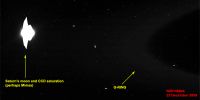
OverSaturation-N00148644.jpgOversaturation (by Elisabetta Bonora)57 visiteNon sempre la sovrasaturazione (o "sovraesposizione") - che è produttiva di una serie di image-artifacts tipici (su tutti, la cosiddetta "Light-Drop") - è il frutto di un errore: gli "oggetti a debole o debolissima luminosità", infatti, per essere evidenziati richiedono - come ben sapete - dei tempi di esposizione più lunghi del solito.
E quando poi, nel campo di ripresa, assieme all'"oggetto debole", vi è pure un "oggetto ad albedo elevata" - come in questo caso accade, rispettivamente, per l'Anello-G di Saturno e la sua luna Mimas -, ecco che l'immagine finale "sembra" venir fuori "sbagliata". Brutta e mossa, di regola (come vedete anche le stelle sono divenute, in questo frame, delle piccole "star-trails").
Ma la verità è che non si è trattato di un errore, ma di è una - oggettiva - necessità (come ben dimostra questa chiara elaborazione della nostra Elisabetta Bonora).MareKromium
|
|
| 25353 immagini su 2113 pagina(e) |
 |
|
|
|
|
1462 | |
|
|
|
|





