| Piú viste |

Ganymede-lor_0035286134_0x630_sci_1.jpgThe "obscure outline" of Ganymede (2)57 visiteDescription: Ganymede crossing crescent Jupiter
Time: 2007-03-04 03:50:16 UTC
Exposure: 80 msec
Target: GANYMEDE
Range: 5,9 MKM MareKromium
|
|
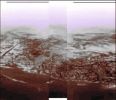
Titan-Huygens_Landing_Site-03-IMG002628-br500.jpgCoastline on Titan57 visiteThe deposits form when solar ultraviolet radiation and charged particles react at high altitudes with Titan’s abundant methane to produce carbon- and hydrogen-bearing (hydrocarbon) molecules like ethane and acetylene, and more complex nitrogen-bearing molecules generally called tholins. These products drift down to the surface as aerosols much in the same way smog particles on Earth form and coat surfaces. On Titan however these deposits may accumulate to thicknesses of hundreds of metres deep.
The dunes are composed of sand-sized material that agglomerated, either during its descent or when reworked by geological processes on the surface. The ice and organic landforms are as different from one another as they are spectacular. To the north of Huygens’ landing site are the bright highlands, displaying channels in a very ramified pattern, branching four or five times as they climb into the hills.
Stereoscopic images from the Descent Imager/Spectral Radiometer (DISR) camera on Huygens have now been analysed and show that some of the ridges between the channels rise to 150 - 200 metres in height, with slopes of thirty degrees. “This is extremely rugged terrain,” says Soderblom. The shape suggests that they are drainage channels, cut by liquid methane falling as rain.
MareKromium
|
|

Titan-Regions-Omacati_Macula_Region-01-LS28_PSS_LASoderblom_VIMSRADAR20070323.jpgDunes in the "Omacati Macula" Region57 visiteThe first two images of Titan (from the top) were obtained by Cassini’s SAR radar and the VIMS imager, respectively. They cover an area about 300 by 1000 Km wide and centred at 20° North and 45° West in the Omacatl Macula Region.
Dunes are generally rare in this area, even if some of them can still be seen in the enlargement provided by the bottom right radar image (blue arrow). These dunes are correlated to the brown spot visible in the VIMS image.
The green arrows linking the lower left radar image with the VIMS image illustrate that in this region the dark blue units are correlated to with sinuous channels and flow features.MareKromium
|
|

Titan-Huygens_Landing_Site-02-LS28_PSS_LASoderblom_VIMSRADAR20070323.jpgHuygens Probe Landing Site57 visiteThese images of the Huygens Landing Site on Titan were obtained by Cassini’s SAR radar (1st and 3rd rows) and VIMS (2nd and 4th rows) instruments, and are correlated in this composite view.
The 4 upper images show the Region of the Sinlap Crater in the Huygens Landing Site Region. The area shown is about 850 by 1150 Km wide.
The 4 lower images are colour-mapped as: red, to indicated solid dunes; yellow, to indicate a partial dune coverage; and green to indicate not mappable areas.MareKromium
|
|

Candor_Chasma_Region-01.jpgCandor Chasma: the "Noise" (EDM - Saturated Natural Colors; credits for the additional process. and color.: Dr Paolo C. Fienga - Lunexit Team)57 visitenessun commentoMareKromium
|
|

NGC-4438_and_NGC-4435.jpgInteracting Galaxies: NGC 4438 and NGC 443557 visite"...As long as our Language is inadequate, our Vision remains formless..."
Adrienne Rich - "On Lies, Secrets, and Silence" (1980)MareKromium
|
|
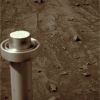
SOL1218-2P234480929EFFATF3P2558R1M1.jpgAntenna and "Home Plate" - Sol 121857 visitenessun commentoMareKromium
|
|
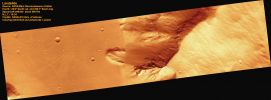
PSP_003516_1540_RED_browse.jpgLarge (and VERY Old) Landslide Deposit57 visiteThis HiRISE image is centered on a large landslide which formed the large lobe at the base of the steep slope. This is material which was transported in a massive rock-slide.
The landslide has several ridge-and-trough lineations in the direction of the flow. These occur in similar landslides on Earth as well. Comparing these features on Mars with similar examples on Earth helps geologists better understand how they work on both Planets.
In this case, the slide is relatively old.
The material has many impact craters superimposed. The steep slope, which was the source of the landslide, has undergone further erosion, so the landslide source area is no longer clear. MareKromium
|
|
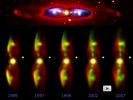
M2-9-00.jpgEvolution...57 visite"...In medio clivo laborat..."
(Petronio)
"...Chi si trova a metà (di un'opera o di un percorso) ha ancora molto da fare..."MareKromium
|
|
SOL1229-2P235474338EDNAU00P2277L6M1.jpgReflections on the Solar Panel... - Sol 1229 (Natural colors - elab. Lunexit)57 visitenessun commentoMareKromium
|
|
SOL1232-2M235734766EFFAU00P2956M2M1.jpgInteresting Soil... (3) - Sol 123257 visitenessun commentoMareKromium
|
|
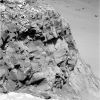
OPP-SOL1213-1P235875841EFF85MYP2444L6M1.jpgThe Inner Wall of Victoria - Sol 121357 visiteI frames relativi alle pareti interne del Cratere Victoria sono molto suggestivi ed intriganti, senza dubbio...Ma ad occhi attenti ed allenati non potranno sfuggire alcuni dettagli curiosi.
Dettagli che ci parlano, ancora una volta (e dopo parecchio tempo), di strane rocce e di gruppi di macigni che giacciono assecondando incastri ed equilibri piuttosto...strani.
Buona ricerca!MareKromium
|
|
| 25353 immagini su 2113 pagina(e) |
 |
|
|
|
|
1456 | |
|
|
|
|





