| Piú viste |

Volcanic_Features-Paterae-Peneus_Patera-PCF-LXTT.jpgClouds over Peneus Patera (Extremely Enhanced and Saturated Natural Colors; credits for the additional process. and color.: Dr Paolo C. Fienga - Lunar Explorer Italia)57 visiteCaption NASA:"Spring is the "Storm Season" in the Southern Hemisphere of Mars. This image shows several bands of Clouds over the Plains to the West of Peneus Patera".
MareKromium
|
|

PurpleRain.jpgPurple Rain (by Marco Faccin)57 visitenessun commentoMareKromium
|
|

Titan-Lakes-South_Polar_Unnamed_Lakes-PIA11147.jpgChanges in the Titanian Lakes57 visiteCaption NASA:"These mosaics of the South Pole of Saturn's moon Titan, made from images taken almost one year apart, show changes in dark areas that may be lakes filled by seasonal rains of liquid hydrocarbons.
The images on the left (unlabeled at top and labeled at bottom) were acquired July 3, 2004. Those on the right were taken June 6, 2005. In the 2005 images, new dark areas are visible and have been circled.
The very bright features are clouds in the lower Atmosphere (the Troposphere). Titan's clouds behave similarly to those on Earth, changing rapidly on timescales of hours and appearing in different places from day to day. During the year that elapsed between these two observations, clouds were frequently observed at Titan's
South Pole by observers on Earth and by Cassini's imaging science subsystem (see also PIA06124).
It is likely that rain from a large storm created the new dark areas that were observed in June 2005. Some features, such as Ontario Lacus, show differences in brightness between the two observations that are the result of differences in illumination between the two observations. These mosaics use images taken in InfraRed Light at a wavelength of 938 nanometers.
The images have been oriented with the South Pole in the center (black cross) and the 0° Meridian toward the top.
Image resolutions are several kilometers per pixel".MareKromium
|
|

Titan-Map-PIA11146.jpgUpdated Map of Titan57 visiteCaption NASA:"These updated maps of Saturn's moon Titan, consisting of data from the Cassini imaging science subsystem, include Cassini's August 2008 imaging of the moon's Northern Hemisphere.
Evidence from Cassini's imaging science subsystem, radar, and Visual and InfraRed Mapping Spectrometer instruments strongly suggests that dark areas near the Poles are lakes of liquid hydrocarbons (an analysis affirmed by images capturing those changes in the lakes thought to be brought on by rainfall).
Colored lines in the polar portions of these maps illustrate the boundaries between surface regions having different albedos — or differences in surface brightness — which Cassini scientists have interpreted as potential shorelines. Blue outlines indicate features that changed between observations made one year apart (see also PIA11147).
The top map is a simple cylindrical projection. Atmospheric effects complicate incorporation of data from high Northern Latitudes, which are shown separately in a polar view. The map at bottom left is a North Polar projection showing latitudes 55° to 90°. The bottom right map is a South Polar projection showing latitudes - 55° to - 90°.
The maps are compiled from images dating from April 2004 through August 2008, and their resolutions vary from a few meters to a few tens of kilometers per pixel. Brightness variations are due to differences in surface albedo rather than topographic shading".MareKromium
|
|

Psp_010744_1840_red.jpgSouthern Margin of Cerberus Palus (Natural Colors; credits: Lunar Explorer Italia)57 visiteMars Local Time: 15:41 (middle afternoon)
Coord. (centered): 4,0° North Lat. and 149,0° East Long.
Spacecraft altitude: 274,8 Km (such as about 171,7 miles)
Original image scale range: 27,5 cm/pixel (with 1 x 1 binning) so objects ~82 cm across are resolved
Map projected scale: 25 cm/pixel
Map projection: EQUIRECTANGULAR
Emission Angle: 4,8°
Phase Angle: 59,7°
Solar Incidence Angle: 55° (meaning that the Sun is about 35° above the Local Horizon)
Solar Longitude: 155,6° (Northern Summer)
Credits: NASA/JPL/University of Arizona
Additional process. and coloring: Lunar Explorer ItaliaMareKromium
|
|
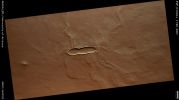
Psp_010661_1780_red.jpgShield Volcano with Leveed Channels in Noctis Fossae (possible Natural Colors; credits: Lunar Explorer Italia)57 visiteMars Local Time: 15:42 (middle afternoon)
Coord. (centered): 1,9° South Lat. and 256,3° East Long.
Spacecraft altitude: 258,3 Km (such as about 161,4 miles)
Original image scale range: 51,7 cm/pixel (with 1 x 1 binning) so objects ~1,55 mt across are resolved
Map projected scale: 50 cm/pixel
Map projection: EQUIRECTANGULAR
Emission Angle: 0,9°
Phase Angle: 56,2°
Solar Incidence Angle: 57° (meaning that the Sun is about 33° above the Local Horizon)
Solar Longitude: 152,2° (Northern Summer)
Credits: NASA/JPL/University of Arizona
Additional process. and coloring: Lunar Explorer ItaliaMareKromium
|
|

ESP_011331_1560_RED_abrowse.jpgTerrain in Eberswalde Crater (possible Natural Colors; credits: Lunar Explorer Italia)57 visiteMars Local Time: 15:54 (middle afternoon)
Coord. (centered): 23,9° South Lat. and 326,8° East Long.
Spacecraft altitude: 258,6 Km (such as about 161,6 miles)
Original image scale range: 25,9 cm/pixel (with 1 x 1 binning) so objects ~78 cm across are resolved
Map projected scale: 25 cm/pixel
Map projection: EQUIRECTANGULAR
Emission Angle: 1,3°
Phase Angle: 60,3°
Solar Incidence Angle: 61° (meaning that the Sun is about 29° above the Local Horizon)
Solar Longitude: 180,4° (Northern Autumn)
Credits: NASA/JPL/University of Arizona
Additional process. and coloring: Lunar Explorer ItaliaMareKromium
|
|
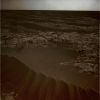
OPP-SOL1784-1N286569217EFF95RNP0723R0M1.jpgTwilights over Meridiani - Sol 1784 (natural colors; credits: Lunexit)57 visitenessun commentoMareKromium
|
|

The_Rings-PIA10571.jpgThe core of the F-Ring (Natural Colors; credits: Lunar Explorer Italia)57 visiteCaption NASA:"Structure in the tenuous F-Ring can be seen in this image of the ring's bright core.
Much of the structure in the F-Ring is created by its two shepherding moons: Prometheus (about 86 Km, or approx. 53 miles across) and Pandora (about 81 Km, or approx. 50 miles across).
The image was taken in Visible Light with the Cassini Spacecraft narrow-angle camera on Dec. 8, 2008.
The view, which looks down from about 70° above the Ring-Plane toward the unilluminated side of the Rings, was acquired at a distance of approx. 613.000 Km (about 381.000 miles) from Saturn and at a Sun-Saturn-Spacecraft, or Phase, Angle of 77°.
Image scale is roughly 3 Km (a little less than 2 miles) per pixel".MareKromium
|
|

Comets-Comet_Lulin-01.jpgStill Comet Lulin57 visiteDa "NASA - Picture of the Day" del giorno 7 Febbraio 2009:"Sweeping through the Inner Solar System, Comet Lulin is easily visible in both Northern and Southern Hemispheres with binoculars or a small telescope. Recent changes in Lulin's lovely greenish Coma and Tails are featured in this two panel comparison of images taken on January 31st (top) and February 4th, 2009.
Taken from dark New Mexico Skies, the images span over 2°. In both views the comet sports an apparent Anti-Tail at the left - the comet's Dust Tail appearing almost edge on from an earth-based perspective as it trails behind in Lulin's orbit.
Extending to the right of the coma, away from the Sun, is the beautiful Ion Tail. Remarkably, as captured in the bottom panel, Comet Lulin's Ion Tail became disconnected on February 4, likely buffeted and torn away by magnetic fields in the Solar Wind.
In 2007 NASA satellites recorded a similar disconnection event for Comet Encke. Don't worry, though: comet tails can grow back".MareKromium
|
|
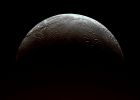
Enceladus-PIA10573.jpgCrescent Enceladus (Natural Colors; credits: Lunar Explorer Italia)57 visiteCaption NASA:"Sunrise uncovers both old and new Enceladus in this image from the Cassini Spacecraft. The lit side of the moon faces Saturn in this view of the Trailing Hemisphere. Old craters still pockmark the Northern Hemisphere while more recent geologic activity has swept them away in the South. North is on the right (Dx) in this image.
Mountain Ranges, a.k.a. "Dorsae", undulate across the moon's surface near the Equator.
From this high northern viewing angle, the South Pole's fascinating "Tiger Stripe Area" lies just out of view. Sulci, a.k.a. "furrows", in that area, are the sources of icy plumes being studied by Cassini scientists.
(See also PIA07800 and PIA09761).
Also near the Tiger Stripes are rift segments that resemble the zigzag patterns seen on Earth of sea-floor spreading from upwelling magma. See PIA11138 for a comparison of the phenomena.
Like outstretched fingers, the Samarkand Sulci reach from the West toward the North Pole, clearing their path of craters and slicing some in half.
This Natural Colors mosaic combines narrow-angle camera images obtained through UltraViolet, Green, and near-InfraRed camera filters. The images were acquired on Dec. 2, 2008 at a distance of approx. 124.000 Km (such as about 77.000 miles) from Enceladus and at a Sun-Enceladus-Spacecraft, or Phase, Angle of 116°.
Image scale is roughly 742 meters (2430 feet) per pixel".MareKromium
|
|
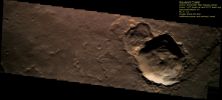
Craters-Unnamed_Crater-20080218a-PCF-LXTT.jpgNot Round... (Enhanced Natural Colors; credits for the additional process. and color.: Dr Paolo C. Fienga - Lunexit Team)57 visiteCaption NASA:"There are several reasons that an impact crater may end up not being round. Preexisting faults and fractures in the ground can control how the impact energy is distributed, resulting in corners or straight walls along the fracture trends. Very low angle impacts (from 5 up to 12°) can 'skip' along the surface, creating an elongated crater".
MareKromium
|
|
| 25353 immagini su 2113 pagina(e) |
 |
|
|
|
|
1453 | |
|
|
|
|





