| |
| Piú viste |

APOLLO_15_AS_15-85-11447_HR-2.jpgAS 15-85-11447 - Hill 305 and Station 2 Boulder (2)57 visiteGrazie al Dr Gianluigi Barca, che ha rapidamente rintracciato la versione originale e non compressa di questo interessantissimo frame, possiamo ora svolgere qualche nuova considerazione, così come suggeritoci dal nostro Amico "Ufologo". Allora: il boulder che vediamo è, molto probabilmente, un ejecta-boulder - anche se la NASA non si è sbilanciata al riguardo. Il fatto che non sia visibile una depressione al di sotto di esso è, effettivamente, un dato curioso, ma non impossibile da spiegare. Voi sapete che la profondità dei crateri secondari, formati proprio dagli ejecta-boulders, è già di per se stessa inferiore (MOLTO inferiore!) alla profondità dei crateri primari. Questo perchè la velocità di impatto di un ejecta-boulder sulla superficie di un Corpo Celeste è di gran lunga inferiore alla velocità di impatto di un bolide che arriva dallo Spazio; ma non solo: occorre considerare anche dati quali le dimensioni e la massa dell'ejecta-boulder in rapporto alla tessitura, consistenza e resistenza del terreno su cui va ad impattare. E che dire poi del tempo intercorso fra impatto dell'ejecta-boulder ed individuazione di quest'ultimo? Quanto più i crateri (sìano essi primari o secondari) sono antichi, tanto più i loro bordi (rim) tendono a cancellarsi (ad essere ricoperti o a franare), ora in ragione dell'azione di agenti atmosferici e geologici (come accade su Marte e come, forse, in un tempo remoto accadeva sulla Luna stessa), ora a causa di fenomeni di gravity-wasting. E così via.
I fattori considerabili sono tanti, ma già questi sono sufficienti per azzardare un'ipotesi: l'ejecta-boulder che vediamo in questo extra-detail mgnf "sembra" posato al suolo e non "precipitato" al suolo perchè:
1) l'ejecta-boulder ha dimensioni modestissime e la velocità di impatto era presumibilmente bassa;
2) la resistenza del suolo era alta e, comunque, l'urto è stato - sostanzialmente - elastico (e cioè l'ejecta-boulder NON si è frantumato ed il suolo ha "assorbito" l'urto senza cedere);
3) l'evento che ha portato l'ejecta-boulder là dove lo vediamo adesso, è un evento antichissimo (forse qualche milione di anni): un tempo tale per cui quelli che potevano essere i minuscoli "rim" di un mini-cratere secondario (ammesso che cratere e rim esistessero in origine) si sono ridotti in polvere.
E' un'ipotesi, certo, ed è altrettanto certo che sia discutibile. Ma è un'ipotesi razionale e, tutto sommato, credibile.
Alle ipotesi esotiche (che pure ci piacciono, molto spesso), in qualità di Ricercatori Professionisti, noi possiamo e dobbiamo arrivare SOLO da aver escluso/rigettato tutte quelle ipotesi non-esotiche che possono essere impiegate per interpretare una qualsiasi fenomenologia.
Insomma, il mix lo conoscete: razionalità e pragmatismo, ma occhi aperti. Sempre.
Grazie al Dr Barca per il prezioso supporto ed all'Amico Ufologo per lo spunto che ci ha fornito!MareKromium
|
|

Comets-Comet_Holmes-UZ-0.jpgComet 17-P-Holmes, from HST57 visiteCaption NASA:"These images taken by NASA's Hubble Space Telescope reveal Comet Holmes's bright core. The images show that the coma, the cloud of dust and gas encircling the comet, is getting fainter over time. The coma was brightest in the Oct. 29 image. It is two times fainter on Oct. 31 and nine times dimmer on Nov. 4 than during the Oct. 29 observation.
The coma is getting fainter because it is expanding. A huge number of small dust particles was created during the Oct. 23 outburst. Since then those particles have been moving away from the nucleus and filling interplanetary space.
The coma therefore is becoming more diffuse over time.
The nucleus, however, is still active and is producing a significant amount of new dust. So the region around the nucleus is still much brighter (at least 10 times brighter) than it usually is at this point in the comet's orbit.MareKromium
|
|

PSP_005571_0950_RED_abrowse-01.jpgSouth Polar Residual Cap Margin (extra-detail mgnf; MULTISPECTRUM - elab. Lunexit)57 visiteIn this extra-detail mgnf one can see fractures in the Residual Cap ice near the margin and, farther in, circular depressions that, in some places, appear to have coalesced.
These depressions constitute what is called "Swiss Cheese Terrain" and it's fairly easy to see why. The Swiss cheese terrain is created when the CO2 goes directly from the solid state (ice) to a gaseous state (the more familiar CO2 gas) as temperatures warm during South Polar Summer.
Swiss Cheese Formation may also be linked in a complicated way to the behavior of major Martian Dust Storms.
Images like these, taken before and after dust storm events, can aid our understanding of that complicated relationship.MareKromium
|
|

NGC-1333~0.jpgNGC 1333 - Stardust in Perseus57 visite"...Stet quicumque volet potens aulae culmine lubrico,
Me dulcis saturet quies. Obscuro positus loco
Leni perfruar otio. Nullis nota Quiritibus
Aetas per tacitum fluat. Sic cum transierint mei
Nullo cum strepitu dies, plebeius moriar, sed senex..."
(Seneca)
"...Stia chi vuole nella somma e perigliosa dimora dei Re; a me basta la quiete.
Celato, in un luogo remoto, godrò dolce riposo, mentre nessun Romano che ami la fama della città in cui vive potrà godere della tranquillità.
E così scorrendo i miei giorni, senza rumori, morirò plebeo; ma vecchio..." (trad. libera)MareKromium
|
|
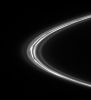
The_Rings-PIA09782.jpgPrometheus' Trail57 visiteCaption NASA:"Seen here is the end result of the process that occurs every time the moon Prometheus closely approaches Saturn's F-Ring. The moon cuts a dark channel in the ring's inner edge that then shears out over successive orbits, giving the inner edge of the ring the grooved appearance seen here.
This process is described in detail, along with a movie of Prometheus creating one of the streamer/channel features, in Soft Collision.
The view is toward the sunlit side of the Rings from about 3° below the Ring-Plane.
The image was taken in visible light with the Cassini spacecraft narrow-angle camera on Oct. 25, 2007. The view was acquired at a distance of approx. 624.000 Km (such as about 388000 miles) from Saturn and at a Sun-Ring-Spacecraft, or phase, angle of 23°.
Image scale is roughly 3 Km (about 2 miles) per pixel".MareKromium
|
|

APOLLO_15_-_AS_15-87-11725.jpgAS 15-87-11725 - Mare Ingenii and Thomson Crater57 visitenessun commentoMareKromium
|
|

Phobos_Deimos-PIA10117.jpgCRISM Views Phobos and Deimos57 visiteThese 2 images taken by the Compact Reconnaissance Imaging Spectrometer for Mars (CRISM) show Mars' 2 small moons, Phobos and Deimos, as seen from the MRO's low orbit around Mars. Both images were taken while the spacecraft was over Mars' night side, with the spacecraft turned off its normal nadir-viewing geometry to glimpse the moons. The image of Phobos, shown at the top, was taken at 01:19 UTC on October 23, 2007 (19:19 EDT on Oct. 22), and shows features as small as 400 mt (1320 feet) across. The image of Deimos, shown at the bottom, was taken at 20:16 UTC (00:16 EDT) on June 7, 2007, and shows features as small as 1,3 Km (0,8 miles) across.
Both CRISM images were taken in 544 colors covering 0.36-3.92 micrometers and are displayed at twice the size in the original data for viewing purposes.
Phobos and Deimos are about 21 and 12 Km (13,0 and 7,5 miles) in diameter and orbit Mars with periods of 7 hours, 39,2 minutes and 1 day, 6 hours, 17,9 minutes respectively. Because Phobos orbits Mars in a shorter time than Mars' 24 hour, 37.4-minute rotational period, to an observer on Mars' surface it would appear to rise in the West and set in the East. From Mars' surface, Phobos appears about one-third the diameter of the Moon from Earth, whereas Deimos appears as a bright star. The moons were discovered in 1877 by the astronomer Asaph Hall, and as satellites of a planet named for the Roman God of War, they were named for Greek mythological figures that personify fear and terror.
The first spacecraft measurements of Phobos and Deimos, from the Mariner 9 and Viking Orbiter spacecraft, showed that both moons have dark surfaces reflecting only 5 to 7% of the sunlight that falls on them. The first reconstruction of the moons' spectrum of reflected sunlight was a difficult compilation from 3 different instruments, and appeared to show a flat, grayish spectrum resembling carbonaceous chondrite meteorites. Carbonaceous chondrites are primitive carbon-containing materials thought to originate in the outer part of the Asteroid Belt. This led to a commonly held view among planetary scientists that Mars' moons are primitive asteroids captured into Martian orbit early in the Planet's history. More recent measurements have shown that the moons are in fact relatively red in their color, and resemble even more primitive D-type asteroids in the outer Solar System.
Those ultra-primitive bodies are also thought to contain carbon as well as water ice, but to have experienced even less geochemical processing than many carbonaceous chondrites.
The version of the CRISM images shown here were constructed by displaying 0.90, 0.70, and 0.50 micrometer wavelengths in the red, green, and blue image planes. This is a broader range of colors than is visible to the human eye, but it accentuates color differences. Both moons are shown with colors scaled in the same way.
Deimos is red-colored like most of Phobos. However, Phobos' surface contains a second material, grayer-colored ejecta from a 9-Km (5,6-mile) diameter crater.
This crater, called Stickney, is located at the upper left limb of Phobos and the grayer-colored ejecta extends toward the lower right.
These CRISM measurements are the first spectral measurements to resolve the disk of Deimos, and the first of this part of Phobos to cover the full wavelength range needed to assess the presence of iron-, water-, and carbon-containing minerals.MareKromium
|
|
SOL003-2P126632747EFF0200P2899L6M1.jpgEarly Soles... - Sol 3 (natural colors; elab. Dr Marco Faccin)57 visitenessun commentoMareKromium
|
|
OPP-SOL330.jpgMulticolored Reflections or just "something else"? - Sol 330 (credits: Dr Marco Faccin)57 visitenessun commentoMareKromium
|
|

NGC-6397.jpgNGC 6397 - Globular Star Cluster57 visite"...Magna debet esse Eloquentia quae invitis placeat..."
(Seneca)
"...Per piacere anche ai nemici, l'Eloquenza deve essere somma..."MareKromium
|
|

SOL1368-mic-spirit-1.jpgScraping the Rocks (1) - Sol 1368 (natural colors; elab. Dr Marco Faccin)57 visitenessun commentoMareKromium
|
|

Atlas_Pan-PIA08405.jpgJust like Flying Saucers: Atlas and Pan57 visiteCaption NASA:"These HR images of Pan and Atlas reveal distinctive "flying saucer" shapes created by prominent Equatorial Ridges not seen on the other small moons of Saturn.
From left to right: a view of Atlas' Trailing Hemisphere, with North up, at a spatial scale of about 1 Km (0,6 mile) per pixel; Atlas seen at about 250 meters (820 feet) per pixel from Mid-Southern Latitudes, with the Sub-Saturn Hemisphere at the top and Leading Hemisphere to the left; Pan's Trailing Hemisphere seen at about 3 Km (about 2 miles) per pixel from low Southern Latitudes; an Equatorial view, with Saturn in the background, of Pan's Anti-Saturn Hemisphere at about 1 Km (0.6 mile) per pixel.
On Atlas, the ridge extends 20 to 30° in latitude on either side of the Equator; on Pan, its latitudinal extent is 15 to 20°. Atlas shows more asymmetry than Pan in having a more rounded ridge in the Leading and Sub-Saturn Quadrants.
The heights of the Ridges can be crudely estimated by assuming (ellipsoidal) shapes that lack ridges and vary smoothly cross the Equator. Heights of Atlas' Ridge range from about 3 Km (about 2 miles) at 270° West Long. to 5 Km (approx. 3 miles) at 180 and 0°. Pan's Ridge reaches about 4 Km (about 2,5 miles) at 0° West Long. and is about 1,5 Km (0,9 mile) high over most of the rest of the Equator.
The ridges represent about 27% of Atlas' volume and 10% of Pan's volume.
The images were acquired with the Cassini Spacecraft narrow-angle camera between 2005 and 2007. Pan is about 33 Km (apprx. 20,5 miles) across at its Equator and about 21 Km (approx. 13 miles) across at its Poles; Atlas is 39 Km (such as about 24 miles) across at its Equator and 18 Km (approx. 11 miles) across at its Poles".MareKromium
|
|
| 25353 immagini su 2113 pagina(e) |
 |
|
|
|
|
1451 | |
|
|
|
|
|
|





