| Piú viste |

vo2_428b60-PCF-LXTT.jpgFrame Viking Orbiter 2 n. 428b60 (Natural Colors; credits for the additional process. and color.: Dr Paolo C. Fienga - Lunexit Team)215 visitenessun commentoMareKromium
|
|

053-Vesta-PIA14312.jpgFeatures of 4- Vesta (Saturated Absolute Natural Colors; credits for the additional process. and color: Dr Paolo C. Fienga - Lunexit Team)215 visiteCaption NASA:"NASA's Dawn Spacecraft obtained this image of the giant Asteroid 4-Vesta with its framing camera on July, 9, 2011. It was taken from a distance of about 26.000 miles (approx. 41.000 Km). 4-Vesta is also considered a "protoplanet" because it is a large body that almost became a planet. Each pixel in the image corresponds to roughly 2,4 miles (about 3,8 Km).
The Dawn mission to 4-Vesta and 1-Ceres is managed by the Jet Propulsion Laboratory, for NASA's Science Mission Directorate, Washington, D.C. It is a project of the Discovery Program managed by NASA's Marshall Space Flight Center, Huntsville, Ala. UCLA, is responsible for overall Dawn mission science. Orbital Sciences Corporation of Dulles, Va., designed and built the Dawn Spacecraft!".
MareKromium
|
|

Aeolian_features-Yardangs-2-s_015_050504_0143_4_3d_01_Yardangs_FAZ-PCF-LXTT.jpgWind-Lanes (Absolute Natural Colors; credits for the additional process. and color.: Dr Paolo C. Fienga - Lunexit Team)215 visiteCaption ESA originale:"Loose sand fragments were transported by wind, and impacted on the Bedrock, slowly removing parts of the Surface, like a sand-blaster. If the winds blow in the same direction for a long enough period, ‘Wind-Lanes’, as shown in the picture, can occur. On Earth, the remnants of these features which have not been eroded away are called ‘Yardangs’. Where the Surface consists of more resistant material, the force of the wind may not be strong enough to cause this sand-blasting. This might be the reason for the three flat regions (the first in the foreground on the left, and the other two on the top right), which measure about 17 by 9 Km".MareKromium
|
|
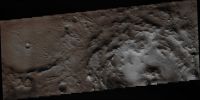
Craters-Unnamed_Crater_with_Dark_Slope_Streaks-PIA14997-PCF-LXTT.jpgOld and Highly Degraded Unnamed Northern Crater (Enhanced and Sharpened Absolute Natural Colors; credits for the additional process. and color.: Dr Paolo C. Fienga - Lunexit Team)215 visiteOrbit Number: 43578
Latitude: 21,5399° North
Longitude: 31,9211° East
Instrument: VIS
Captured: October, 11th, 2011
Mars Local Time (M.L.T.): 12:39 (Early Afternoon)
MareKromium
|
|

ESP_024048_1425-PCF-LXTT-01.jpgChaos Terrain (CTX "B" - Enhanced Absolute Natural Colors; credits for the additional process. and color.: Dr Paolo C. Fienga - Lunexit Team)215 visiteMars Local Time: 14:24 (Early Afternoon)
Coord. (centered): 37,3° South Lat. and 178,7° East Long.
Spacecraft altitude: 253,4 Km (such as about 158,4 miles)
Original image scale range: 50,7 cm/pixel (with 2 x 2 binning) so objects ~ 1 mt and 52 cm across are resolved
Map projected scale: 50 cm/pixel
Map projection: EQUIRECTANGULAR
Emission Angle: 0,3°
Sun-Mars-Spacecraft (or "Phase") Angle: 50,1°
Solar Incidence Angle: 50° (meaning that the Sun is about 40° above the Local Horizon)
Solar Longitude: 359,9° (Northern Winter)
Credits: NASA/JPL/University of Arizona
Additional process. and coloring: Dr Paolo C. Fienga - Lunar Explorer ItaliaMareKromium
|
|

PSP_007547_1895_RED_abrowse-04.jpgFeatures of Shalbatana Vallis (EDM n.3 - Absolute Natural Colors; credits for the additional process. and color.: Dr Paolo C. Fienga - Lunexit Team)215 visiteMareKromium
|
|

ESP_024584_1655-PCF-LXTT-01.jpgProximities of the Valles Marineris Canyon System (CTX Frame "B" - Absolute Natural Colors; credits for the additional process. and color.: Dr Paolo C. Fienga - Lunexit Team)215 visiteMars Local Time: 14:30 (early afternoon)
Coord. (centered): 14,2° South Lat. and 302,2° East Long.
Spacecraft altitude: 266,9 Km (such as about 166,8 miles)
Original image scale range: 53,4 cm/pixel (with 2 x 2 binning) so objects ~ 1 mt and 60 cm across are resolved
Map projected scale: 50 cm/pixel
Map projection: EQUIRECTANGULAR
Emission Angle: 6,4°
Phase Angle: 49,1°
Solar Incidence Angle: 44° (meaning that the Sun is about 46° above the Local Horizon)
Solar Longitude: 20,1° (Northern Spring)
Credits: NASA/JPL/University of Arizona
Additional process. and coloring: Lunar Explorer ItaliaMareKromium
|
|
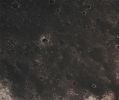
ESP_024556_2045-PCF-LXTT-00b.jpgFeatures of Mawrth Vallis (CTX Frame "B" - Absolute Natural Colors; credits for the additional process. and color.: Dr Paolo C. Fienga - Lunexit Team)215 visiteMars Local Time: 14:24 (early afternoon)
Coord. (centered): 24,1° North Lat. and 342,5° East Long.
Spacecraft altitude: 286,8 Km (such as about 179,2 miles)
Original image scale range: 28,7 cm/pixel (with 1 x 1 binning) so objects ~ 86 cm across are resolved
Map projected scale: 25 cm/pixel
Map projection: EQUIRECTANGULAR
Emission Angle: 0,3°
Phase Angle: 38,2°
Solar Incidence Angle: 38° (meaning that the Sun is about 52° above the Local Horizon)
Solar Longitude: 19,1° (Northern Spring)
Credits: NASA/JPL/University of Arizona
Additional process. and coloring: Lunar Explorer ItaliaMareKromium
|
|
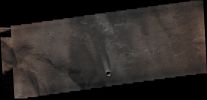
Aeolian_Features-Windstreaks-DP-PIA15167-PCF-LXTT.jpgWindstreak in Daedalia Planum (Absolute Natural Colors; credits for the additional process. and color.: Dr Paolo C. Fienga - Lunexit Team)215 visiteOrbit Number: 43797
Latitude: 8,04853° South
Longitude: 221,555° East
Instrument: VIS
Captured: October, 29th, 2011
Mars Local Time (M.L.T.): 11:02 (Late Morning Hours)MareKromium
|
|
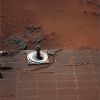
OPP-SOL2855-PCF-LXTT.jpgWaiting for the Winter... - Sol 2855 (Absolute Natural Colors; credits for the additional process. and color: Dr Paolo C. Fienga - Lunexit Team)215 visitenessun commentoMareKromium
|
|

W-Possible_UFO-153861023_5401826013191553_8165356506997056401_n.jpgVERY interesting!215 visitenessun commentoMareKromium
|
|

APOLLO 11 AS 11-39-5742ANOMALY.jpgAS 11-39-5742 - A star over the Sea of Tranquillity (1)214 visiteMolto bassa rispetto all'orizzonte Lunare e posta leggermente a Sn dell'Osservatore, si può chiaramente vedere un punto luminoso nel cielo. Questo NON è un difetto dell'immagine ed il frame originale e non compresso conferma l'esistenza del punto luminoso. Potrebbe essere una stella, ma non sapremmo dire quale. In ogni caso, questa immagine dimostra, ancora una volta, che il cielo della Luna che appare nelle foto degli astronauti NON è sempre "nero come la pece", anzi. Il punto è che bisogna saper guardare.
|
|
| 25353 immagini su 2113 pagina(e) |
 |
|
|
|
|
145 | |
|
|
|
|





