| Piú viste |

as15-86-11607-1.jpgAS 15-86-11607 - The "Glass Sphere" (extra-detail mgnf)57 visitenessun commentoMareKromium
|
|
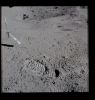
as15-86-11642.jpgAS 15-86-11642 - Gnomon & Bootprint (2)57 visiteCaption NASA:"Dave (Scott) stepped to his right to get this stereo companion to 11641".MareKromium
|
|

LunarEclipses.jpgEclipses...57 visiteCaption NASA, da "NASA - Picture of the Day", del 29 Febbraio 2008:"Welcome to the extra day in the Gregorian Calendar's leap year 2008! To celebrate, consider this grid of lunar eclipse pictures - starting in leap year 1996 and ending with February's eclipse - with the date in numerical year/month/day format beneath each image. Mostly based on visibility from a site in Turkey, the 3x4 matrix includes 11 of the 13 total lunar eclipses during that period, and fills out the grid with the partial lunar eclipse of September 2006. Still, as the pictures are at the same scale, they illustrate a noticeable variation in the apparent size of the eclipsed Moon caused by the real change in Earth-Moon distance around the Moon's elliptical orbit. The total phases are also seen to differ in color and darkness. Those effects are due to changes in cloud cover and dust content in the atmosphere reddening and refracting sunlight into Earth's shadow. Of course, the next chance to add a total lunar eclipse to this grid will come at the very end of the decade".MareKromium
|
|

SOL1473-2M257129600EFFAY00P2936M2M1.jpgWhat's on Spirit Solar Panels? (2) - Sol 147357 visitenessun commentoMareKromium
|
|
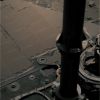
SOL1446.jpgSpirit's "dusty" Solar Panels - Sol 144657 visitenessun commentoMareKromium
|
|
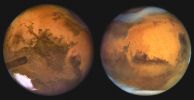
MARS-000.jpgMars: the Orange, Greenish, Bluish, Gray and White Planet (True Colors; credits: NASA)57 visitenessun commentoMareKromium
|
|

017-Mars_Crustal_Magnetism.jpgMars Crustal Magnetism57 visiteThe Mars Global Surveyor spacecraft carried a Magnetometer, the MAG/ER.
During MGS's aerobraking procedure, the MAG/ER found that Mars does not have a global Magnetic Field like the Earth does, but large areas are strongly magnetic.
There are few good ideas of what this magnetism means, although plate tectonic processes do not seem likely. The area of Magnetic Anomalies seems to make a girdle around Mars, and this is (at least partly) because that's where MGS's orbit took it closest to Mars during aerobraking.MareKromium
|
|
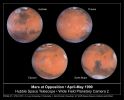
MARS-001.jpgMars from Hubble Space Telescope57 visiteThe Hubble Space Telescope has taken lovely images of Mars, which complement the MOC Atlas Mercator Projection. This image montage is from Mars' 1999 oppoxition.MareKromium
|
|
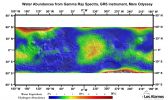
023-Mars_Water-2.jpgWhere is the "Water" of Mars? (Equatorial and Middle Latitude Regions)57 visiteA Neutron Spectrometer on the Mars Odyssey Spacecraft measures the abundances of neutrons of various energies emitted from Mars' Surface.
The ratio of low- to high-energy neutrons is a sensitive test of water abundances within a meter of Mars' surface.
There is LOTS of water. No one had expected any where near this much water near the Martian Surface.
All this is BETTER described in a press release from the Los Alamos National Laboratory, home of the Neutron Spectrometer and the scientists who run it (http://www.lanl.gov/news/releases/archive/03-101.shtml). MareKromium
|
|
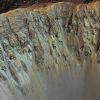
PSP_007151_1445_RED_abrowse-01.jpgColorful Layers in the Walls of an Unnamed Southern Crater (extra-detail mgnf - MULTISPECTRUM; credits: Lunexit)57 visiteThis extra-detail mgnf (enhanced to exaggerate color contrast) shows part of the North-facing walls of the crater, deeply carved by landslides. Rocky layers, mostly purplish in color, can be followed for hundreds of meters, poking through the loose materials that cover the slopes.
Locally, the rocky layers show patches of diverse colors (blue, green, yellow). These colors may be indicative of compositional differences in the rocky layers.MareKromium
|
|

ZO-Mercury21_Messenger-big.jpgCrescent Mercury (in Accentuated Colors; credits: NASA)57 visiteCaption NASA:"The colors of Mercury are subtle but beautiful. At first glance, our Solar System's innermost Planet appears simply black and white, but images that include IR colors normally beyond human vision accentuate a world of detail. One such image, shown above, was acquired by the robotic MESSENGER Spacecraft that swung by Mercury in mid-January 2008.
Here, most generally, the hot world itself acquires a slightly more brown hue. Many craters that appear on top of other craters - and so surely have formed more recently - appear here as bright with bright rays that include a slightly blue tint, indicating that soil upended during the impact was light in color. A few craters, such as some in the huge Caloris Basin impact feature visible on the upper right, appear unexpectedly to be ringed with a dark material, the nature of which is being researched.
MESSENGER continues to glide through the inner Solar System and will pass Mercury again this October and next September, before entering orbit around the desolate world in 2011".MareKromium
|
|

PSP_006673_1600_RED_abrowse.jpgBright Material on the Floor of an Unnamed Crater (natural colors; credits: Lunexit)57 visiteThis image shows part of a crater wall and floor, where the floor is covered by dunes and distinct regions of bright material. The bright material stands higher than the rest of the floor suggesting that it is more resistant to erosion than surrounding materials.
It is possible that more and more bright material will be exposed over time; why the material is bright is unknown.
The material might be evaporites, that form when salt water dries up and leaves behind salt deposits (the evaporites).
Also in this scene is a crater with a ridge running up to its west (left) side. The ridge is lighter and might be evidence that water flowed through it, bleaching the rocks as it went. The water might have cemented the soil, causing it to be more resistant to erosion and high standing as seen today.MareKromium
|
|
| 25353 immagini su 2113 pagina(e) |
 |
|
|
|
|
1438 | |
|
|
|
|





