| Piú viste |
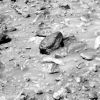
SOL430-2P164540149ESFA8B3P2595R3M1~0.JPGUnusual stones from Sol 430 (3)57 visiteIl ragionamento in questione attiene la cosiddetta "omogeneità" di specie. Pensate ad una pietraia terrestre posta in riva al mare, ad una posta nelle prossimità di un fiume o di un lago e ad un'altra ancora situata in un deserto o magari alle pendici di una montagna. Al di là della diversa composizione chimico/fisica delle rocce componenti le diverse pietraie, non sarà difficile notare che le rocce che formano ciascuna di esse, nel loro lato esteriore ed apparente, pur essendo ben diverse da quelle che si trovano in ognuna delle altre, sono fra loro simili.
In altre parole: pur essendo le pietraie - ergo le pietre che le formano - fra loro diverse (MOLTO diverse), le pietre che formano ciascuna pietraia sono, fra loro, simili (MOLTO simili).
E allora come mai, dicono alcuni, le "Pietraie Marziane" accomunano rocce così tanto dissimili fra loro? Di risposte valide e logiche ce ne sarebbero centinaia, probabilmente, ma l'obiezione, in sè, non è infondata:...
|
|

Saturn-tilted.jpgTilted Saturn57 visiteCaption NASA originale:"Saturn's whirling vortices and feathery cloud bands are the signs of a restless world. Cassini captured this arresting view of the giant planet scored by bold shadows cast by the rings. The rings are seen edge-on in this dramatic, artfully tilted scene.
The image was taken with the Cassini spacecraft wide-angle camera on March 6, 2005, at a distance of approx. 1,7 MKM (1 MMs) from Saturn through a filter sensitive to wavelengths of infrared light centered at 750 nnmts. The image scale is 10 Km per pixel".
|
|
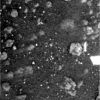
SOL431-2M164621116EFFA8B3P2957M2M1.JPGCristals in the ground?57 visiteL'immagine è decisamente sfuocata e la qualità intrinseca dei frames che ci arrivano dal Microscopic Imager sembra essere in netto calando. Ciò nonostante, alcuni dettagli del suolo Marziano su cui il Rover Spirit si sta muovendo ci sembrano apparire con una discreta chiarezza: innanzitutto i detriti di colore chiaro e di forma vagamente rotondeggiante che si vedono in giro non paiono avere proprio nulla in comune con i cosiddetti "Martian Berries" che ricoprono Meridiani Planum; in secondo luogo, così confermando quanto già rilevato in passato, ci sembra che il terriccio sia piuttosto ricco di piccoli frammenti cristallini (forse un tipo di quarzo?). Non sappiamo che cosa sia, invece, la macchia luminosa bianca visibile alla Dx del frame (potrebbe trattarsi di una piccola roccia bianca sovraesposta come di un artefatto fotografico).
|
|

Janus-PIA06612.jpgJanus rides the Rings57 visiteCaption NASA originale:"Cassini was nearly in the plane of Saturn's Rings when it took this image of Janus. The nearly edge-on rings appear almost ribbon-like in this view and some surface detail is visible on the small moon. The image was taken in visible light with the Cassini spacecraft narrow-angle camera on Feb. 18, 2005, at a distance of approximately 911.000 Km from Janus and at a phase angle of 101°. The image scale is 5 Km per pixel".
|
|
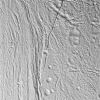
Enceladus-PIA06215.jpgCracks on Enceladus (and possible Anomaly)57 visiteCaption NASA originale:"This view of Enceladus shows an area that has undergone a very intriguing sequence of events. The craters here are subdued, as seen elsewhere on Enceladus and most, but not all, are older than the fractures. Fracturing has occurred at a wide variety of scales, from the wide rift running through the center of the image to much narrower sets of shorter fractures that crosscut the craters (and each other) to the left. This region is a transition from cratered to wrinkled terrain. Westward (left) of the central rift that divides the 2 regions are relatively parallel grooves and ridges that are reminiscent of terrain on Jupiter's large moon Ganymede. Very few craters are seen in this area of Enceladus. Right of the large rift the terrain becomes more cratered, although the craters are quite degraded. A prominent fracture runs North-South to the center of the image".
Nota: guardate bene che cosa c'è all'interno di questo crepaccio, in alto, proprio a ridosso del bordo superiore del frame!
|
|

SOL043-2N130196948EFF0700P1835L0M1.jpgThe "Sitting Eagle" - Sol 4357 visiteIl boulder (---> macigno) che si vede ad una ventina di metri dal Rover ha una forma davvero bizzarra e, da questo punto di vista, ci ricorda un grosso rapace accovacciato. Noi lo abbiamo quindi battezzato "Sitting Eagle", ma se a Voi non piacesse...Potete cambiarlo: non ci sono diritti di esclusiva e copyright sulle rocce di Marte!
Per ora...
|
|
OPP-SOL409-1P164492976EFF5100P2291R2M1.jpgPanorama - Sol 409 (2)57 visitenessun commento
|
|
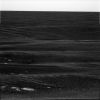
OPP-SOL409-1P164494649EFF5100P2291L1M1.jpgPanorama - Sol 409 (5)57 visiteSi tratta solo di un leggero avvallamento (che Opportunity dovrà aggirare, molto probabilmente), oppure questo è un altro cratere di modestissime dimensioni? A giudicare dalla forma, forse, è più probabile che si tratti di un piccolo cratere, ancora senza nome.
|
|
OPP-SOL409-1P164494860EFF5100P2291L1M1.jpgPanorama - Sol 409 (6)57 visitenessun commento
|
|
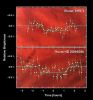
PlanetsLight-PIA07491.jpgThe language of "Planetary Light"57 visiteThis graph of data from NASA's SST shows changes in the infrared light output of 2 star-planet systems located hundreds of LY away. The data were taken while the planets, called HD 209458b and TrES-1, disappeared behind their stars in what is called a "secondary eclipse." The dip seen in the center of each graph represents the time when the planets were eclipsed, and tells astronomers exactly how much light they emit.
Why a secondary eclipse? When a planet transits, or passes in front of, its star, it partially blocks the light of the star. When the planet swings around behind the star, the star completely blocks its light. This drop in total light can be measured to determine the amount of light coming from just the planet.
Why infrared? In visible light, the glare of a star overwhelms its planetary companion and the little light the planet reflects. In infrared, a star shines less brightly and its planet gives off its own internal light, or heat radiation, making the planet easier to detect. By observing these secondary eclipses at different infrared wavelengths, astronomers can obtain the planet's temperature, and, in the future, they may be able to pick out chemicals sprinkled throughout a planet's atmosphere. The technique also reveals whether a planet's orbit is elongated or circular".
|
|
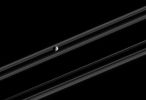
Epimetheus-PIA06615.jpgEpimetheus, from approx. 990.000 Km57 visiteCaption NASA originale:"Saturn's small, irregularly-shaped moon Epimetheus orbits against the backdrop of the planet's rings, which are nearly edge-on in this view. Some of the moon's larger geological features can be seen here. The image was taken in visible light with the Cassini spacecraft narrow-angle camera on Feb. 18, 2005, at a distance of approximately 990.000 Km (approx. 615.000 miles) from Epimetheus and at a phase angle of 99°. Resolution in the original image was 6 Km per pixel. The image has been contrast-enhanced and magnified by a factor of two to aid visibility".
|
|
SOL439-2N165342666EFFA912P0695R0M1.jpgUnusual rocks, just rocks... (17)57 visitenessun commento
|
|
| 25353 immagini su 2113 pagina(e) |
 |
|
|
|
|
1433 | |
|
|
|
|





