| Piú viste |
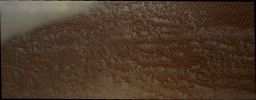
North_Polar_Features-The_Erg-PCF-LXTT-6.jpgThe "North Polar Erg" (Absolute Natural Colors; credits for the additional process. and color.: Dr Paolo C. Fienga - Lunar Explorer Italia)58 visiteCaption NASA:"This VIS image shows a small part of the North Polar Sand Sea [or Erg]. In this Region individual dunes are coalescing into large dune groups".
Coord.: 77,0° North Lat. and 309,5° East Long.MareKromium
|
|
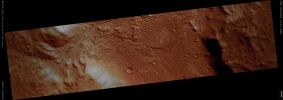
PSP_009992_1615_RED.jpgAl-Qahira Vallis (possible True Colors; credits: Lunar Explorer Italia)58 visiteMars Local Time: 15:36 (middle afternoon)
Coord. (centered): 18,2° South Lat. and 162,9° East Long.
Spacecraft altitude: 260,7 Km (such as about 162,9 miles)
Original image scale range: 52,2 cm/pixel (with 1 x 1 binning) so objects ~1,56 mt across are resolved
Map projected scale: 50 cm/pixel
Map projection: EQUIRECTANGULAR
Emission Angle: 0,2°
Phase Angle: 65,6°
Solar Incidence Angle: 65° (meaning that the Sun is about 25° above the Local Horizon)
Solar Longitude: 126,4° (Northern Summer)
Credits: NASA/JPL/University of Arizona
Additional process. and coloring: Lunar Explorer ItaliaMareKromium
|
|

SOL082-2N133638138EFF2232P1957L0M1.jpgMorning Sky over Spirit - Sol 82 (possible True Colors; credits: Lunar Explorer Italia)58 visiteLeft Navigation Camera Non-linearized Full frame EDR acquired on Sol 82 of Spirit's mission to Gusev Crater at approximately 10:27:08 Mars Local Solar Time.MareKromium
|
|

North_Polar_Regions-The_Erg-MO.jpgThe North Polar Erg (Natural Colors; credits for the additional process. and color.: Dr Paolo C. Fienga - Lunar Explorer Italia)58 visiteCaption NASA:"With the surface frost removed by the Summer Sun, different polar textures are exposed. This image contains Polar Dunes and a large region just off the Permanent Polar Cap".
Coord.: 82,1° North Lat. and 113,5° East Long.MareKromium
|
|
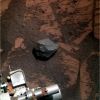
OPP-SOL1748-1.jpgInteresting Rock-fragment - Sol 1748 (True Colors; credits: Dr G. Barca)58 visiteL'osservazione di questo piccolo frammento di roccia dai riflessi bluastri costituisce un eccellente banco di prova per testare quello strumento di analisi scientifica (basata sull'osservazione in modalità remota) che abbiamo chiamato "Contestualizzazione".
Il panorama di riferimento lo conoscete: il MER Opportunity è stazionario, da qualche Sol, su un Pavimento Marziano Affiorante, ricoperto di berries.
Osservazioni: il colore del Pavimento è arancio-marrone, con riflessi rossastri mentre il colore del nostro frammento è grigio/blu; la surface texture del Pavimento è (se non altro in apparenza) ruvida e grezza mentre quella del frammento di roccia è liscia; l'albedo del Pavimento è bassa, ma quella del frammento - specie sulla sua porzione (diciamo così) "frontale" e rivolta verso il Rover - appare medio/alta (si direbbe addirittura che il frammento di roccia abbia una Matrice, se non altro in parte, cristallina).
Inoltre (dettaglio quanto meno curioso), i segni di deposito di polveri sottili sul frammento roccioso paiono decisamente leggeri ed appena accennati sulla sua porzione superiore e nettamente più marcati su quella laterale ed opposta all'angolo di osservazione.
Che cosa possiamo dedurre, a questo punto, sul frammento in questione? Fondamentalmente due cose:
1) esso NON è un frammento di Pavimento Marziano (non è contestualizzabile nel contesto al quale accede);
2) esso ha RECENTEMENTE (o forse addirittura RECENTISSIMAMENTE) trovato la sua attuale configurazione superficiale.
Conclusioni (interlocutorie): si dovrebbe trattare di un ejecta oppure è un frammento di un corpo non indigeno di questa zona di Meridiani (potrebbe anche essere un frammento di un meteorite).MareKromium
|
|
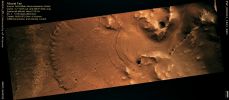
PSP_006941_1825_RED_abrowse~0.jpgAlluvial Fan in Crater East of Maja Valles (MULTISPECTRUM; credits: Lunexit)58 visiteThis image shows a large symmetrical Alluvial Fan at the mouth of a small channel along an unnamed crater. Alluvial fans with a well-defined channel source area are relatively uncommon on Mars.
This fan has a rib-like outer margin and many more terrace-like scarps upslope near the channel mouth. These terraces may indicate the outer margin of sediment deposits during each “pulse” of deposition. Further study of these types of alluvial fans may shed light on past sedimentary environments and conditions on Mars. MareKromium
|
|

SOL052-2R130984134EFF1120P1310R0M1.jpgInteresting Outcrop - Sol 52 (natural colors; credits: Lunexit)58 visitenessun commentoMareKromium
|
|
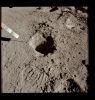
APOLLO_15_-_AS_15-86-11645.jpgAS 15-86-11645 - Gnomon and Hole at Station 6 (possible True Colors; credits: Lunar Explorer Italia)58 visitenessun commentoMareKromium
|
|

APOLLO_12_-_AS_12-52-7739.jpgAS 12-52-7739 - Copernicus (possible True Colors; credits: Lunar Explorer Italia)58 visiteCoord. (center of the frame): approx. 10,0° North Lat. and 20,0° West Long.MareKromium
|
|

NGC-4945.jpgNGC 4945 in Centaurus58 visite"...Cercare di conquistare una fisica Immortalità è futile, poichè dobbiamo morire tutti: si sa, ed è un fatto inevitabile. Cercare di costruire qualcosa che ci sopravviva, invece, è Opera meritoria..."
Paolo C. FiengaMareKromium
|
|

The_Rings-Shadow-N00127583.jpgEclipsing the Rings (4)58 visitenessun commentoMareKromium
|
|
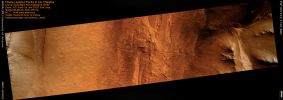
PSP_007219_1720_RED_abrowse-00~0.jpgFinely-Layered Rocks in Ius Chasma (context-frame - MULTISPECTRUM; credits: Lunexit)58 visiteThe high resolution of HiRISE allows us to see the many Fine Layers, or Strata, of Rock Outcrops all over Mars. This image shows a portion of Ius Chasma in the western portion of the large Valles Marineris Canyon System.
The Outcrop of Rock in the center of the image is about 5,5 Km across. Similar light-toned Strata are observed elsewhere in the canyon system and the CRISM instrument has shown that they often contain sulfate salts. The presence of Sulfate Salts indicate that water once interacted with this area, possibly as fluids that migrated through pre-existing rocks or as shallow evaporating pools of water.MareKromium
|
|
| 25353 immagini su 2113 pagina(e) |
 |
|
|
|
|
1431 | |
|
|
|
|





