| Piú viste |

OPP-SOL1581-1P268538296ESF90B0P2540R2M1.jpgThe Inner Rim of Victoria - Sol 1581 (MULTISPECTRUM; credits: Lunexit)58 visitenessun commentoMareKromium
|
|
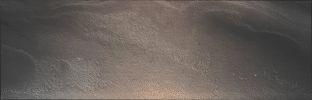
South_Polar_Regions-20080711a-PCF-LXTT.jpgVastitas Australis: the South Polar Region of Mars (Absolute Natural Colors; credits for the additional process. and color.: Dr Paolo C. Fienga - Lunexit Team)58 visiteCoord.: 85,6° South Lat. and 211,7° East Long.MareKromium
|
|

OPP-SOL1216-2.jpgBig-Ones and Small-Ones... - Sol 1216 (Superdefinition + MULTISPECTRUM; credits: Dr G. Barca & Lunexit)58 visitenessun commentoMareKromium
|
|

OPP-SOL1168-2.jpgBerries and "Greenish" Dust - Sol 1168 (Superdefinition + MULTISPECTRUM; credits: Dr G. Barca & Lunexit)58 visitenessun commentoMareKromium
|
|

The_Rings-PIA10423.jpgSpooky Spokes! (MULTISPECTRUM; credits: Lunexit)58 visiteCaption NASA:"As they wheel about the Planet, Saturn's sunlit Rings often exhibit dark, radial markings called "spokes". Spokes are seen only in the broad B-Ring, and can also appear bright in certain viewing geometries.
This view looks toward the sunlit side of the Rings from about 11° below the Ring-Plane.
Pandora (about 81 kilometers, or approx. 50 miles across) is a speck above the Rings at left. The Planet's shadow darkens the Ring-Plane at lower right.
The image was taken in visible light with the Cassini Spacecraft wide-angle camera on June 3, 2008. The view was acquired at a distance of approx. 1 MKM (about 636.000 miles) from Saturn and at a Sun-Saturn-Spacecraft, or Phase, Angle of 19°.
Image scale is roughly 61 Km (approx. 38 miles) per pixel".MareKromium
|
|
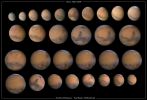
MARS-002.jpgMars in Time58 visiteCaption NASA, da "NASA - Picture of the Day" del 14 Luglio 2008:"Does Mars always appear the same? No.
As both Earth and Mars orbit the Sun, the apparent angular size of Mars changes as viewed from the Earth. Pictured above from Enschede, Holland, Mars was captured in 2007 and 2008 with 30 separate images, all taken with the same magnification.
When Earth and Mars are on opposite sides of the Sun, Mars appears relatively small. Conversely, when Earth and Mars are near each other, Mars looms large and bright. The largest Mars has appeared in recent history was the opposition of August 2003.
Since Mars is always more distant from the Earth from the Sun, Mars never shows a crescent phase to Earthlings. Visible also in the above images are the North Polar Cap of Mars, dark and light soil, clouds, and, in the early images, a Global Dust Storm.
The next opposition, when Earth again passes near to Mars, will occur in early 2010".MareKromium
|
|

PSP_006952_1870_RED_abrowse~0.jpgDark Dunefield in West Arabia Terra (MULTISPECTRUM and Yellow/Orange Filters ON; credits: Lunexit)58 visiteThis image shows dunes in an unnamed crater in the west Arabia Terra Region.
The rim of the crater lies to the South of the image (Sx)and a dark, toned field of Barchan Sand Dunes rests on the crater floor in the Northern portion of the observation.
Barchan Dunes are commonly found on Earth, and are generally crescent-shaped with a steep slip face bordered by horns oriented in the downwind direction. Barchan Dunes form by unidirectional winds and are good indicators of the dominant wind direction. In this case, the strongest winds blew approximately North to South.
These dunes are most likely composed of basaltic sand that has collected on the bottom of the crater.
Superimposed on their surface are smaller secondary dunes which are commonly seen on terrestrial dunes of this size. Many smaller and brighter bed forms — most likely small dunes or granule ripples — also cover the substrate between the larger dark dunes. The dark dunes overlie the small bright bed forms indicating that the darker dunes formed more recently.
MareKromium
|
|

OPP-SOL661-2.jpgOpportunity's perfectly CLEAN Solar Panels - Sol 661 (natural colors; credits: Dr G. Barca)58 visiteDue splendide elaborazioni del bravissimo Dr Gianluigi Barca che ci mostrano, mentre il Sole splende quasi a picco sulla Piana di Meridiani, i Pannelli Solari - splendidamente immacolati! - di Opportunity.
Tutto questo per riflettere - ancora una volta... - a proposito di quello che Marte, in accordo al nostro Lavoro, "è", in relazione a quello che Marte, invece ed in accordo al Lavoro NASA, "sembra".MareKromium
|
|

PIA10140-DarkFans~0.jpgBright Streaks and Dark Fans (MULTISPECTRUM; credits: Lunexit)58 visiteIn a Region of the South Pole known informally as "Ithaca", numerous Fans of dark frost form every Spring. HiRISE collected a time lapse series of these images, starting at Ls = 185 and culminating at Ls = 294. "Ls" is the way we measure time on Mars: at Ls = 180 the Sun passes the Equator on its way South; at Ls = 270 it reaches its maximum subsolar latitude and Summer begins.
We believe that the bright streaks are fine frost condensed from the gas exiting the vent. The conditions must be just right for the bright frost to condense. MareKromium
|
|

OPP-SOL663-1.jpgMartian Paving and Solar Panels - Sol 663 (natural colors; credits: Dr G. Barca)58 visitenessun commentoMareKromium
|
|
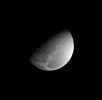
Dione-PIA10431.jpgDione58 visiteCaption NASA:"This Cassini Spacecraft view, taken from a vantage point 64° above Dione's Equator, looks down onto the bright fractures that cover the moon's Trailing Side. The fractures crisscross a region of terrain that is significantly darker than the rest of the moon's surface. Dione is approx. 1123 Km (about 698 miles) across.
The image was taken in visible light with the Cassini spacecraft narrow-angle camera on June 15, 2008. The view was obtained at a distance of approx. 601.000 Km (such as about 374.000 miles) from Dione and at a Sun-Dione-Spacecraft, or Phase, Angle of 76°. Image scale is roughly 4 Km (a little more than 2 miles) per pixel".MareKromium
|
|

Mawrth_Vallis-The_Waterfall-CC.gifZooming on the "Waterfall" - Mawrth Vallis (GIF-Movie, by Carlo Contu)58 visiteAcquisition date: January, 04, 2008
Local Mars Time: 14:19
Latitude: 23,0° North
Longitude: 341,6° East
Range to target site: 309,9 Km
Original image scale range: 31 cm/pixel (with 1 x 1 binning) so objects ~93 cm across are resolved
Map projected scale: 25 cm/pixel and North is up
Map projection: EQUIRECTANGULAR
Emission angle: 22,7°
Phase angle: 60,1°
Solar incidence angle: 38°, with the Sun about 52° above the horizonMareKromium
|
|
| 25353 immagini su 2113 pagina(e) |
 |
|
|
|
|
1430 | |
|
|
|
|





