| Piú viste |
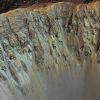
PSP_007151_1445_RED_abrowse-01.jpgColorful Layers in the Walls of an Unnamed Southern Crater (extra-detail mgnf - MULTISPECTRUM; credits: Lunexit)58 visiteThis extra-detail mgnf (enhanced to exaggerate color contrast) shows part of the North-facing walls of the crater, deeply carved by landslides. Rocky layers, mostly purplish in color, can be followed for hundreds of meters, poking through the loose materials that cover the slopes.
Locally, the rocky layers show patches of diverse colors (blue, green, yellow). These colors may be indicative of compositional differences in the rocky layers.MareKromium
|
|
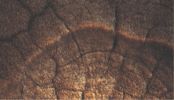
PSP_007173_2245_RED_abrowse-01.jpgScallops and Polygons in the Utopia Planitia Region (extra-detail mgnf - MULTISPECTRUM; credits: Lunexit)58 visiteSeveral cracks cut through the side of the scallops suggesting that they must be at least as deep as the scallops. The polygons may have been present previous to the erosion of the mantle.
The landforms we observe here most likely show that ice-rich permafrost is present or has been present geologically recently. At this latitude on Mars, the conditions of pressure and temperature allow water ice within the ground to sublime.
The disappearance of the ice component of the ground probably leads to the formation of the depressions, a process that may still be active today.MareKromium
|
|

Enceladus-5-CASSINI-big.jpgOver and Above... (natural colors; credits: Lunexit)58 visiteCaption NASA:"What does the surface of Saturn's ice-spewing moon Enceladus look like? To help find out, the robotic Cassini Spacecraft now orbiting Saturn was sent soaring past the cryovolcanic moon and even right through one of Enceladus' ice plumes.
Cassini closed to about 52 Km during its closest encounter to date. The above unprocessed image was taken looking down from the North, from about 30.000 Km away. Visible are at least two types of terrain.
The first type of terrain has more craters than occur near Enceladus' South Pole.
The other type of terrain has few craters but many ridges and grooves that may have been created by surface-shifting tectonic activity.
Exogeologists are currently poring over this and other Cassini images from last Wednesday's flyby to better understand the moon's patch-work surface, its unusual ice-geysers, and its potential to support life. Cassini is scheduled to fly by Enceladus at least 9 more times, including an even closer pass of just 25 Km in October 2008".MareKromium
|
|

ZO-Mercury21_Messenger-big.jpgCrescent Mercury (in Accentuated Colors; credits: NASA)58 visiteCaption NASA:"The colors of Mercury are subtle but beautiful. At first glance, our Solar System's innermost Planet appears simply black and white, but images that include IR colors normally beyond human vision accentuate a world of detail. One such image, shown above, was acquired by the robotic MESSENGER Spacecraft that swung by Mercury in mid-January 2008.
Here, most generally, the hot world itself acquires a slightly more brown hue. Many craters that appear on top of other craters - and so surely have formed more recently - appear here as bright with bright rays that include a slightly blue tint, indicating that soil upended during the impact was light in color. A few craters, such as some in the huge Caloris Basin impact feature visible on the upper right, appear unexpectedly to be ringed with a dark material, the nature of which is being researched.
MESSENGER continues to glide through the inner Solar System and will pass Mercury again this October and next September, before entering orbit around the desolate world in 2011".MareKromium
|
|

SOL317-2N154514768EFF9400P0645L0M1.jpgPanorama from Sol 317 (natural colors; credits: Lunexit)58 visitenessun commentoMareKromium
|
|

APOLLO_14_AS_14-77-10359a.JPGAS 14-77-10359 (a) - Lunar Bootprint58 visiteAstronaut bootprint; taken at at a location midway between the LM and Station "A".MareKromium
|
|

Spacer.jpgHappy Easter 2008! (by Giorgio Picciau)58 visiteUn Saluto ed un Augurio "UFO-Roboticamente Spaziali" di Buona Pasqua 2008, a Tutti gli Amici di Lunar Explorer Italia, da parte del bravissimo ed immaginifico "Artista del Cosmo", Giorgio Picciau!
Un grande complimento a Lui, per questa bella e romantica "Visione" che - ne siamo certi - ci riporterà tutti indietro di qualche anno, "...quando le cose erano (forse) più semplici ed i cieli (di certo) erano più limpidi".
MareKromium
|
|
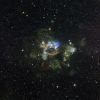
N-44.jpgThe N44 Complex58 visite"...I commune with my heart in the night; I meditate and search my Spirit..."
- Psalm 77:6MareKromium
|
|
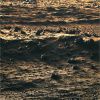
SOL1147-0.jpgLong Shadows in the Evening Hours near Home Plate (1) - Sol 1147 (True Colors + MULTISPECTRUM; credits: Dr Marco Faccin & Lunexit)58 visitenessun commentoMareKromium
|
|

Gravitational_Lensing-01.jpgGravitational Lensing and "Light Distortion"58 visite"...Noi continuiamo a definire, reputare e trattare il Tempo e lo Spazio come ed in quanto Misure Lineari.
Questo, a mio parere, equivale a dire che non solo le nostre "basi" sono fatiscenti, ma altresì che noi non abbiamo la minima idea di che cosa il Tempo e lo Spazio sìano effettivamente...
Comunque sia, dobbiamo aspettare. La Verità, nella Vita come nella Scienza, alla fine si automanifesta e si dimostra da sola, nonostante tutto e tutti..."
Paolo C. Fienga (appunti)MareKromium
|
|

SOL586-1.jpgMarble-like Rocks in the Sand - Sol 586 (True Colors + MULTISPECTRUM; credits: Dr G. Barca & Lunexit)58 visitenessun commentoMareKromium
|
|
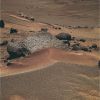
SOL582-1.jpgMarble-like Rocks in the Sand - Sol 582 (True Colors + MULTISPECTRUM; credits: Dr G. Barca & Lunexit)58 visitenessun commentoMareKromium
|
|
| 25353 immagini su 2113 pagina(e) |
 |
|
|
|
|
1426 | |
|
|
|
|





