| Piú viste |

NGC-2237_and_NGC-2244-01.jpgNGC 2237 - The "Rosette Nebula", and Globular Star Cluster NGC 224458 visite"...Caput columbae, cauda scorpionis est..."
(anonimo)
"...Ha il il capo di una colomba, ma la coda di uno scorpione..."
(Detto riferito ai falsi amici che blandiscono con la bocca e poi feriscono con la mano, non appena si presenta l'occasione)
|
|

NGC-3576-1.jpgNGC 3576 - Emission Nebula58 visite"...Vivos voco, mortuos plango, fulgura frango..."
(Indovinello medioevale)
"...Chiamo coloro che vivono, piango i defunti e spezzo i fulmini..."
|
|
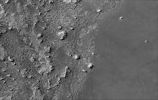
T-TRA_000833_1800_RED.jpgMeridiani Planum58 visiteThis HiRISE image shows geologic "contacts", or boundaries, between light-toned and dark-toned material in Meridiani Planum, near the equator of Mars. Merdiani Planum is where the Mars Exploration Rover Opportunity is located, although this image covers an area that is more than 600 km to the east of the Opportunity site. The central portion of the image shows very smooth, dark plains that are typical of much of the Meridiani region. These plains are flanked by more rugged lighter-toned materials. The light-toned materials have been eroded to form dramatic pits, buttes and mesas. Based on the lengths of the shadows that they cast, some of the buttes and mesas are up to about 30 meters (~100 feet) tall. The light-toned material shows distinctive layering, suggesting that it may be composed of sedimentary rock. Scattered across the scene, especially in the light-toned materials where they are prominent in low spots and around some of the larger buttes and mesas, are dunes and other similar landforms created by martian winds.
|
|

T-TRA_000862_1710_RED_CandorChasma_01.jpgCandor Chasma58 visiteThis HiRISE sub-image shows the steep slopes along wallrock in the eastern edge of West Candor Chasma. In general, the rocks in the upper part of the canyons are interpreted to be lava flows that cover the plains surrounding Valles Marineris, whereas the deeper material along the walls could be either more lava flows or megaregolith that resulted from numerous impact craters that disrupted the Martian surface during the first billion years after formation of the planet. Resistant material is visible in portions of the sub-image and HiRISE is able to resolve 1-2 meter size boulders shedding out of these resistant wallrock units. The bright and dark lineations seen in the right of the sub-image follow the slope of the wallrock (downslope is towards the top of the sub-image) and likely represent bright dust and dark sand that are sliding downslope. The large number of small impact craters visible along the slopes indicates that there isn't a large amount of material moving downslope recently because these craters would have been destroyed or buried.
|
|
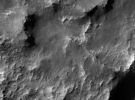
T-TRA_000853_1450_RED_AtlantisChaos_01.jpgAtlantis Chaos58 visiteThis HiRISE image covers a small area within a degraded crater adjacent to Atlantis Chaos in the Electris region of Mars. The crater and much of the surrounding region were once extensively mantled by a layer of material(s) of unknown origin and only small remnant outcrops of this material remain seen as flat topped mesas in the image sub-frame shown here. Intervening areas expose ancient uplands materials locally punctuated by narrow ridges that may represent more resistant material within the mantling deposit that were left in relief as the sediments were eroded away. Although the mesas do not appear to be comprised of finely layered materials, hints of some layering in a few locations can be seen. Large blocks of material are being shed from the mesas, but do not appear to accumulate on the mesa slopes as large talus aprons. Some wind blown dunes and ripples can be observed, but are not as widespread as in many other locations imaged with HiRISE. Collectively, these characteristics suggest that the material(s) forming the mantling deposit possess some limited strength, but are easily broken down and removed by wind over time. One possible Earth analog for these deposits may be the wind blown accumulations of very fine sediments, or silt known as loess.
|
|
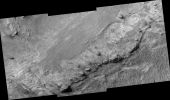
T-TRA_000849_1675_RED.jpgCoprates Labes58 visiteCoprates Labes is a Martian canyon, part of the huge Valles Marineris system. Valles Marineris most likely formed through tectonic processes, with extensional stresses leading to collapse of the terrain that now lies at the base of the canyons. Filling most of this image, we see a raised block on the canyon bottom, which is quite possibly a horst—a block bounded by faults that separate it from sunken blocks on each side. The raised block is heavily eroded, possibly by wind; this erosion has exposed its internal layering, especially at the southeast margin of the block. Here we see asymmetric erosion features with shallow slopes trailing off to the northwest, suggesting that southeasterly winds dominate the flow through this region. The arrangement of dunes and ripples in the lower right portion of the image confirms this prevailing wind direction. Finally, dark-toned material appears to have flowed from northeast to southwest along the block, possibly moving in a very fluid debris flow.
|
|

IC-0342.jpgIC 342 - Spiral Galaxy58 visite"...E quando alfin l'Ora Fatale è giunta,
Forza, ingegno non val, non valgon prieghi;
Contro il Destin non la si vince e spunta,
E tutto sotto lui forza è che pieghi..."
(Casti)
|
|

NGC-6888-02.jpgNGC 6888 - Emission Nebula58 visite"...Pascha non sequitur Marcum, nec praecedit Benedictum..."
(proverbio medievale)
"...La Pasqua non segue il giorno di S. Marco (25 Aprile), nè precede quello di S. Benedetto (21 Marzo)..."
(questo detto fissa i termini della Pasqua la quale, per regola generale, non può cadere prima del 22 Marzo - però accadde nel 1818 ed avverrà ancora nel 2285 e nel 2353 A.D. -, nè dopo il 25 Aprile - come però avvenne nel 1886 e nel 1943)
|
|
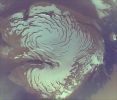
North_Polar_Cap_oct2006.jpgThe "North Polar Cap" of Mars58 visiteDuring the last week of September and the first week or so of October, 2006, the Mars Reconnaissance Orbiter (MRO) scientific instruments were turned on to acquire test information leading up to full science operations to begin the first week of November 2006, following superior conjunction (superior conjunction is where a planet goes behind the sun as viewed from the Earth). Since it is very difficult to communicate with a spacecraft when it is close to the Sun as seen from Earth, this checkout of the instruments was crucial to being ready for the Primary Science Phase (PSP) of the mission.
Throughout the Transition Phase of operations, the Mars Color Imager (MARCI) acquired terminator (transition between nighttime and daytime) to terminator swaths of color images on every dayside orbit, as the spacecraft moved northward in its orbit. The south polar region was deep in winter shadow, but the north polar region was illuminated the entire martian day. During the primary mission, these swaths will be assembled into global maps that portray the state of the martian atmosphere -- its weather -- as seen every day and at every place at about 3 PM local solar time. After the Transition Phase was completed, most of the instruments were turned off, but the Mars Climate Sounder and MARCI have been left on. Their data will be recorded and played back to Earth following the communications blackout associated with conjunction and just prior to the start of the PSP.
Combined with Mars Global Surveryor (MGS) Mars Orbiter Camera (MOC) wide angle image mosaics taken at 2 PM local solar time, the MARCI maps will be used to track motions of clouds.
The image shown above is a composite mosaic of four polar views of Mars, taken at midnight, 6 AM, noon, and 6 PM local martian time. This is possible because during summer the sun is always shining in the polar region. It shows the mostly water ice perennial cap (white area), sitting atop the north polar layered materials (light tan immediately adjacent to the ice), and the dark circumpolar dunes. This view shows the region poleward of about 72 degrees north latitude. The data were acquired at about 900 meters per pixel. Three channels are shown here (425 nm, 550 nm, and 600 nm).
|
|

Craters-Unnamed_Crater_in_Terra_Sirenum_12m-00.jpgCrater in Terra Sirenum (1)58 visiteThe largest number of gullies on Mars occur on the walls of southern hemisphere craters. During southern winter, many of the gullied walls are in shadow. It has been known for many years from Mars Global Surveyor Mars Orbiter Camera images that frost forms on these shadowed slopes and that differences in the amount or nature of the frost deposits highlight the gully floors and deposits. Such differences may occur because the materials are of different particle sizes, or have other differing attributes that affect their thermophysical properties. To investigate this phenomenon, CTX acquired this image of a crater at 39.3°S, 136.5°W, where gullies were known to display frost during winter. To see the gullies, download the image and view it in an image processing program, as they are nearly invisible in the normal contrast image.
|
|

TRA_000830_1440_IRB-1.jpgNiger Vallis (1)58 visiteThis image shows a portion of the floor of Niger Vallis, an ancient Martian outflow channel. Niger Vallis originates on the flanks of the volcano Hadriaca Patera, and empties into the Hellas impact basin. Outflow channels are observed in many regions of the planet, and may have been carved by brief eruptions of liquid water from beneath the surface. Since Niger Vallis formed, impacts have cratered the channel floor, and fine-grained wind-blown debris has been transported across the surface, eroding and burying all but the freshest craters. The curved ridge in the scene may be the remnant of a large crater rim. At the high resolution of this image, a pattern of parallel dunes and ripples can be seen, as well as individual boulders as large as two meters across.
Image TRA_000830_1440 was taken by the High Resolution Imaging Science Experiment (HiRISE) camera onboard the Mars Reconnaissance Orbiter spacecraft on September 30, 2006. The full image shown below is centered at -35.5 degrees latitude, 92.1 degrees East longitude. The range to the target site was 255 km (159 miles). At this distance the image scale is 51 cm/pixel (with 2 x 2 binning) so objects ~153 cm across are resolved. The image shown here has been map-projected to 50 cm/pixel and north is up. The image was taken at a local Mars time of 3:35 PM and the scene is illuminated from the west with a solar incidence angle of 77.5 degrees, thus the sun was about 12.5 degrees above the horizon. At a solar longitude of 113.8 degrees, the season on Mars is Northern Summer / Southern Winter.
|
|

TRA_000840_2750_IRB-004.jpgChasma Boreale (4)58 visitenessun commento
|
|
| 25353 immagini su 2113 pagina(e) |
 |
|
|
|
|
1424 | |
|
|
|
|





