| Piú viste |
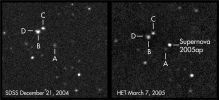
SN-2005ap.jpgSupernova SN 2005ap58 visite"...Son gli Dei spettator, la Terra è scena:
E noi siam gli istrioni, ond'Ella è piena..."
L. Alemanni - "Versi e Prose"
Nota: frase ripresa (forse) da Petronio (Fragm. - Ad Rhenum), il quale diceva:"...Fere totus mundus exercet histrionem..."MareKromium
|
|
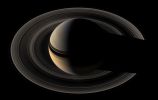
Saturn-PIA08388.jpgLooking at the Giant58 visiteSaturn sits nested in its rings of ice as Cassini once again plunges toward the graceful giant. This natural color mosaic was acquired by the Cassini spacecraft as it soared 39° above the unilluminated side of the Rings.
Little light makes its way through the Rings to be scattered in Cassini's direction in this viewing geometry, making the Rings appear somewhat dark compared to the reflective Planet. The view can be contrasted with earlier mosaics designed to showcase the Rings rather than the Planet, which were therefore given longer exposure times.
Bright clouds play in the blue-gray skies of the North. The Ring shadows continue to caress the Planet as they slide farther South toward their momentary disappearance during Equinox in 2009.
The Rings' reflected light illuminates the Southern Hemisphere on Saturn's night side.
The scene is reminiscent of the parting glance of NASA's Voyager 1 as it said goodbye to Saturn in 1981 (see PIA00335). Cassini, however, will continue to orbit Saturn for many years to come.
Three of Saturn's moons are visible in this image: Mimas (about 397 Km across) at the 2 o'clock position, Janus (about 181 Km across) at the 4 o'clock position and Pandora (about 84 Km across) at the 8 o'clock position. Pandora is a faint speck just outside the narrow F-Ring.
This mosaic was constructed from wide-angle camera images taken just before the narrow-angle camera mosaic PIA08389.
The view combines 45 images -- 15 separate sets of red, green and blue images -- taken over the course of about two hours, as Cassini scanned across the entire Main Ring System.
The images in this view were obtained on May 9, 2007, at a distance of approx. 1,1 MKM (about 700.000 miles) from Saturn.
Image scale is about 62 Km (approx. 39 miles) per pixel. MareKromium
|
|

MilkyWayRoad.jpgThe "Milky Way Road"58 visite"...Dominus dedit, Dominus abstulit..."
(Giobbe - 1, 21)
"...Dio diede, Dio tolse..."MareKromium
|
|
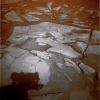
OPP-SOL1329-1N246174117EFF8788P0175R0M1.jpgPaving and Razorblades inside Victoria (1 - possible natural colors; light-blue color filter on; elab. Lunexit)58 visitenessun commentoMareKromium
|
|
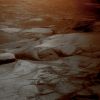
OPP-SOL1329-1P246170461ESF8754P2585L3M1.jpgThe "Inner Paving" and the "Red Sands" of Victoria - Sol 1329 (red-orange filter ON - possible natural colors - elab. Lunexit)58 visitenessun commentoMareKromium
|
|

PSP_005346_1755_RED_abrowse-01.jpgLow-Order Inverted Streams near Juventae Chasma (extra-detail mgnf)58 visiteThis subimage (approx. 1120 meters across) shows a juncture of 2 of the "Inverted Channels".
It is likely that the water flowed from the left to the right of the scene, because channels usually join rather than divert unless there is an obvious obstacle in the way.
No such obstacle is seen here, but one might have been present when the stream originally flowed.
However, there is no way of knowing this.MareKromium
|
|

PSP_005381_0870_RED_abrowse.jpgSouth Polar Layered Deposits with Surface Modification (possible natural colors - elab. Lunexit)58 visiteThis image shows a scarp exposing the south polar layered deposits (SPLD). The polar layered deposits are thought to record recent climate variations on Mars, similar to ice ages on Earth.
Radar data indicate that the SPLD are ice-rich, with variations in dust contamination likely causing the layering visible here. HiRISE images of the SPLD will help to unravel Mars' climate history, but this image illustrates how this effort is complicated.
The development of surface features, by erosion, deposition, or modification of the surface, makes it difficult to determine the characteristics of the layers themselves. Some of the layers appear wavy, perhaps due to folding, flow, or uneven erosion since they were laid down. Short, branching, often radial channel systems are cut into the surface of the layers in places. These may be related to "spiders," thought to be formed as carbon dioxide gas flows along the surface when the seasonal polar cap sublimates in the spring. Pits and polygonal fractures are visible on the layers as well.
Apparently this exposure of SPLD is relatively old, as these features probably take many years to form. While these features are interesting in their own right, they disturb the SPLD outcrops and make it more difficult to measure the thickness of layers and compare them to other outcrops of SPLD.
MareKromium
|
|

NGC-3372.jpgNGC 3372 - The "Carina Nebula"58 visite"...See, the whole land is before you: go wherever you think it is good and right to go..."
- Jeremiah, 40:4MareKromium
|
|

LLN-Itokawa-ST_2506733028_v.pngApproaching Itokawa (4 - natural colors; elab. Lunexit)58 visitenessun commentoMareKromium
|
|
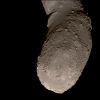
LLN-Itokawa-ST_2506694595_v.pngApproaching Itokawa (3 - natural colors; elab. Lunexit)58 visitenessun commentoMareKromium
|
|

LLO-Itokawa-ST_25326292LL77_v.jpgThe unbelievable surface of 25143-Itokawa (HR1 - possible natural colors; elab. Lunexit)58 visitenessun commentoMareKromium
|
|

Quasar_MC2-1635+119-B.jpgQuasar MC2-1635+11958 visite"...Est quadam prodire tenus, si non datur ultra..."
(Orazio)
"...E' già buona cosa giungere sino ad un certo punto, se non è possibile andare oltre..." (trad. libera)MareKromium
|
|
| 25353 immagini su 2113 pagina(e) |
 |
|
|
|
|
1416 | |
|
|
|
|





