| Piú viste |

Mimas&Saturn-PIA08122.jpgThe King and I...58 visiteA small and battered reminder of the Solar System's violent youth, the ice moon Mimas hurtles around its gas giant parent, Saturn.
With its "poor dimensions" (Mimas is only about 397 Km across), this little moon is dwarfed by the immensity of Saturn (the Ringed Gas Planet is more than 150 times as wide as Mimas).
Mimas is seen here against the night side of Saturn and Saturn itself is faintly lit by sunlight reflecting off its Rings.
The image was taken in visible light with the Cassini spacecraft narrow-angle camera on Jan. 20, 2006, at a distance of approx. 1,4 MKM (such as about 900,000 miles) from Mimas and at a Sun-Mimas-spacecraft, or phase, angle of 145°. Image scale is about 9 Km (approx. 5 miles) per pixel.
|
|

Titan-W00013654.jpgA "bright light" in the clouds?58 visiteCerchiatura Bianca: la macchia bianca che vediamo fra le nuvole di Titano è un gruppo di 8 "dead-pixels" circondato da un grappolo di almeno una ventina di "bad-pixels" (e dunque uno dei soliti photoartifact), oppure si tratta di un oggetto luminosissimo il quale ha provocato la evidentissima sovraesposizione della zona in cui si trovava al tempo dello scatto?
Caption originale:"W00013654.jpg was taken on February 27, 2006 and received on Earth February 27, 2006. The camera was pointing toward TITAN at approximately 34.753 Km, and the image was taken using the CB3 and CL2 filters. This image has not been validated or calibrated".
|
|

Titan-W00013654-1.jpgA "bright light" in the clouds? (LR)58 visiteSi tratta dello stesso frame che evidenzia una possibile Anomalìa negli strati alti dell'atmosfera di Titano, ma con una risoluzione leggermente più bassa (500x500 anzichè 512x512). L'abbassamento di risoluzione, come potete verificare Voi stessi, non ha danneggiato la percezione del flash bianco, anzi: diremmo che in questo frame (sempre NASA Originale: non siamo stati noi a ridurne la risoluzione) la possibile Anomalìa trova un modo migliore per evidenziarsi.
Nostra opinione: premesso che si tratta di una sensazione, ottenuta su besi meramente intuitive e non sostanziabili, secondo noi quello che si vede in questo frame è un qualcosa di reale e NON un pohotoartifact (che poi si tratti di un fulmine - ipotesi tutt'altro che impossibile -; di una nuvoletta composta al 99,9% di ghiaccio d'acqua - e dunque dall'albedo altissima - o di una nave spaziale aliena in ricognizione - perchè no?!? - non ci è possibile dirlo).
|
|

Titan-PIA08126.jpgShining through the Rings...58 visiteCaption originale:"Titan's smoggy atmosphere glows brilliantly in scattered Sunlight, creating a thin, gleaming crescent beyond Saturn's Rings. At this slight angle above the Ring-Plane, the thin F-Ring shines brightly. Light from Titan's eastern and western limbs (edges) penetrates the Cassini Division, which looks like a thin gap from this angle.
The image was taken in visible light with the Cassini spacecraft narrow-angle camera on Jan. 18, 2006, at a distance of approx. 1 MKM (such as about 600.000 miles) from Saturn. Planet-sized Titan (5.150 Km, or 3,200 miles across) was 2,2 MKM (about 1,4 MMs) from Cassini at that time. The image scale is 13 Km (8 miles) per pixel on Titan".
Nota: crediamo che sia la prima volta in cui la NASA, nel fornire i dati contingenti sul frame (ivi, in particolare, la distanza Sonda-Oggetto Ripreso), aggiunge la precisazione "...at that time...".
Ci teniamo a sottolineare che questo tipo di precisazione (a nostro parere fondamentale per far capire a tutti i Lettori - e soprattutto ai più giovani - che la "staticità" non appartiene al Cosmo) l'abbiamo introdotta noi, come Lun-Ex-It, in sede di integrazione dei dettati (captions) originali dei frames relativi a Saturno ed al suo Sistema.
|
|

Centaurus A-SST-1.jpgCentaurus A - SST (HR)58 visite"...Nusquam tuta Fides..."
(Virgilio)
"...La Fede non è al sicuro in nessun luogo..."
|
|

SOL748-Home Plate-PIA02690-4.jpgHome Plate: almost true colors and HR (4) - Sol 748 to 75158 visitenessun commento
|
|
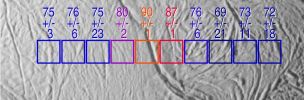
Enceladus-PIA07794.jpgEnceladus' surface temperatures (2)58 visiteEnhanced thermal emission is seen in the vicinity of the prominent "Tiger Stripe" fissures discovered by the imaging cameras.
In these images, the excess emission is most strongly seen in the left-most composite Infrared Spectrometer field of view, which includes a fissure near the end of one of the Tiger Stripes. The peak temperatures, 86 and 90 Kelvin (such as about -305 and -298 Fahrenheit) respectively, are averages over the Composite Infrared Spectrometer field of view, and other composite Infrared Spectrometer data suggest that much higher temperatures, up to at least 145 Kelvin (such as -199 Fahrenheit), occur in narrow zones a few hundred meters wide along the Tiger Stripe fissures.
The 1st image is centered near long. 135° W. and lat. 65° S. and each square from the composite infrared spectrometer field of view is about 17,5 Km (approx. 10,9 miles) across.
The 2nd image was taken nearly 3 times closer to Enceladus and is centered near long. 120° W, lat. 82° S.
|
|
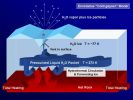
Enceladus-PIA07799.jpgEnceladus' Geysers Model58 visiteAs Saturn's active moon Enceladus continues to spew icy particles into space, scientists struggle to understand the mechanics of what is going on beneath the fractured south polar terrain. This graphic illustrates key aspects of the model proposed by the Cassini imaging science team in a paper published in the journal Science on March 10, 2006.
The model shows how proposed underground reservoirs of pressurized liquid water above 273 degrees Kelvin (0° Celsius) could fuel geysers that send jets of icy material into the skies above the moon's south pole. In the graphic, the vent to the surface pierces one of the "tiger stripe" fractures seen in Cassini views of the Southern Polar Terrain. Temperatures increase with depth.
Some combination of internal radioactive decay and flexing--perhaps concentrated within the tiger stripe fractures and brought about by the particular characteristics of Enceladus' orbit--is implicated as the source of the heat creating the liquid reservoirs. However, it is not yet clear how the deep interior of Enceladus functions, nor whether the moon is fully differentiated (separated into layers, with rock at the center and ice outside).
|
|
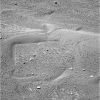
OPP-SOL758-1P195468289EFF65C3P2365L7M1.jpgNatural or artificial? (1) - Sol 75858 visiteCaption Originale:"Left PanCam Non-linearized Full frame EDR acquired on Sol 758 of Opportunity's mission to Meridiani Planum at approximately 10:02:59 MLT.
Camera commanded to use Filter 7 (432 nm)".
|
|

OPP-SOL760-1N195655203EFF65KEP0695L0M1.jpgThe Dunes around Opportunity (3) - Sol 76058 visitenessun commento
|
|

Craters-Buried_Crater-00.JPGUnder the Sand (Original NASA/MGS/MSSS b/w Frame)58 visiteCaption NASA originale:"This MGS-MOC image shows a partially-buried crater in the North Polar Region of Mars.
The circular feature is surrounded and partly overlain by some of the many, many sand dunes in the area. The steepest slopes on each dune — their "slip faces" — face toward the SouthEast, indicating that the dominant winds responsible for sand transport in this Region come from the NorthWest".
Location near: 76,0° North; 82,2° West
Image width: ~3 Km (~1,9 mi)
Illumination from: lower left
Season: Northern Spring
|
|

Rhea-N00055690.jpgRhea and a "streak of light"58 visiteCerchiatura Bianca: un (nuovo) "streak" di luce bianca e molto intensa il quale, laddove non fosse il solito photoartifact, potrebbe concretare una interessante Anomalìa.
In realtà, la "striscia" in questione non ci pare proprio un photoartifact ed inoltre essa non dovrebbe neppure essere la semplice evidenza di un corpo celeste (un'altra luna di Saturno, ad esempio) il quale è rimasto non solo sovraesposto, ma anche strisciato (o "mosso") a causa della (eccessiva) durata della ripresa fotografica in rapporto alla velocità della Sonda . Per altro, anche osservando altri frames della Serie "N" - ad esempio N00055772 - la nostra sensazione è che il moto di Cassini, dal punto di vista dell'Osservatore e rispetto a Rhea, è ORIZZONTALE (da Sx a Dx) mentre lo streak è invece VERTICALE!
Deduzione logica: lo streak rappresenta un oggetto reale, situato ad una distanza indefinita da Cassini, il quale si sta muovendo rapidamente mentre asseconda una traiettoria incongrua rispetto a quella di Cassini.
Un "UFO", insomma...
|
|
| 25353 immagini su 2113 pagina(e) |
 |
|
|
|
|
1411 | |
|
|
|
|





