| Piú viste |
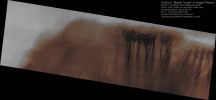
PSP_005160_1150_RED_abrowse-PCF-LXTT-00.jpgGullies in Mantle Terrain in Sisyphi Planum (CTX Frame - Absolute Natural Colors; credits for the additional process. and color.: Dr Paolo C. Fienga - Lunexit Team) 217 visiteCaption NASA:"This observation shows the East-facing Walls of an Unnamed Crater in Sisyphi Planum, near the South Polar Regions. Gullies, as well as Mantle Terrain and Polygons are also visible; these features suggest that at some point in time, liquid and ice may have been present at and near the Surface. The Gullies, which are rather eroded, have ample Alcoves and subdued Channels; dark patches and Ripples in the bottom of the Channels indicate that the most recent activity was Aeolian (such as "wind-driven") in Nature. Mantle Terrains are characterized by their smooth Surface and light, uniform color. They are widely interpreted as Terrains blanketed by a mixture of Ice and Dust, deposited under climatic conditions different from that of today. The Gullies in this image have Alcove Areas that seem to have cut through the Mantle Terrain, exposing the underlying materials". MareKromium
|
|
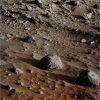
SOL1200-2P232911622EFFATB4P2367R1M1-PCF-LXTT.jpgLow Sun over Gusev - Sol 1200 (Absolute Natural Colors; credits for the additional process. and color.: Dr Paolo C. Fienga - Lunar Explorer Italia)217 visitenessun commentoMareKromium
|
|
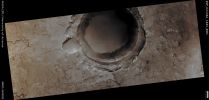
ESP_023382_1845_RED_abrowse-PCF-LXTT.jpgUnnamed Crater in Meridiani Planum (Enhanced Absolute Natural Colors; credits for the additional process. and color.: Dr Paolo C. Fienga - Lunexit Team)217 visiteMars Local Time: 14:07 (Early Afternoon)
Coord. (centered): 4,4° North Lat. and 356,6° East Long.
Spacecraft altitude: 272,9 Km (such as about 170,6 miles)
Original image scale range: 27,3 cm/pixel (with 1 x 1 binning) so objects ~ 82 cm across are resolved
Map projected scale: 25 cm/pixel
Map projection: EQUIRECTANGULAR
Emission Angle: 3,2°
Sun-Mars-Spacecraft (or "Phase") Angle: 32,3°
Solar Incidence Angle: 35° (meaning that the Sun is about 55° above the Local Horizon)
Solar Longitude: 332,8° (Northern Winter)
Credits: NASA/JPL/University of Arizona
Additional process. and coloring: Dr Paolo C. Fienga - Lunar Explorer ItaliaMareKromium
|
|
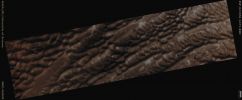
ESP_023956_1075_RED_abrowse-PCF-LXTT.jpgThe Beautiful Dunefield inside Richardson Crater (Absolute Natural Colors; credits for the additional process. and color.: Dr Paolo C. Fienga - Lunexit Team)217 visiteMars Local Time: 14:54 (Middle Afternoon)
Coord. (centered): 72,1° South Lat. and 180,9° East Long.
Spacecraft altitude: 250,8 Km (such as about 156,7 miles)
Original image scale range: 50,2 cm/pixel (with 2 x 2 binning) so objects ~ 1 mt and 51 cm across are resolved
Map projected scale: 50 cm/pixel
Map projection: POLAR STEREOGRAPHIC
Emission Angle: 8,6°
Sun-Mars-Spacecraft (or "Phase") Angle: 71,1°
Solar Incidence Angle: 76° (meaning that the Sun is about 14° above the Local Horizon)
Solar Longitude: 356,3° (Northern Winter)
Credits: NASA/JPL/University of Arizona
Additional process. and coloring: Dr Paolo C. Fienga - Lunar Explorer ItaliaMareKromium
|
|

Hyperion-PIA14583-PCF-LXTT.jpgHyperion (Absolute Natural Colors; credits for the additional process. and color.: Dr Paolo C. Fienga - Lunexit Team)217 visiteCaption NASA:The Cassini Spacecraft looks at Saturn's highly irregular moon Hyperion in this view taken from the Spacecraft's during the Fly-By that occurred on August, 25th, 2011. Hyperion (approx. 168 miles, or about 270 Km across) has an irregular shape, and it tumbles through its orbit: that is, it does not spin at a constant rate or in a constant orientation. (A standard reference latitude-longitude system has not yet been devised for this moon)
Images such as this one extend previous coverage and allow a better inventory of the Surface Features, the satellite's shape and changes in its spin.
The image was taken with the Cassini Spacecraft narrow-angle camera using a combination of spectral filters sensitive to wavelengths of Polarized Green Light centered at 617 and 568 nanometers. The view was obtained at a distance of approx. 36.000 miles (such as about 58.000 Km) from Hyperion and at a Phase Angle of 43° degrees. Image scale is 1145 feet (349 meters) per pixel".
MareKromium
|
|

ESP_024048_1425-PCF-LXTT-00.jpgChaos Terrain (CTX "A" - Enhanced Absolute Natural Colors; credits for the additional process. and color.: Dr Paolo C. Fienga - Lunexit Team)217 visiteMars Local Time: 14:24 (Early Afternoon)
Coord. (centered): 37,3° South Lat. and 178,7° East Long.
Spacecraft altitude: 253,4 Km (such as about 158,4 miles)
Original image scale range: 50,7 cm/pixel (with 2 x 2 binning) so objects ~ 1 mt and 52 cm across are resolved
Map projected scale: 50 cm/pixel
Map projection: EQUIRECTANGULAR
Emission Angle: 0,3°
Sun-Mars-Spacecraft (or "Phase") Angle: 50,1°
Solar Incidence Angle: 50° (meaning that the Sun is about 40° above the Local Horizon)
Solar Longitude: 359,9° (Northern Winter)
Credits: NASA/JPL/University of Arizona
Additional process. and coloring: Dr Paolo C. Fienga - Lunar Explorer ItaliaMareKromium
|
|
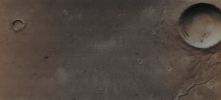
ESP_024563_1930-PCF-LXTT.jpgUnnamed Craters in Cerberus Fossae (Absolute Natural Colors; credits for the additional process. and color.: Dr Paolo C. Fienga - Lunexit Team) 217 visiteMars Local Time: 14:35 (early afternoon)
Coord. (centered): 12,7° North Lat. and 154,9° East Long.
Spacecraft altitude: 306,8 Km (such as about 191,8 miles)
Original image scale range: 30,7 cm/pixel (with 1 x 1 binning) so objects ~ 92 cm across are resolved
Map projected scale: 25 cm/pixel
Map projection: EQUIRECTANGULAR
Emission Angle: 25,6°
Phase Angle: 13,0°
Solar Incidence Angle: 38° (meaning that the Sun is about 52° above the Local Horizon)
Solar Longitude: 19,3° (Northern Spring)
Credits: NASA/JPL/University of Arizona
Additional process. and coloring: Lunar Explorer ItaliaMareKromium
|
|
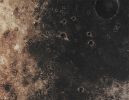
ESP_024556_2045-PCF-LXTT-00a.jpgFeatures of Mawrth Vallis (CTX Frame "A" - Absolute Natural Colors; credits for the additional process. and color.: Dr Paolo C. Fienga - Lunexit Team)217 visiteMars Local Time: 14:24 (early afternoon)
Coord. (centered): 24,1° North Lat. and 342,5° East Long.
Spacecraft altitude: 286,8 Km (such as about 179,2 miles)
Original image scale range: 28,7 cm/pixel (with 1 x 1 binning) so objects ~ 86 cm across are resolved
Map projected scale: 25 cm/pixel
Map projection: EQUIRECTANGULAR
Emission Angle: 0,3°
Phase Angle: 38,2°
Solar Incidence Angle: 38° (meaning that the Sun is about 52° above the Local Horizon)
Solar Longitude: 19,1° (Northern Spring)
Credits: NASA/JPL/University of Arizona
Additional process. and coloring: Lunar Explorer ItaliaMareKromium
|
|

OPP-SOL2806-1P377286744EFFBR08P2592R1M1-PCF-LXTT-0.jpgPartial View of Cape York - Sol 2806 (Enhanced and Sharpened Absolute Natural Colors; credits for the additional process. and color.: Dr Paolo C. Fienga - Lunexit Team)217 visitenessun commentoMareKromium
|
|

ESP_024435_2045_RED-PCF-LXTT.jpgUnnamed Crater with strange-looking Material on its Floor (Absolute Natural Colors; credits for the additional process. and color.: Dr Paolo C. Fienga - Lunexit Team)217 visiteCoord. (centered): 24,4° North Lat. and 46,6° East Long.MareKromium
|
|

ESP_024988_1370_RED-PCF-LXTT-00.jpgSouthern Dark Dunefield (CTX Frame "A" - Absolute Natural Colors; credits for the additional process. and color.: Dr Paolo C. Fienga - Lunexit Team)217 visiteCoord. (centered): 42,6° South Lat. and 74,0° East Long.MareKromium
|
|

SOL0173-GB-LXTT-IPF-CTX+EDM_ivana_p3_(1).jpgMartian Oddities - Sol 173217 visiteAs we wrote in yesterday's, February 4th, 2013, APOD, nobody knows for sure what this bright and metal-looking Feature that shines in the Sun right in front of the NASA - Mars Exploration Rover - Mars Laboratory "Curiosity" - and highlighted by a red circle that we drew around it - can be. As a matter of fact, the texture of the whole Feature (that looks extremely smooth) and the color of its upper portion, are completely different from the texture and color of the Rocky Paving that the Feature appears to be part of, and which characterizes the area currently explored by the Rover, and known as Yellowknife Bay. Maybe, if the NASA People will decide to get closer to this intriguing Feature and so take a better look at it, we may know more. But for now, we can only draw your attention on what it seems to be one of the greatest oddities ever discovered on the Red Planet.
And that is not all! Look at the Feature highlighted by the yellow square that we drew around it and then take a careful look at what seems to be hiding in an horizontal crack of the huge boulder that is only a few meters away from the Rover... Is that an optical illusion? A very oddly-shaped rock? Or - maybe - we are really looking at something that looks like a small rodent that can perfectly "hide in plain sight"? Of course, we do not know. What we do know is that this second Feature is not just a a light-trick (actually, it casts a small shadow on the wall of the crack behind it), but something real. Something that, in our opinion, as IPF, should really be investigated...
This picture (which is an image-mosaic obtained from several Original NASA - Mars Exploration Rover - Mars Laboratory "Curiosity" b/w frames taken during the 173rd Sol of the Rover's exploration of Gale Crater) has been additionally processed, calibrated and colorized in Natural Colors (such as the colors that a perfect human eye - or an Electronic Eye - would actually perceive if someone were near the NASA - Mars Exploration Rover (MER) - Mars Laboratory "Curiosity" and then looked ahead, towards the Rocky Paving located in front of and around the Rover), by using an original technique created - and, in time, dramatically improved - by the Lunar Explorer Italia Team. Different colors, as well as different shades of the same color, mean, among other things, the existence of different Elements (Minerals) present on the Surface of Gale Crater, each having a different Albedo (---> Reflectivity) and Chemical Composition.MareKromium
|
|
| 25353 immagini su 2113 pagina(e) |
 |
|
|
|
|
141 | |
|
|
|
|





