| Piú viste |

Hills-Knob-Elysium_Planitia-PIA08079-00.jpgBizarre "Knob" in Elysium Planitia (Original NASA/JPL/ASU b/w Frame)58 visiteImage information: VIS instrument;
Latitude: 1,1° South;
Longitude: 156,0° East;
Resolution: 18 meter/pixel.
|
|
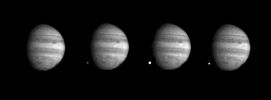
Shoemaker-Levy 9-1.jpgShoemaker-Levy 9: the W-impact (1)58 visiteThese four pictures, taken 2,3" apart, show the early meteor, or "bolide", stage of the impact of the last major fragment of Comet Shoemaker-Levy 9 into Jupiter's night side. In the first image (8:06:12 UTC), no impact is visible. In the second picture, a bright point of light appears superimposed on the dark side of Jupiter's Southern Hemisphere. In the third image, the impact has grown so bright that it saturates the CCD picture element at the center of the image of the impact flash. By remarkable coincidence, the HST took a picture of the W-impact, also in green light, within 1" of this image, providing a complementary view of very faint associated phenomena at very high altitudes in Jupiter's atmosphere, just above the planet's edge as seen from Earth. In the final Galileo image (8:06:19 UTC), the impact flash has faded appreciably.
These images are pictures 5 through 8 of a series of 56 placed on a single frame in time-lapse fashion. We interpret the rapid rise and fall of this initial peak over just 7 seconds to be the bolide phase of the W fragment's impact, analogous to the flash of light of meteors entering Earth's atmosphere. Images immediately following this show that the luminosity continues to fade over the next 15 seconds.
|
|

Shoemaker-Levy 9-2.jpgShoemaker-Levy 9: the W-impact (2)58 visiteThese four images of Jupiter and the luminous night-side impact of fragment W of Comet Shoemaker-Levy 9 are different versions of an average of 8 images taken by the Galileo spacecraft of July 22, 1994.
The frames that were averaged span about 30" near 8:06 UT.
These four "averaged" images show the scene without and with (top and bottom) spatial filtering and contrast enhancement, and without and with (left and right) a latitude/longitude grid. Grid spacing is 30 degrees, with 230° Longitude centered. The terminator is at about 265°. The impact location is about 43° South, as predicted, and at 280° Longitude. The dark spots to the right of the flash are from previous impacts.
|
|

Troughs-Olympica_Fossae-MGS-02.jpgThe Troughs of Olympica Fossae (2 - Original NASA/MGS/MSSS b/w Frame)58 visiteCaption originale:"This MGS-MOC image shows a complex pattern of intersecting and overlapping Troughs in the Olympica Fossae Region of Northern Tharsis. Some combination of Floods, Lava Flows and faulting/tectonic activity contributed to this scene, followed by mantling by dust. Dark Streaks on Slopes in the Troughs were formed by Dust Avalanches".
Location near: 24,8° North Lat. and 114,8° West Long.
Image width: ~3 Km (~1,9 mi)
Illumination from: lower left
Season: Northern Winter
|
|

OPP-SOL797-1N198933365EFF6912P1785L0M1.jpgMartian Sandglasses & Martian Paving (1) - Sol 79758 visitenessun commento
|
|

OPP-SOL797-1N198933365EFF6912P1785R0M1.jpgA very strange double-feature (1) - Sol 79758 visiteUn trittico di frames, ben selezionati ed evidenziati dal Dr Gianluigi Barca, i quali ci mostrano, nella Cerchiatura Verde (Gialla per il frame 2 e Fucsia per il frame 3) questa coppia di stranissimi rilievi che stazionano ad una - presumiamo - cinquantina di metri (o poco più) da Opportunity.
Se il dettaglio non fosse stato ripetitivo avremmo anche potuto pensare a dei photoartifacts, ma la verità è che si tratta di oggetti reali i quali, pur apparendoci un pò deformati e confusi (sia a causa della scarsa qualità dei frames, sia a causa della loro distanza dalla NavCam di Opportunity), ci sembrano veramente curiosi e, in un certo senso, disarmonici rispetto al paesaggio al quale accedono e del quale fanno parte.
Che cosa stiamo guardando?
|
|

OPP-SOL797-1N198933402EFF6912P1785L0M1.jpgA very strange double-feature (2) - Sol 79758 visitenessun commento
|
|

VAA-Uranus Rings-1.jpgUranus' Rings (3)58 visiteCiò che intendiamo dire (l'ipotesi di lavoro che Vi proponiamo) è questo: forse gli Anelli di Giove, Urano e di Nettuno hanno un'origine diversa (almeno in parte) rispetto a quelli di Saturno. Gli Scienziati che vanno per la maggiore, infatti, pensano che la differenza nella "tessitura" degli Anelli tipici dei Giganti Gassosi dipenda solo dalle dimensioni originali del corpo celeste (o dei corpi celesti) dal cui disintegrarsi essi vennero generati: più grande era questo/i corpo/i, maggiore era il quantitativo di materiale che si distribuiva lungo l'orbita, più grande e maestosa (scenicamente) risultava la trama finale degli Anelli. Noi opiniamo che, forse, questa costruzione spiega gli Anelli di Giove, Urano e Nettuno ma non è sufficiente - da sola! - per spiegare l'origine degli Anelli di Saturno i quali ci appaiono troppo grandi e troppo complessi per essere derivati soltanto da un evento come quello dianzi ipotizzato.
Ne riparleremo ancora.
|
|

Craters-Unnamed_Crater-Terra_Cimmeria.JPGUnnamed Crater with Gullies in Terra Cimmeria (Original NASA/MGS/MSSS b/w Frame)58 visiteCaption NASA originale:"This MGS-MOC image shows an array of gullies in the North-NorthWest wall of a crater in Terra Cimmeria. These features may have been formed through the interaction of several processes including, but not limited to, mass wasting and/or seepage and runoff of groundwater".
Location near: 33,5° South Lat. and 207,2° West Long.
Image width: ~3 Km (~1,9 mi)
Illumination from: upper left
Season: Southern Summer
|
|
Chaotic_Terrain-Memnonia-PIA08104-2.jpgChaotic Terrain between Memnonia Fossae and Elysium Planitia (2 - Original NASA/JPL/ASU b/w Frame)58 visitenessun commento
|
|

NGC-2207-PIA08097_modest.jpgNGC 2207 and IC 2163 (Colliding Galaxies)58 visite"...Keep your heart with all vigilance,
For from it flow the Springs of Life..."
Proverbs 4:23
|
|

Titan-PIA08167.jpgTitan's foggy Northern "Cap" (Original NASA/JPL/SSI b/w RAW Frame)58 visiteCaption NASA:"The complex and dynamic Atmosphere of Titan displays multiple Haze Layers near the North Pole in this view, which also provides an excellent look at the detached Stratospheric Haze Layer that surrounds the moon at lower Latitudes.
North on Titan is up and rotated 20° to the left.
The image was taken with the Cassini Spacecraft narrow-angle camera on March 16, 2006, using a filter sensitive to wavelengths of UltraViolet Light centered at 338 nanometers. The image was obtained at a distance of approx. 1,2 MKM (about 800.000 miles) from Titan and at a Sun-Titan-Spacecraft, or Phase, Angle of 68°. Image scale is approx. 7 Km (such as about 5 miles) per pixel".
|
|
| 25353 immagini su 2113 pagina(e) |
 |
|
|
|
|
1407 | |
|
|
|
|





