| Piú viste |

Solar Corona.jpgThe 2006 Total Solar Eclipse: the Solar Corona58 visiteDa "NASA - Picture of the Day", del 7 Aprile 2006:"During a total Solar Eclipse, the Sun's extensive outer atmosphere (or Corona) is an awesome and inspirational sight. The subtle shades and shimmering features of the corona that engage the eye span a brightness range of over 10.000 to 1, making them notoriously difficult to capture in a single picture. But this composite of 33 digital images ranging in exposure time from 1/8000 to 1/5th of second comes very close to revealing the crown of the Sun in all its glory. The telescopic views were recorded from Side, Turkey, during the March 29, 2006, Solar Eclipse, a geocentric celestial event that was widely seen under nearly ideal conditions.
The composite also captures a pinkish prominence extending just beyond the upper edge of the eclipsed Sun".
|
|

Q-S-BosporusRupes-PIA08047_modest.jpgBosporos Rupes58 visiteThis image was taken in the mid-latitudes of Mars' Southern Hemisphere near the giant Argyre Impact Basin. It is located just to the West of a prominent scarp known as Bosporos Rupes. The left side of the image shows cratered plains. Some of the craters are heavily mantled and indistinct, whereas others exhibit sharp rims and dramatic topography. The largest crater in this half of the image is about 2,5 Km wide. Mounds and ridges, which may be remnants of an ice-rich deposit, are visible on its floor. Three sinuous valleys occupy the center of the image. Valleys such as these were first observed in data returned by the NASA Mariner 9 spacecraft, which reached Mars in 1971. The right side of the image shows part of an impact crater that is approx. 20 Km in diameter. The furrowed appearance of the crater's inner wall suggests that it has been extensively modified, perhaps by landslides and flowing water. Like other craters in the area, the floor of this crater has a rough and dissected texture that is often attributed to the loss of ice-rich material.
This image was taken by the High Resolution Imaging Science Experiment (HiRISE) camera onboard NASA's Mars Reconnaissance Orbiter spacecraft on March 24, 2006. The image is centered at 40,64° South Latitude, 303,49° East Longitude. The image is oriented such that North is 7° to the left of up. The range to the target was 2.044 Km (about 1.270 miles). At this distance the image scale is 2,04 mt (6,69 feet) per pixel, so objects as small as 6,1 mt (20 feet) are resolved. In total this image is 40,90 Km (about 25,41 miles) or 20.081 pixels wide and 11,22 Km (such as 6,97 miles) or 5.523 pixels high. The image was taken at a Local Mars Time of 07:30 and the scene is illuminated from the upper right with a solar incidence angle of 81,4° (this meaning that the Sun was about 8,6° above the horizon).
|
|

ZYZ-Q-PlutoLatestColors.jpgThe "true" colors of Pluto (another interpretation)58 visiteUno studio sui possibili colori autentici di Plutone, realizzato dal bravo e modesto Ricercatore Don Davis, di cui abbiamo già apprezzato svariati studi ed elaborazioni sui "Colori del Sistema Solare" (Marte e Venere, in maniera particolare, sono - secondo noi - i suoi lavori più belli e riusciti).
Caption originale:"Pluto seems to have intriguing surface details, with pronounced contrast between white and yellow brown Regions. These regional contrasts have been largely detected by measurements of light changes as Pluto was eclipsed by its large satellite Charon, in the late 1980's. The albedo of Pluto ranges from 0,49 to 0,66, while darker more neutral colored Charon averages about 0,37".
|
|

Q-U-Bosporus Planum (IR-VIS)-04.jpgBosporus Planum - detail mgnf (4)58 visitenessun commento
|
|

OPP-SOL786-1N197958385EFF68M8P1795L0M1.jpgLooking behind (2) - Sol 78658 visitenessun commento
|
|

NGC-0869_and_0884.jpgNGC 869 ("h" Persei) and NGC 884 ("chi" Persei)58 visite"...C'è solo un interrogativo che mi fa davvero impazzire, ed è questo: sono io quello che è pazzo, o lo sono tutti quelli che mi circondano?..."
Albert Einstein
|
|

Craters-Unnamed_Crater-Layered_Outcrop-Thaumasia_Region-00.jpgLayered Rocky Outcrops (Original NASA/MGS/MSSS b/w Frame)58 visiteCaption NASA originale:"This MGS-MOC image shows light-toned, layered rock outcrops in the central pit of an impact crater in the Thaumasia Planum Region of Mars. The outcrops were tilted and broken-up by the extreme energy of the impact that formed the crater in which they occur. These are layers of rock that were brought up by the impact from horizontal beds that lie below the floor of the crater".
Location near: 21,7° South Lat. and 69,4° West Long.
Image width: ~3 Km (~1,9 mi)
Illumination from: upper left
Season: Southern Summer
Nota: difficile pensare, per spiegare i rilievi catturati in questo frame, ad una costruzione logica più improbabile di quella proposta dalla NASA...
|
|

Hills-Knob-Elysium_Planitia-PIA08079-00.jpgBizarre "Knob" in Elysium Planitia (Original NASA/JPL/ASU b/w Frame)58 visiteImage information: VIS instrument;
Latitude: 1,1° South;
Longitude: 156,0° East;
Resolution: 18 meter/pixel.
|
|
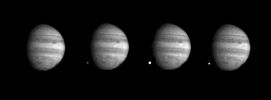
Shoemaker-Levy 9-1.jpgShoemaker-Levy 9: the W-impact (1)58 visiteThese four pictures, taken 2,3" apart, show the early meteor, or "bolide", stage of the impact of the last major fragment of Comet Shoemaker-Levy 9 into Jupiter's night side. In the first image (8:06:12 UTC), no impact is visible. In the second picture, a bright point of light appears superimposed on the dark side of Jupiter's Southern Hemisphere. In the third image, the impact has grown so bright that it saturates the CCD picture element at the center of the image of the impact flash. By remarkable coincidence, the HST took a picture of the W-impact, also in green light, within 1" of this image, providing a complementary view of very faint associated phenomena at very high altitudes in Jupiter's atmosphere, just above the planet's edge as seen from Earth. In the final Galileo image (8:06:19 UTC), the impact flash has faded appreciably.
These images are pictures 5 through 8 of a series of 56 placed on a single frame in time-lapse fashion. We interpret the rapid rise and fall of this initial peak over just 7 seconds to be the bolide phase of the W fragment's impact, analogous to the flash of light of meteors entering Earth's atmosphere. Images immediately following this show that the luminosity continues to fade over the next 15 seconds.
|
|

Shoemaker-Levy 9-2.jpgShoemaker-Levy 9: the W-impact (2)58 visiteThese four images of Jupiter and the luminous night-side impact of fragment W of Comet Shoemaker-Levy 9 are different versions of an average of 8 images taken by the Galileo spacecraft of July 22, 1994.
The frames that were averaged span about 30" near 8:06 UT.
These four "averaged" images show the scene without and with (top and bottom) spatial filtering and contrast enhancement, and without and with (left and right) a latitude/longitude grid. Grid spacing is 30 degrees, with 230° Longitude centered. The terminator is at about 265°. The impact location is about 43° South, as predicted, and at 280° Longitude. The dark spots to the right of the flash are from previous impacts.
|
|

Troughs-Olympica_Fossae-MGS-02.jpgThe Troughs of Olympica Fossae (2 - Original NASA/MGS/MSSS b/w Frame)58 visiteCaption originale:"This MGS-MOC image shows a complex pattern of intersecting and overlapping Troughs in the Olympica Fossae Region of Northern Tharsis. Some combination of Floods, Lava Flows and faulting/tectonic activity contributed to this scene, followed by mantling by dust. Dark Streaks on Slopes in the Troughs were formed by Dust Avalanches".
Location near: 24,8° North Lat. and 114,8° West Long.
Image width: ~3 Km (~1,9 mi)
Illumination from: lower left
Season: Northern Winter
|
|

OPP-SOL797-1N198933365EFF6912P1785L0M1.jpgMartian Sandglasses & Martian Paving (1) - Sol 79758 visitenessun commento
|
|
| 25353 immagini su 2113 pagina(e) |
 |
|
|
|
|
1406 | |
|
|
|
|





