| Piú viste |
SOL1254-2N237599908EFFAUCMP1936R0M1.jpgFoggy days over Gusev Crater... - Sol 125458 visitenessun commentoMareKromium
|
|

NGC-6384.jpgNGC 6384 - Spiral Galaxy58 visite"...Multa cadunt inter calicem supremaque labra..."
(Gellio)
"...Molti eventi accadono nel (pur breve) tempo che occorre per portare una coppa alle labbra..."MareKromium
|
|

SOL1255-2P237774685EFFAUCMP2380L6M1.jpgStill foggy days over Gusev... (1) - Sol 125558 visitenessun commentoMareKromium
|
|

The_Rings-PIA08988.jpgBright Region in the C-Ring58 visiteCaption NASA:"This bright, isolated plateau in the middle of the C-Ring displays interesting internal variations in brightness. The plateau is not high in terms of elevation, but rather in terms of its particle density (seen here as brightness), which is several times higher than the surrounding Ring Structure.
Ring scientists are working to understand what produces the sharp boundaries of the plateau features, as well as the nature of the internal variations in brightness.
This view looks toward the sunlit side of the Rings from about 18° below the Ring-Plane.
The image was taken in visible light with the Cassini spacecraft narrow-angle camera on June 12, 2007 at a distance of approx. 230.000 Km (about 143.000 miles) from Saturn. Image scale is roughly 1 Km (3353 feet) per pixel".MareKromium
|
|

as17-153-23589.jpgAS 17-153-23589 - Wallace Crater58 visiteImage Collection: 70mm Hasselblad
Mission: 17
Magazine: 153
Magazine Letter: MM
Revolution: 39
Latitude: 20,4° North
Longitude: 8,3° West
Lens Focal Length: 80 mm
Camera Altitude: 103 Km
Sun Elevation (on Local Horizon): 1°
Mission Activity: REV 39
Film Type: SO-368
Film Width: 70 mm
Film Color: colorMareKromium
|
|
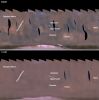
OPP-SOL1235-PIA-00936.jpgSeries of Storms Shrouds Mars in Dust (1) - NASA/JPL/Malin Space Science Systems58 visiteSince late June 2007, Mars has been having a series of regional dust storms. The dust raised by these individual storms has obscured most of the planet over the past few weeks. The two maps shown here are mosaics of images acquired by the Mars Reconnaissance Orbiter (MRO) Mars Color Imager (MARCI) on two days separated by about 3 and a half weeks. The first, on 22 June, shows that there was a dust storm occurring near the east end of the Valles Marineris trough system (left of the label for "Opportunity" in the map). This was the first in the series of storms. The second mosaic shows how Mars appeared on 17 July, after dust was lofted high into the atmosphere by several regional storms and countless smaller, local dust storms.
Each map was constructed from 13 pole-to-pole image swaths at red, green, and blue wavelengths acquired by the MRO MARCI. The maps are simple cylindrical projections, with north at the top and south at the bottom. Each image swath was acquired at about 3 p.m. local time on Mars over the course of 13 orbits. The black gaps occur in the MARCI data at places where the MRO spacecraft was slewed east or west to point its instruments at a specific target of scientific interest. The north polar region is not shown because winter began on 4 July and the north polar region is in wintertime darkness. Key features labeled on the maps include the Tharsis Montes and Olympus Mons volcanoes, the Hellas impact basin, Noachis Terra, Sinus Meridiani, and the two Mars Exploration Rover (MER) landing sites, Opportunity and Spirit. The dust storms, and the planet-encircling dust veil they generated, has greatly reduced the amount of sunlight available to run the two solar-powered rovers.
MareKromium
|
|

as17-152-23328.jpgAS 17-152-23328 - Lunar Maria: Crisium and Tranquillitatis (elab. in true colors by Lunexit)58 visitenessun commentoMareKromium
|
|

A-Phoenix-000.jpgThe (fully assembled) Phoenix Mars Lander58 visitenessun commentoMareKromium
|
|

A-Phoenix-006.jpgLooking at the Twilights...58 visitenessun commentoMareKromium
|
|
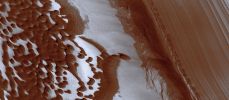
North_Polar_Regions-Chasma_Boreale-MGS-01.jpgBrown Dunes in Chasma Boreale (Enhanced Natural Colors; credits for the additional process. and color.: Dr Paolo C. Fienga - Lunexit Team)58 visitenessun commentoMareKromium
|
|

North_Polar_Features-Dunes-MGS-01.jpgNorth Polar Dunes (Natural Colors; credits for the additional process. and color.: Dr Paolo C. Fienga - Lunexit Team)58 visiteCaption NASA originale:"This MGS-MOC image shows dunes in the North Polar Region of Mars. In this Springtime view, the dunes are largely covered by frozen Carbon Dioxide (CO2) that was deposited during the Winter months in the Northern Hemisphere. Dark spots indicate areas where the frost has begun to either sublime away, acquire a roughened texture, or both".
Location near: 77,3° North; 95,4° West
Image width: ~3 Km (~1,9 mi)
Illumination from: lower left
Season: Northern SpringMareKromium
|
|
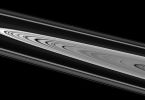
The_Rings-PIA08999.jpgSidelong View58 visiteCaption NASA:"Saturn's enchanting rings display crisply defined edges and strong contrast on their unilluminated side. Atlas (32 Km, or about 20 miles across) sits on the far side of the Rings above center, between the "A" and "F" Rings. This view was acquired from about 1° above the Ring-Plane.
The image was taken in visible light with the Cassini spacecraft narrow-angle camera on June 21, 2007 at a distance of approx. 2,4 MKM (about 1,5 MMs) from Atlas. Image scale is roughly 14 Km (about 9 miles) per pixel".MareKromium
|
|
| 25353 immagini su 2113 pagina(e) |
 |
|
|
|
|
1405 | |
|
|
|
|





