| Piú viste |

Japetus-PIA08378.jpgSo close, and yet so far...58 visiteThis mosaic of Cassini images shows the smallest details ever observed on Saturn's moon Japetus.
Visible here are small craters as well as the base of a large mountain ridge located just South of the mosaic. At several places, bright spots about 20 to 50 meters (66 to 164 feet) across are visible. At these locations, more recent impactors have punched through the overlying blanket of dark material to reveal brighter, cleaner ice beneath.
Since the bright craters are relatively small and very shallow, it is likely that the dark blanket is rather thin in this area; it is assumed that its actual average thickness might be on the order of a foot.
The small crater at the upper left edge of the mosaic has a diameter of about 50 meters (164 feet) and shows a distinct ray pattern from excavated ice. This feature is so bright in comparison to the dark surrounding terrain that it had to be darkened manually so as not to look overexposed in this mosaic.
The mosaic consists of 8 image footprints across the surface of Japetus, presented here in simple cylindrical projection. The view is centered on terrain near 0° North Latitude, 164,9° West Longitude, within the dark Leading Hemisphere of Japetus. Image scale is approx. 10 meters (33 feet) per pixel.
The clear spectral filter images in this mosaic were obtained with the Cassini spacecraft narrow-angle camera on Sept. 10, 2007, at distances ranging from 1.627 to 2.040 Km (such as from about 1.011 to 1.268 miles) from Japetus.MareKromium
|
|
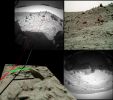
SOL1332-2N24462071-Martian_Wheel.jpgWhere's the Wheel?!? - Sol 133258 visiteUn nuovo, ed anche questo davvero MOLTO suggestivo e ben fatto, Lavoro del Dr Faccin, il quale ci fornisce alcuni "riferimenti" essenziali per tentare una triangolazione e quindi capire DOVE si trova la "Ruota" rispetto al Rover che, come ormai avrete notato, sta facendo delle acrobazie per passarci accanto senza vederla...
Complimenti, ancora una volta meritatissimi, al Dr Faccin e, per il resto, buon lavoro a chiunque voglia tentare non solo di dirci dove si trova, ma anche (e soprattutto) che cosa - effettivamente - potrebbe essere/è questa Ruota Marziana...MareKromium
|
|

Enceladus-PIA08385.jpgThe sources of Enceladus' Fountains58 visiteCaption NASA:"This map of the South Polar Region of Enceladus shows the correlation between jet sources identified in Cassini imaging data and hot spots on the surface located by the Composite Infrared Spectrometer Instrument.
To identify jet source locations on the surface, imaging scientists carefully measured the locations and orientations of individual jets observed along the moon's limb in Cassini images taken from multiple viewing angles. For each jet measurement, the researchers then computed a curve, or ground track, on the surface of Enceladus along which that jet might lie. The ground tracks from all of the measurements made in the various images produced many intersections on this map. By considering the jet directions at every possible intersection, the researchers isolated 8 clusters of ground track intersections as jet sources.
The 8 identified jet source locations are labeled with yellow roman numerals. Composite Infrared Spectrometer hot spots are red boxes labeled with green capital letters.
The line-of-sight intersections indicating the measurements of each source in individual images are shown as colored diamonds.
White circles indicate the uncertainty in the locations of those sets of intersections.
The map is a polar stereographic projection of Cassini imaging data.
The 4 Tiger Stripe fractures, or sulci, are labeled here.
The South Pole is the dead center on the map.
Key longitudes are also labeled around the perimeter of the map".MareKromium
|
|
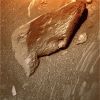
SOL1338-2P245143232EFFAVFUP2514R1M1.jpgSo bright and clean... (2) - Sol 133858 visitenessun commentoMareKromium
|
|
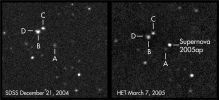
SN-2005ap.jpgSupernova SN 2005ap58 visite"...Son gli Dei spettator, la Terra è scena:
E noi siam gli istrioni, ond'Ella è piena..."
L. Alemanni - "Versi e Prose"
Nota: frase ripresa (forse) da Petronio (Fragm. - Ad Rhenum), il quale diceva:"...Fere totus mundus exercet histrionem..."MareKromium
|
|

MilkyWayRoad.jpgThe "Milky Way Road"58 visite"...Dominus dedit, Dominus abstulit..."
(Giobbe - 1, 21)
"...Dio diede, Dio tolse..."MareKromium
|
|
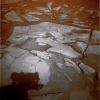
OPP-SOL1329-1N246174117EFF8788P0175R0M1.jpgPaving and Razorblades inside Victoria (1 - possible natural colors; light-blue color filter on; elab. Lunexit)58 visitenessun commentoMareKromium
|
|
OPP-SOL1329-1P246170461ESF8754P2585L3M1.jpgThe "Inner Paving" and the "Red Sands" of Victoria - Sol 1329 (red-orange filter ON - possible natural colors - elab. Lunexit)58 visitenessun commentoMareKromium
|
|

PSP_005346_1755_RED_abrowse-01.jpgLow-Order Inverted Streams near Juventae Chasma (extra-detail mgnf)58 visiteThis subimage (approx. 1120 meters across) shows a juncture of 2 of the "Inverted Channels".
It is likely that the water flowed from the left to the right of the scene, because channels usually join rather than divert unless there is an obvious obstacle in the way.
No such obstacle is seen here, but one might have been present when the stream originally flowed.
However, there is no way of knowing this.MareKromium
|
|

PSP_005381_0870_RED_abrowse.jpgSouth Polar Layered Deposits with Surface Modification (possible natural colors - elab. Lunexit)58 visiteThis image shows a scarp exposing the south polar layered deposits (SPLD). The polar layered deposits are thought to record recent climate variations on Mars, similar to ice ages on Earth.
Radar data indicate that the SPLD are ice-rich, with variations in dust contamination likely causing the layering visible here. HiRISE images of the SPLD will help to unravel Mars' climate history, but this image illustrates how this effort is complicated.
The development of surface features, by erosion, deposition, or modification of the surface, makes it difficult to determine the characteristics of the layers themselves. Some of the layers appear wavy, perhaps due to folding, flow, or uneven erosion since they were laid down. Short, branching, often radial channel systems are cut into the surface of the layers in places. These may be related to "spiders," thought to be formed as carbon dioxide gas flows along the surface when the seasonal polar cap sublimates in the spring. Pits and polygonal fractures are visible on the layers as well.
Apparently this exposure of SPLD is relatively old, as these features probably take many years to form. While these features are interesting in their own right, they disturb the SPLD outcrops and make it more difficult to measure the thickness of layers and compare them to other outcrops of SPLD.
MareKromium
|
|

NGC-3372.jpgNGC 3372 - The "Carina Nebula"58 visite"...See, the whole land is before you: go wherever you think it is good and right to go..."
- Jeremiah, 40:4MareKromium
|
|

LLN-Itokawa-ST_2506733028_v.pngApproaching Itokawa (4 - natural colors; elab. Lunexit)58 visitenessun commentoMareKromium
|
|
| 25353 immagini su 2113 pagina(e) |
 |
|
|
|
|
1404 | |
|
|
|
|





