| Piú viste |

Titan-Huygens_Landing_Site-05-LS27_PSS_LSoderblom_DISR_Topo20070323.jpgTectonic and fluid-flow patterns on Titan (HR)58 visiteThis image of Titan’s surface, obtained by Huygens’ DISR imager, shows patterns of tectonic and fluid-flow activity.
The tectonic patterns are indicated by blue lines; the drainage divide is indicated by the red line; flow directions are indicated by the green arrows.
The Huygens Landing Site is marked by a white cross.
MareKromium
|
|

Titan-Huygens_Landing_Site-02-LS28_PSS_LASoderblom_VIMSRADAR20070323.jpgHuygens Probe Landing Site58 visiteThese images of the Huygens Landing Site on Titan were obtained by Cassini’s SAR radar (1st and 3rd rows) and VIMS (2nd and 4th rows) instruments, and are correlated in this composite view.
The 4 upper images show the Region of the Sinlap Crater in the Huygens Landing Site Region. The area shown is about 850 by 1150 Km wide.
The 4 lower images are colour-mapped as: red, to indicated solid dunes; yellow, to indicate a partial dune coverage; and green to indicate not mappable areas.MareKromium
|
|

Titan-Huygens_Landing_Site-00-LS27_PSS_LSoderblom_DISR_Topo20070323.jpgHuygens Probe Landing Site (perspective)58 visiteThis West-looking perspective of the Huygens Landing Site shows the Huygens descent trajectory in blue (the blue vertical lines indicate the ground track location). The base map (16 metres per pixel) is a mosaic obtained by the Descent Imager and Spectral Radiometer (DISR) on board Huygens.MareKromium
|
|

NGC-4438_and_NGC-4435.jpgInteracting Galaxies: NGC 4438 and NGC 443558 visite"...As long as our Language is inadequate, our Vision remains formless..."
Adrienne Rich - "On Lies, Secrets, and Silence" (1980)MareKromium
|
|
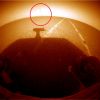
OPP-SOL1196-1F234369336EFF84GZP1212R0M1-1.jpgDark "Streak" (context image) - Sol119658 visiteNella Cerchiatura Rossa ci appare, come ben segnalatoci dal Dr Gianluigi Barca (che ringraziamo per la costante attenzione e dedizione), un "dark streak" (o "striscia di colore scuro") la cui natura è davvero difficile - se non impossibile - da definire.
Le nostre ipotesi le troverete nel frame che segue. MareKromium
|
|

Titan-W00028749.jpgOn the "Dark Side" of Titan...58 visitenessun commentoMareKromium
|
|

SOL1218-2P234480929EFFATF3P2558R1M1.jpgAntenna and "Home Plate" - Sol 121858 visitenessun commentoMareKromium
|
|

Titan-N00084850.jpgInterpreting Titan (5)58 visitenessun commentoMareKromium
|
|
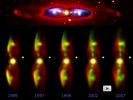
M2-9-00.jpgEvolution...58 visite"...In medio clivo laborat..."
(Petronio)
"...Chi si trova a metà (di un'opera o di un percorso) ha ancora molto da fare..."MareKromium
|
|
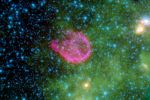
SNR-N132D-PIA09604.jpgThe "Shock-Waves" of N132D58 visiteSupernovae are the explosive deaths of the universe's most massive stars. In death, these volatile creatures blast tons of energetic waves into the cosmos, destroying much of the dust surrounding them.
This false-color composite from NASA's Spitzer Space Telescope and NASA's Chandra X-ray Observatory shows the remnant of one such explosion. The remnant, called N132D, is the wispy pink shell of gas at the center of this image. The pinkish color reveals a clash between the explosion's high-energy shockwaves and surrounding dust grains.
In the background, small organic molecules called polycyclic aromatic hydrocarbons are shown as tints of green. The blue spots represent stars in our galaxy along this line of sight.
N132D is located 163.000 LY away in the Large Magellanic Cloud.
In this image, infrared light at 4,5 microns is mapped to blue, 8,0 microns to green and 24 microns to red. Broadband X-ray light is mapped purple. The infrared data were taken by Spitzer's infrared array camera and multiband imaging photometer, while the X-ray data were captured by Chandra.
MareKromium
|
|
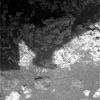
SOL1232-2M235735230EFFAU00P2956M2M1.jpgInteresting Soil... (5) - Sol 123258 visitenessun commentoMareKromium
|
|
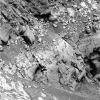
OPP-SOL1214-1P235957410EFF85NOP2445L2M1.jpgThe Inner Wall of Victoria - Sol 121458 visitenessun commentoMareKromium
|
|
| 25353 immagini su 2113 pagina(e) |
 |
|
|
|
|
1403 | |
|
|
|
|





