| Piú viste |

as16-118-18977.jpgAS 16-118-18977 - Mendeleev Crater (additional processing by Lunexit)58 visiteImage Collection: 70mm Hasselblad
Mission: 16
Magazine: 118
Magazine Letter: NN
Latitude: 7,7° North
Longitude: 140,2° East
Camera Altitude: 122 Km
Film Type: SO-368
Film Width: 70 mm
Film Color: colorMareKromium
|
|

Craters-Unnamed_Crater_with_possible_Oil_Lake-V07738009-PCF-LXTT-06.gifAs Time Goes By... (a GIF-Movie by Dr Gianluigi Barca - Lunexit Team)58 visitenessun commentoMareKromium
|
|

Craters-Unnamed_Crater_with_possible_Oil_Lake-V07738009-PCF-LXTT-03.jpgMigrating Dunes, Dirty Waters or maybe Surfacing Hydrocarbons? (4 - Natural Colors; credits for the additional process. and color.: Dr Paolo C. Fienga - Lunexit Team)58 visitenessun commentoMareKromium
|
|

PSP_004989_0945_RED_browse.jpgSwiss Cheese Terrain in the South Polar Region58 visiteSince Mars is colder than Earth, there is not just water ice at the Poles, but also a concentration of Carbon Dioxide (CO2) ice. Some of the Carbon Dioxide ice at the South Pole is there all year long and called the "Residual Cap".
This image was taken near the South Pole of Mars and shows a characteristic "Swiss cheese" pattern.
This pattern is created when there is relatively high, smooth material that is broken up into these circular-shaped depressions forming the "Swiss cheese" terrain.
The depressions are thought to be caused by sublimation, which is when a material goes directly from a solid to a gas phase.
Repeated images are taken of areas like this so the changes in depression size and where they form can be monitored through the seasons.MareKromium
|
|

Titan-Atmosphere-N00091073.jpgIn the Night of Titan - (possible natural colors; elab. Lunexit)58 visiteCaption NASA:"N00091073.jpg was taken on August 30, 2007 and received on Earth September 01, 2007. The camera was pointing toward TITAN that, at the time, was approx. 138.726 Km away, and the image was taken using the CL1 and UV3 filters. This image has not been validated or calibrated".MareKromium
|
|

Rho_Ophiuci.jpgRho Ophiuci58 visite"...Virtus et Summa Potestas non coeunt..."
(Lucano)
"...Virtù e Potere non vanno d'accordo..."MareKromium
|
|

PSP_003948_0935_RED_browse.jpgSouth Pole Residual Cap (Swiss-Cheese Terrain Monitoring)58 visiteLike Earth, Mars has concentrations of water ice at both Poles. Because Mars is so much colder however, Carbon Dioxide (CO2) ice is deposited at high latitudes in the Winter and is removed in the Spring, analogous to winter-time water ice/snow on Earth.
Around the South Pole there are areas of this CO2 ice that do not disappear every Spring, but rather survive Winter after Winter; this persistent CO2 ice is called the "South Pole Residual Cap".
The retention of CO2 ice throughout the year by the Southern Polar Cap is one characteristic that distinguishes it significantly from Mars' North Polar Cap.
As can be seen in this HiRISE image of the south pole residual cap, relatively high-standing smooth material is broken up by circular, oval, and blob-shaped depressions. This patterned terrain is called "swiss cheese" terrain. The high-standing areas are carbon dioxide ice with thicknesses of several to approximately 10 meters. The depressions are thought to be caused by the removal of this carbon dioxide ice by sublimation (the change of a material from solid directly to gas). As most depressions seem to have relatively flat floors, there is likely some layer below, possibly made of water ice, that cannot be as easily removed by sublimation. Complicated shapes arise when neighboring growing depressions intersect.
A previous Mars imaging system, the Mars Orbiter Camera (MOC), took images of the same places on the south pole residual cap every year for many years, and showed that there are annual changes taking place within it. By looking at different sizes and shapes of depressions in an image such as this, and by comparing images of the same place from year to year, the development of "swiss cheese" terrain can be described. The sublimation process may begin as a small, shallow depression in a smooth surface. This depression then deepens until reaching the resistant layer below, and continues to expand laterally in all directions, creating the generally round depressions we see today. Different heights and thicknesses of smooth areas, and different depths of depressions, may indicate that multiple episodes of accumulation and sublimation have occurred.
This is one of the locations previously monitored at lower resolution by MOC. With the high resolution and repeat-imaging capability of HiRISE, we intend to continue monitoring and better measure the amount of expansion of the depressions over one or more Mars years. This is one of the locations specifically targeted by HiRISE for this purpose.
Knowing the amount and rate of carbon dioxide removal can give us a better idea of the role of carbon dioxide (the main component of the Martian atmosphere) in polar and atmospheric processes, of current environmental and climatic conditions, and of how Mars climate may be changing.
In HiRISE images such as this one, it is evident on the slopes of the large, especially high mesa just above the center of the image that the carbon dioxide-rich material may be constructed of several individual horizontal layers. However, it also appears that as erosion eats into the mesa, pieces of a stronger mesa surface layer break off and are left strewn on the mesa slopes, where they may give the appearance of layering.
An interesting feature in this HiRISE image is the crisscrossing network of faint ridges and troughs on the upper smooth terrain. These may also be complexly involved in the sublimation and deposition of carbon dioxide ice. MareKromium
|
|
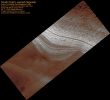
PSP_004742_0990_RED_browse.jpgGeologic History Recorded in the South Polar Layered Deposits (Extremely Enhanced Natural Colors; credits for the additional process. and color.: Dr Paolo C. Fienga - Lunexit Team)58 visiteThe Polar Layered Deposits on Mars are thought to be composed of varying amounts of water ice and dust. The variations in the relative amounts of ice and dust are probably caused by recent climate changes on Mars, similar to ice ages on Earth.
This image of the South Polar Layered Deposits shows many layers, some of which are cut off or truncated against other layers (near the center of the image). These truncations are probably due to periods of erosion separating periods of deposition.
After nearly horizontal layers are deposited, they can be partly eroded (perhaps by winds) before more layers are deposited over them. In this image, there is evidence for at least two such episodes of erosion and burial. These types of observations are useful to Mars scientists as they try to unravel the climate history of Mars. MareKromium
|
|
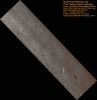
PSP_004673_0935_RED_browse.jpgSouth Pole Residual Cap - Swiss-Cheese Terrain Monitoring (Natural Colors; credits for the additional process. and color.: Dr Paolo C. Fienga - Lunexit Team)58 visitenessun commentoMareKromium
|
|
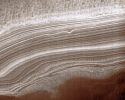
PSP_004917_1080_RED_browse-01.jpgComplex Geology in the South Polar Layered Deposits (extra-detail mgnf)58 visiteAbove and right of center, the layers appear wavy and in places, layers are cut off by other layers. Such structures may be formed by flow or faulting, but in this case they are more likely to be due to erosion of the lower part of the layered deposits before the upper part was laid down over it. For example, deposition may have halted long enough for channels to be eroded into the layered deposits.
When deposition resumes, new layers deposited in the channels could form the structures visible here. However, without more precise topographic information than is currently available, other hypotheses cannot be excluded.MareKromium
|
|
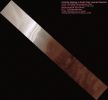
PSP_004917_1080_RED_browse-00.jpgComplex Geology in the South Polar Layered Deposits (context image)58 visiteThis section of the HiRISE image shows a scarp exposing the South Polar Layered Deposits, with illumination from the upper right (scarp slopes toward bottom). The Polar Layered Deposits probably contain a record of relatively recent climate changes on Mars, similar to ice ages on Earth.
The Deposits appear to be composed mostly of water ice, with variations in dust content controlling the erosion of the layers. This image shows that the history of the South Polar Layered Deposits has not been simple accumulation of horizontal layers.MareKromium
|
|

PSP_004959_0865_RED_browse.jpgPolygonal Fracturing of South Polar Layered Deposits58 visiteThis image shows the South Polar Layered Deposits, with curving layer outcrops caused by erosion of valleys into the Deposits.
On closer inspection, polygonal (mostly rectangular) fractures are visible, mostly near the center of the image. Polygonal fractures are also observed in the North Polar Layered Deposits, but typically on a much smaller scale.
Here in the South, the fractures cross layer boundaries, while in the North the fractures are usually confined to a single layer.
Therefore, the fractures in the South Polar Layered Deposits formed after the surface was eroded to the configuration seen here, probably due to expansion and contraction of water ice below the surface.MareKromium
|
|
| 25353 immagini su 2113 pagina(e) |
 |
|
|
|
|
1401 | |
|
|
|
|





