| Piú viste |

SOL582-2N178037282EFFAE00P0695R0M1.jpgPanorama (3) - Sol 58258 visitenessun commento
|
|

SOL582-2N178037333EFFAE00P0695L0M1.jpgPanorama (4) - Sol 58258 visitenessun commento
|
|

SOL582-2N178037431EFFAE00P0695R0M1.jpgPanorama (5) - Sol 58258 visitenessun commento
|
|
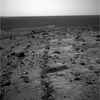
SOL582-2N178037631EFFAE00P0795L0M1.jpgPanorama (6) - Sol 58258 visitenessun commento
|
|
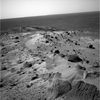
SOL582-2N178037831EFFAE00P0795R0M1.jpgPanorama (7) - Sol 58258 visitenessun commento
|
|

Rhea-PIA07575.jpgTirawa Impact Basin on Rhea58 visiteThe giant Tirawa impact basin straddles the day and night boundary on Saturn's moon Rhea in this view from the Cassini spacecraft. The ancient basin is 5 Km deep in places, as measured in NASA Voyager images. The whole basin is about 360 Km across.
The prominent bright splotch to the southeast of Tirawa is ejecta from a fairly fresh crater. This view of Rhea (1.528 Km, such as about 949 miles across) reveals terrain slightly to the East of a similar Cassini view, released earlier (see Diversity of Impacts). The sunlit surface in this view is principally on the leading hemisphere of Rhea. North is up and rotated 13° to the left.
The image was taken in visible light with the Cassini spacecraft narrow-angle camera on Aug. 13, 2005, at a distance of approx. 2 MKM (about 1,2 MMs) from Rhea and at a Sun-Rhea-spacecraft, or phase, angle of 50°. Resolution in the original image was 12 kilometers (7 miles) per pixel. The image has been contrast-enhanced and magnified by a factor of two to aid visibility.
|
|

SOL497-Gusev_Crater7-PIA04179.jpgGusev Crater's Horizon - Soles 497/500 (Approximate True Colors; credits: NASA/JPL-Caltech)58 visitenessun commento
|
|

Mimas-HerschelCrater.jpgHerschel Crater on Mimas58 visitenessun commento
|
|

SOL582-3-PIA04181.jpgView from the Summit: the rim of Thira Crater and the Eastern Horizon - Sol 58258 visiteOriginal caption:"After 581 Soles and 4810 meters (about 2,99 miles), Spirit reached the crest of Husband Hill.
The top of the hill is moderately flat and fairly easy to navigate. Even though Sol 581 (Aug. 21, 2005) marked a major accomplishment for Spirit, the "little rover that could" had no time to rest. On sol 582, the team commanded the Rover to drive to a better location for taking images in all directions. This spot was about 20 mt (about 66 feet) along the crest, and it was from this location that Spirit started acquiring frames with the PanCam for a 360°, full-color, panorama.
The panoramic imaging will take about 12 hours to complete. In Mars time this means about four sols. On sols 583, 584 and 585, Spirit will image the martian landscape, and the team will wait until sol 586 to image the rover equipment deck.
Since Spirit will be in the same location for a while, Spirit placed its robotic arm onto an undisturbed soil target and started a long Mössbauer spectrometer integration on Sol 584".
|
|

SOL583-1-PIA04183.jpgTennessee Valley: a HR View from Husband's Summit - Sol 583 (1)58 visiteQuesta immagine e la seguente sono solo due frammenti della (enorme e, per noi, non pubblicabile in un'unica soluzione) versione in HR dello stesso Panorama/Cartolina già pubblicato nella Sezione "Mars in Colors" (Tennesse Valley). Non si tratta, comunque, di una inutile ripetizione: la elevata definizione di questi due dettagli, infatti, ci permette di cogliere alcune nuances del paesaggio Marziano che le versioni in LR e MR, pur risultando visivamente più "accattivanti" ed "immediate", purtroppo (e, diremmo, inevitabilmente) cancellano.
|
|

SOL583-2-PIA04183.jpgTennessee Valley: a HR View from Husband's Summit - Sol 583 (2)58 visitenessun commento
|
|

Rings-PIA03556.jpg"Clumps" in the A-Ring58 visiteOriginal NASA caption:"The left image is a false-color view of Saturn's A-Ring from the Ultraviolet Imaging Spectrograph aboard Cassini.
The A-Ring is the bluest in the center, where the gravitational clumps are the largest. The thickest black band in the Ring is the "Encke-Gap" while the thin black band further to the right is the "Keeler-Gap".
The right image is a computer simulation about 150 mt (about 490 feet) across illustrating a "clumpy region" of particles in the A-Ring. And, there and that is the 'real surprise'...The particles are moving counterclockwise, from bottom to top!".
|
|
| 25353 immagini su 2113 pagina(e) |
 |
|
|
|
|
1400 | |
|
|
|
|





