| Piú viste |

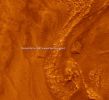
as15-81-11022.jpgAS 15-81-11022 - Spitzbergen Montes58 visiteImage Collection: 70mm Hasselblad
Mission: Apollo 15
Magazine: 81
Magazine Letter: QQ
Lens Focal Length: 500 mm
Camera Look: n.a.
Camera Tilt: 70°
Camera Azimuth: 335
Film Type: 3401
Film Width: 70 mm
Film Color: black & white
Feature(s): Montes Spitzbergen
|
|

SOL1155-2N228912521ESFAS__P1561L0M1.jpgBeyond the Visible Horizon (2) - Sol 115558 visitenessun commento
|
|

SOL1155-2N228912303ESFAS__P1561L0M1.jpgBeyond the Visible Horizon (1) - Sol 115558 visitenessun commento
|
|

SOL1155-2N228912614ESFAS__P1561L0M1.jpgBeyond the Visible Horizon (3) - Sol 115558 visitenessun commentoMareKromium
|
|

PSP_002244_1720_red.jpgWhite Rock (Enhanced Absolute Natural Colors; credits for the additional process. and color.: Dr Paolo C. Fienga - Lunexit Team)58 visiteThis image shows a portion of a relatively bright landform named "White Rock" on the floor of Pollack Crater in the Sinus Sabaeus Region of Mars.
Data from the Mars Global Surveyor Thermal Emission Spectrometer (TES) indicates that this landform is not anomalously bright, relative to other bright Martian Regions. Further, the apparent brightness seen here is due to contrast with other materials on the crater floor.
Dunes and ripples are visible in the dark material between the bright ridges. Their orientations appear to be influenced by wind directionally channeled by the ridges. Material appears to have been shed from the white landform and deposited on the darker bedforms indicating that the light-toned outcrops break down into fine materials.
Its high albedo and location in a topographic basin have led to suggestions that White Rock is an erosional remnant of an ancient lacustrine evaporate deposit.
Other interpretations include an eroded accumulation of compacted or weakly cemented aeolian sediment.
|
|
Psp_002098_2220_red-01.jpgMantles and Flows in Moreux Crater, with a "small" Surface Anomaly (EDM - False Colors)58 visiteSegnalataci dal Dr Barca (ottimo "occhio"!), la possibile Anomalìa di Superficie si sostanzia in una traccia di colore scuro che ci appare incongrua, nella sua direzione, rispetto alle altre fratture (anche modeste) della superficie ripresa, rispetto alla generale direzione assunta da dune e ripples e rispetto a tutte le altrei stratificazioni visibili.
Di che si tratta? Potrebbe essere un image-artifact (la definizione del frame, sebbene eccellente, non è tale da consentirci di escludere l'ipotesi del vizio fotografico), così come potrebbe trattarsi di una recente frattura del suolo (magari di origine sismica) o anche di uno "scalino" roccioso (un layer sedimentario parzialmente esumato).
Certo, se fossimo degli Eso-Archeologi illuminati ed immaginifici, ci saremmo già diretti verso l'ipotesi (decidete Voi se è "esotica" o meno) della "possibile evidenza di una struttura superficiale artificiale".
Ma noi non siamo Eso-Archeologi.
E, purtroppo, non siamo neppure illuminati ed immaginifici, però...però, se proprio dovessimo "azzardare"...diremmo che il rilievo scuro, in questo frame, potrebbe anche essere un'ombra. Di che cosa? Beh, questo "azzardatelo" Voi!...
|
|
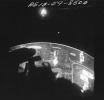
as13-59-8500.jpgAS 13-59-8500 - Time to go Home...58 visiteImage Collection: 70mm Hasselblad
Mission: 13
Magazine: 59
Magazine Letter: R
Lens Focal Length: 250 mm
Description: After separation of Service Module; Moon in background; CM in foreground
Film Width: 70 mm
Film Color: black & white MareKromium
|
|
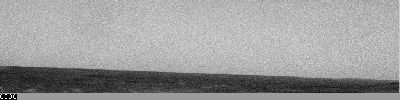
SOL1149-PIA09261.gifOver the Rover... - Sol 114958 visiteCpation NASA:"On Sol 1149 (such as March 28, 2007) of its mission, NASA's Mars Exploration Rover Spirit caught a Wind Gust with its Navigation Camera.
A series of navigation camera images were strung together to create this movie.
The front of the gust is observable because it was strong enough to lift up dust.
From assessing the trajectory of this gust, the atmospheric science team concludes that it is possible that it passed over the Rover. There was, however, no noticeable increase in power associated with this gust.
In the past, Dust Devils and Gusts have wiped the solar panels of dust, making it easier for the solar panels to absorb sunlight".
|
|

Venusian_Atmosphere-ORB157_02_17_WB_H.jpgVenusian Turbulence: the Alpha Regio Area58 visiteThis image of the Venusian South Polar Region was acquired on 24 September 2006 by the Ultraviolet, Visible and Near-Infrared Mapping Spectrometer (VIRTIS) on board ESA’s Venus Express, from a distance of about 53.000 Km from the Planet’s surface.
The image, taken on the night-side of Venus at a wavelength of 1,7 micron, shows waves structure (faint light vertical streaks at the lower left part of the dark band in the centre-left side of the image) and a highly turbulent region (bottom left).
The Alpha Regio area is at the bottom left of the image. This area is characterised by a series of troughs, ridges, and faults that are oriented in many directions, with surface features that can be up to 4 Km high. It is not yet clear if atmospheric turbulences may be induced by the rough topography below the clouds.
The grey-scale of the image is such that black means more transparency, therefore less clouds, while white means more opacity, therefore more cloud concentration.MareKromium
|
|

Venusian_Atmosphere-ORB157_00_17_WB_H.jpgVenusian Turbulence: South Polar Region58 visiteThis image of the Venusian South Polar Region was acquired on 24 September 2006 by the Ultraviolet, Visible and Near-Infrared Mapping Spectrometer (VIRTIS) on board ESA’s Venus Express, from a distance of about 60.000 Km from the Planet’s surface.
The image, taken on the night-side of Venus at a wavelength of 1,7 micron, shows waves structure (faint light vertical streaks at the lower left part of the dark band in the centre-left side of the image) and a highly turbulent region (bottom left).
The Alpha Regio area is at the bottom left of the image. This area is characterised by a series of troughs, ridges, and faults that are oriented in many directions, with surface features that can be up to 4 kilometres high. It is not yet clear if atmospheric turbulences may be induced by the rough topography below the clouds.
The grey-scale of the image is such that black means more transparency, therefore less clouds, while white means more opacity, therefore more cloud concentration. MareKromium
|
|

Venusian_Atmosphere-Airglow_VIRTIS_Anticlockwise-00.jpgThe "Airglow" of Venus58 visiteNew infrared data is now available about Venus’ oxygen airglow – a phenomenon detectable on the night-side that makes the planet glow like a ‘space lantern’.
“The oxygen airglow was first discovered thanks to ground observations, and also observed by other missions to Venus such as the Russian Venera spacecraft and the US Pioneer Venus orbiter,” said Pierre Drossart, co-Principal Investigator on Venus Express’ VIRTIS instrument. “However, the global and detailed view we are getting thanks to Venus Express is truly unprecedented.”
The fluorescence of the airglow is produced when oxygen atoms present in the atmosphere ‘recombine’ into molecular oxygen (or ‘O2’) emitting light. Where does the oxygen come from?
“The oxygen in the atmosphere of Venus is a very rare element,” continued Drossart. At high altitudes in the atmosphere, on the day-side of Venus, the strong flux of ultraviolet radiation coming from the Sun ‘breaks’ the molecules of carbon dioxide (‘CO2’) present in large quantity in the atmosphere, liberating oxygen atoms. “These atoms are then transported by the so-called ‘sub-solar’ and ‘anti-solar’ atmospheric circulation towards the night side of the planet. Here the atoms migrate from the high atmosphere to a lower layer, called ‘mesosphere’, where they recombine into O2. By doing this, they emit light at specific wavelengths that can be observed through remote sensing from Earth and with Venus Express,” added Drossart.
The detection of the airglow, and the capability to follow its evolution in time, is extremely important for several reasons.
“First, we can use the distribution and motion of these fluorescent O2 ‘clouds’ to understand how the atmospheric layers below move and behave,” said Giuseppe Piccioni, the other co-Principal Investigator on VIRTIS. “In this sense, the O2 airglow is a real ‘tracer’ of the atmospheric dynamics on Venus.”
“Second, the analysis of this phenomenon will provide new clues on how its global atmospheric chemistry works – a very challenging task indeed, and still an open field of research,” continued Piccioni. “By calculating the speed at which this chemical ‘recombination’ takes place, we might be able – in the future – to understand if there are mechanisms that favour, or catalyze, this recombination, and learn more about the production and recombination of the other chemical species in the Venusian atmosphere.”
“Third, the observation of the oxygen airglow also allows to a better understanding of the global ‘energetic’ exchange between Venus’s mesosphere – at upper boundary of which the airglow is situated, with Venus’ thermosphere, an even higher layer directly influenced by the Sun.”
MareKromium
|
|

Venusian_Atmosphere-Airglow_VIRTIS_Anticlockwise-02.jpgThe "Glowing Oxygen" of Venus (false colors - elab. ESA)58 visite“During one year of observations, we have already collected huge amount of data, which is exactly what we need to decode the secrets of an atmosphere as complex as that of Venus,” said Håkan Svedhem, Venus Express Project Scientist at ESA. “Analysing it is an extreme effort for all science teams, but it is definitively paying back in terms of results.”
The first ever, terrific global views of the double-eyed vortex at Venus’ south pole, the first sets of 3D data about the structure and the dynamics of the sulphuric-acid clouds surrounding the planet in a thick curtain, temperature maps of the surface and the atmosphere at different altitudes, are only a few of the results obtained so far.
“Continuing at today’s rate, and on the basis of what we were able to see so far, there is no doubt that Venus Express will eventually allow a better global understanding of this planet,” continued Svedhem. “Not only will planetary science in general benefit from this, but also understanding Venus – its climate and atmospheric dynamics –will provide a better comprehension of the mechanisms that drive long-term climate evolution on our own Earth.”
MareKromium
|
|
| 25353 immagini su 2113 pagina(e) |
 |
|
|
|
|
1399 | |
|
|
|
|





