| Piú viste |

PSP_010057_2040_RED.JPGUnnamed Crater with Ridges and DD Tracks (natural colors; credits: Lunexit)58 visiteThis image shows two features of interest on the floor of a large impact crater. The first is the set of roughly parallel ridges on the crater floor that point towards the crater center north of the image. These may be Inverted Stream Channels, where old streambeds became resistant to erosion due to cementation or simply deposition of large rocks. This is consistent with the slightly wavy, sinuous shape of the ridges, but these examples are not particularly well-preserved.
More recently, this site has become blanketed by dust, settling out after Global Dust Storms. This obscures much of the fine-scale geology, but allows HiRISE to see the effects of a recent process: Dust Devils. These have left the dark stripes across the surface by disturbing the dust cover. Most followed straight paths, but a few loops or turns are visible. Dust Devils may be an important factor in the Martian climate system because they lift dust into the atmosphere, helping to trigger larger Dust Storms.MareKromium
|
|
SOL935-1.jpgOpportunity's Gear - Sol 935 (possible True Colors; credits: Dr G. Barca)58 visitenessun commentoMareKromium
|
|

OPP-SOL500-2.jpgRover Tracks - Sol 500 (possible True Colors; credits: Dr G. Barca)58 visitenessun commentoMareKromium
|
|

PSP_010008_2630_RED.jpgStructure of the North Polar Layered Deposits (natural colors; credits: Lunexit)58 visiteThis image shows an exposure of the North Polar Layered Deposits (NPLD) within the Northern Residual Ice Cap. The NPLD are thought to have been formed by recent climate changes on Mars, like ice ages on Earth.
Scientists are studying the NPLD to learn more about these climate changes on Mars. In many places, the NPLD layers appear to extend over large areas, suggesting that they were deposited from atmospheric suspension. If the layers in this image are horizontal and continuous, the apparent curves are caused by erosion of valleys into the NPLD. To determine whether this is the case, HiRISE has acquired two images of this location to form a stereo pair. Analysis of this stereo pair will allow the orientation and thickness of the layers to be measured across the region of stereo coverage, constraining hypotheses for their formation.
Also visible in this image are bright and dark streaks that may be caused by the redistribution of frost by winds.MareKromium
|
|

OPP-SOL019-1M129869847EFF0338P2953M2M1-3.jpgHairy Berries... - Sol 19 (edm; credits: Dr G. Barca)58 visiteEd ora il preziosissimo contributo del Dr Barca alla "disputa" sul presunto "pelo marziano". Già detta così sembra una cosa ridicola...Ma non lo è: tutta la questione è estremamente seria, per questi motivi:
1) l'oggetto ripreso (ed originariamente evidenziato nel 3D del Dr Faccin) esiste e NON PARE essere un qualcosa di correlabile agli air-bags di Opportunity;
2) il "filamento" (chiamiamolo così...), è lungo e, forse, NON E' L'UNICO del frame;
3) SEMBRA che questo/i filamento/i sia/sìano ATTACCATO/I ai berries.
La Materia, come vedete (sorrisi e battute a parte), è quindi molto seria e complessa: che cosa stiamo guardando?!?
"Bachi da Seta Marziani"?!?...O forse un "Ragnetto Marziano" sta tessendo la sua tela?!?...
Scriveteci le Vostre idee!MareKromium
|
|
OPP-SOL543-1.jpgThe Beautiful "Martian Paving" - Sol 543 (possible True Colors; credits: Dr G. Barca & Lunexit)58 visitenessun commentoMareKromium
|
|

OPP-SOL528-1.jpgBerryland! - Sol 528 (possible True Colors; credits: Dr G. Barca & Lunexit)58 visitenessun commentoMareKromium
|
|

PSP_006969_1725_RED_abrowse-00.jpgThe Floor of Noctis Labyrinthus (context frame - MULTISPECTRUM; credits: Lunexit)58 visiteThis image shows part of Noctis Labyrinthus, the “Labyrinth of the Night.” This is a system of connecting troughs which form a maze-like network at the western end of Valles Marineris, the giant canyon system of Mars.
The individual troughs are usually kilometers across; this image shows part of the floor of one of the troughs, with some intriguing fine-scale features.
Near the center of the image, the floor is broken up into many small knobs and hills, probably eroded remnants of a larger geologic unit.MareKromium
|
|
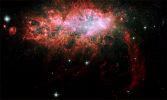
NGC-1569.jpgStarburst Galaxy NGC 156958 visiteThis image taken by NASA's Hubble Space Telescope showcases the brilliant core of one of the most active galaxies in our local neighborhood. The entire core is 5,000 light-years wide.
The galaxy, called NGC 1569, sparkles with the light from millions of newly formed young stars. NGC 1569 is pumping out stars at a rate that is 100 times faster than the rate observed in our Milky Way Galaxy. This frenzied pace has been almost continuous for the past 100 million years.
The core's centerpiece is a grouping of three giant star clusters, each containing more than a million stars. (Two of the clusters are so close they appear as one grouping.) The clusters reside in a large, central cavity. The gas in the cavity has been blown out by the multitude of massive, young stars that already exploded as supernovae. These explosions also triggered a violent flow of gas and particles that is sculpting giant gaseous structures. The sculpted structure at lower right is about 3,700 light-years long.
Huge bubbles of gas, such as the two at left, appear like floating islands. The largest bubble is about 378 light-years wide and the smallest 119 light-years wide. They are being illuminated by the radiation from the bright, young stars within them. Some of those stars are peaking through their gaseous cocoons.
The biggest and brightest objects surrounding the core are stars scattered throughout our Milky Way Galaxy. In contrast, the thousands of tiny white dots in the image are stars in the halo of NGC 1569. The galaxy is 11 million light-years from Earth.
A new analysis of NGC 1569 shows that it is one and a half times farther from Earth than astronomers previously thought. The extra distance places the galaxy in the middle of a group of about 10 galaxies centered on the spiral galaxy IC 342. Gravitational interactions among the group's galaxies may be compressing gas in NGC 1569 and igniting the star-birthing frenzy.
MareKromium
|
|

The_Rings-PIA10518.jpgJust like a "Ribbon"...58 visiteCaption NASA:"The ever-changing F-Ring appears as wisps of smoke in this image taken downstream of the Shepherd Moon, Prometheus.
The image was taken in Visible Light with the Cassini Spacecraft narrow-angle camera on Oct. 23, 2008 at a distance of approx. 437.000 Km (about 272.000 miles) from Saturn and at a Sun-Saturn-Spacecraft Angle of 89°.
Image scale is roughly 2 Km (a little more than 1 mile) per pixel".
Nota Lunexit: un sincero Grazie alla NASA per aver pubblicato questa immagine la quale risolve - diremmo in via definitiva - il dubbio che era nato a proposito del possibile fenomeno di distorsione ottica imputabile ad un campo gravitazionale (e/o magnetico) di grande portata ed estremamente vicino a Cassini.MareKromium
|
|
OPP-SOL1702-1P279291760EFF93LGP2378R1M1.jpgEtched Terrain, on the way to Endeavour - Sol 1702 (possible natural colors; credits: Lunexit)58 visitenessun commentoMareKromium
|
|
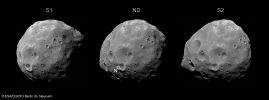
PHOBOS-Image013-411-20081008-5870-6-s12_nd-01-PhobosSeries_H1.jpgViews of Phobos58 visiteThis sequence of images was obtained by the High Resolution Stereo Camera (HRSC) on board ESA’s Mars Express on 26 July 2008 (orbit 5861), at a distance of about 2295 Km from the moon’s centre, and provides a striking impression of the encounter.
These imagee was taken using all 9 imaging channels of the camera. The resolution shown here is 92 mt/pixel for each image.
HRSC is a so-called push-broom camera, building up images in a ‘scanning’ mode while the spacecraft passes over the surface. Its nine channels, or scanning lines, are oriented in different directions that spread from 18,9° behind the nadir viewpoint (corresponding to a vertical line of sight), to 18,9° ahead of the nadir. This gives the camera its stereo-viewing capacity.MareKromium
|
|
| 25353 immagini su 2113 pagina(e) |
 |
|
|
|
|
1393 | |
|
|
|
|





