| Piú viste |

Craters-Secondary_Craters-Arabia_Terra-PIA08759-1.jpgSeconday Craters in Arabia Terra Region58 visiteCaption NASA originale:"This portion of the Arabia Terra Region has several different layers of material exposed.
These layers (usually) occur at the highland/lowland boundary".
Image information: VIS instrument;
Latitude: 26,7° North;
Longitude: 341,0° East;
Resolution: 19 meter/pixel.
|
|
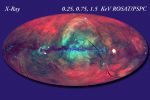
MWMW09_xray_allsky.jpgAll Sky: the "X-Ray Sky"58 visiteNon so proprio cosa dire.
Ero tranquillo, stavo viaggiando in completo relax quando quell’individuo con i pacchetti mi si è parato davanti.
Cristo, non ho potuto fare nulla per evitarlo!
Ricordo di aver schiacciato il freno, certo, ma il manto stradale bagnato deve avermi fatto avanzare scivolando per qualche altro metro, sino ad andargli addosso.
Mi dispiace.
Immediatamente dopo l’urto sono sceso dalla macchina per cercare di fare qualcosa, ma ho capito subito che non c’era più nessuna speranza.
A terra vedo due pacchetti.
Un barattolo di pomodori sta rotolando verso una macchina gialla parcheggiata poco più avanti e, sull’altro lato della strada, vedo un cassone dei rifiuti rovesciato.
C’è immondizia dappertutto.
L’uomo giace a terra, morto.
Un rivolo rosso gli scorre giù dal naso e la testa è piegata in maniera decisamente innaturale verso la sua spalla sinistra.
Credo che abbia l’osso del collo rotto.
Il soprabito è strappato e macchiato di fango e detriti.
Il cappello.
Il cappello - non posso fare a meno di notarlo - gli è rimasto sulla testa.
Adesso piove - pesantemente - ed è scesa una fitta nebbia.
Sono incantato dal rumore delle gocce di pioggia che rimbalzano sulla tesa del cappello dell’uomo a terra.
Cadono e si infrangono generando splendide schegge brillanti.
Lo sguardo dell’uomo è curioso: sembra sorpreso e spaventato al tempo stesso.
La nebbia adesso è davvero spessa.
Ho chiesto ad un passante di chiamare un ambulanza e la polizia, ma non sento ancora il suono delle loro sirene.
La pioggia è incessante e sembra crepitare sulla lamiera della mia macchina.
Che suono strano ed ipnotico.
Non mi sento molto bene: mi fa male il volto e ho freddo.
Molto freddo.
P.C. Floegers - "Oltre la Nebbia" - scena II
|
|
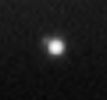
Earth-PIA08324-2.jpgEarth, from Saturn's Space (2)58 visiteThis magnified view of the image taken through the clear filter (monochrome) shows the Moon as a dim protrusion to the upper left of Earth. Seen from the Outer Solar System through Cassini's cameras, the entire expanse of direct human experience, so far, is nothing more than a few pixels across. Earth no longer holds the distinction of being our Solar System's only "water world", as several other bodies suggest the possibility that they too harbor liquid water beneath their surfaces. The Saturnian moon, Enceladus, is among them, and is also captured on the left in this image, with its plume of water ice particles and swathed in the blue E-Ring which it creates. Delicate fingers of material extend from the active moon into the E-Ring. The narrow and tenuous G-Ring and the Main Rings are seen at the right. The view looks down from about 15° above the un-illuminated side of the Rings.
Images taken using red, green and blue spectral filters were combined to create this view. The image was taken by the Cassini spacecraft wide-angle camera on Sept. 15, 2006, at a distance of approx. 2,1 MKM (about 1,3 MMs) from Saturn and at a sun-Saturn-spacecraft angle of almost 179°.
Image scale is roughly 129 Km (about 80 miles) per pixel.
At this time, Cassini was nearly 1,5 BKM (about 930 MMs) from Earth.
|
|
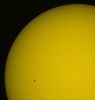
The Sun~0.jpgIn the Sun...58 visiteDa "NASA - Picture of the Day", del 21 Settembre 2006:" Though it's 93 MMs away, the Sun still hurts your eyes when you look at it.
But bright Sunlight (along with accurate planning and proper equipment!) resulted in this sharp silhouette of spaceship and space station.
The amazing telescopic view, recorded on September 17, 2006, captures Shuttle Orbiter Atlantis and the International Space Station in orbit over planet Earth.
At a range of 550 Km from the observing site near Mamers, Normandy, France, Atlantis (left) has just undocked and moved about 200 mt away from the Space Station.
Tomorrow (Sept. 22, 2006), yet another satellite of planet Earth can be seen in silhouette - the Moon will eclipse the Sun. This last eclipse of 2006 will be seen as an annular solar eclipse along a track that crosses Northern South America and the South Atlantic".
|
|

Saturn-W00018136.jpgFrom "A" to "E"!58 visitenessun commento
|
|
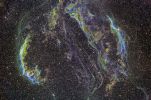
NGC-6960-Veil_Nebula-full.jpgNGC 6960 - The "Veil Nebula"58 visite"It is You, who made the Heavens and the Earth, by Your great power and by Your outstretched arm! Nothing is too hard for You".
- Jeremiah 32:17
|
|
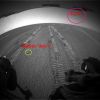
OPP-SOL948-1R212348131EFF7672P1301R0M1.jpgOn the Land and in the Sky... (1) - Sol 94858 visiteAncora due interessantissimi frames selezionati dal bravissimo Dr Gianluigi Barca i quali ci mostrano, oltre a queste (realmente) misteriose "Presenze di Luce" che chiamiamo S.L.O. (Star-Like Objects), anche dei bizzarri rilievi superficiali.
Ma attenzione: quando diciamo bizzarri, intendiamo solo dire - almeno in questi casi - oggetti "dalla forma curiosa", senza implicare (speculando alla cieca) una loro totale o parziale artificialità.
Rilievi "strani", come il "dado" di questo frame o il "cuoricino nero" che vedrete nel prossimo...
|
|

Janus-N00066645.jpgMoments of "Janus" (3)58 visitenessun commento
|
|

North_Polar_Features-Unconformities-01.jpgNorth Polar "Unconformities" (Original NASA/MGS/MSSS b/w Frame)58 visiteCaption NASA originale:"This MGS-MOC image shows Layers exposed in the North Polar Region of Mars. The North Polar Cap is underlain by a thick sequence of Layered Material. The Layers are most commonly exposed on the slopes of troughs that are believed to have formed by Wind Erosion. The Layers give a banded appearance. In this example, some of the Layers are cut off (truncated) by other Layers. This truncation is a classic, textbook example of an Erosional Unconformity, a term commonly used by geologists. The Unconformity occurs when deposition of new layered material stops for a while and erosion occurs. Then, new layers form on top of the eroded surface and the older layers, at some point in time when the erosion stops and deposition of layered material resumes".
Location near: 78,6° North Lat. and 342,0° West Long.
Image width: ~3 Km (~1,9 mi)
Illumination from: upper right
Season: Northern Spring
|
|

OPP-SOL952-1N212701244EFF76EVP0657L0M1.jpgThe features of Victoria Crater, from Duck Bay (6) - Sol 95258 visitenessun commento
|
|

NGC-2237_and_NGC-2244-01.jpgNGC 2237 - The "Rosette Nebula", and Globular Star Cluster NGC 224458 visite"...Caput columbae, cauda scorpionis est..."
(anonimo)
"...Ha il il capo di una colomba, ma la coda di uno scorpione..."
(Detto riferito ai falsi amici che blandiscono con la bocca e poi feriscono con la mano, non appena si presenta l'occasione)
|
|

NGC-2237_and_NGC-2244-2.jpgNGC 2237 - Inside the "Rosette Nebula"58 visite"...Duos parietes de eadem fidelia dealbare..."
(Cicerone)
"...Imbiancare due pareti con la tinta dello stesso vaso..."
(detto riferito a coloro che, pur di mantenere la posizione e lo status conseguiti, si barcamenano fra opposte rive, ora assecondando una corrente ed ora l'altra)
|
|
| 25353 immagini su 2113 pagina(e) |
 |
|
|
|
|
1392 | |
|
|
|
|





