| Piú viste |

HD-189733b.jpgHD-189733b - Exoplanet in Vulpecula58 visite"...Saepe condita luporum fiunt rapinae vulpium..."
(Proverbio Medioevale)
"...Sovente le volpi riescono a sottrarre anche le prede nascoste dai lupi..." (trad. libera)MareKromium
|
|
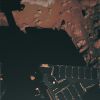
SOL236.jpgEvening Shadow... - Sol 236 (natural colors + MULTISPECTRUM; credits: Dr M. Faccin & Lunexit)58 visitenessun commentoMareKromium
|
|

NGC-2808-The_Region.jpgLooking towards the Centaurus Region58 visite"...Vetera extollimus, recentium incuriosi..."
(Tacito)
"...Magnifichiamo l'antichità e trascuriamo l'attualità..."MareKromium
|
|

NGC-2808-1.jpgNGC 2808 - Omega Centauri (Globular Star Cluster)58 visite"...In culpa est animus, qui se non effugit unquam..."
(Orazio)
"...Un animo consapevole non può sfuggire a se stesso..." (trad. libera)
Nota per i Lettori: ho tradotto "in culpa" come se stesse a significare "nella consapevolezza". Non è una svista, ma una semplice interpretazione personale.MareKromium
|
|
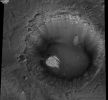
Craters-Pollack_Crater-H1201_0001_ND3_crop_wide-0.jpgPollack Crater and "White Rock" (RAW Frame; credits: ESA - Mars Express)58 visitenessun commentoMareKromium
|
|

O-Mariner9-72-Pollack_Crater_and_White-Rock.jpgPollack Crater and "White Rock" from Mariner 9 (RAW Frame - credits: NASA)58 visite"...It was interesting to browse through the Mariner 9 data set to locate these images, because evidently the Mariner 9 Team wasn't sure to make of these strange bright deposits.
The first one I posted was described as "white rock" in a comment on the image, and that name has stuck. But another image's descriptive comment read "curious ice patches".
Another totally misidentified not only the nature but the location of the photo, describing it as "Polar Cap".
Comments on images of other places in the Mariner 9 Catalog generally reflect the fact that Mars had not yet been systematically surveyed by an orbiter, so the scientists often weren't quite sure what they were looking at, and even when it was clear there were craters, those craters had mostly not yet been named.
I came across comments like "peculiar filametary structure" and "possible craters" and "streaky detail" and "cloud?" and "multitude of surface detail" and "odd fork-shaped bright pattern."
It's fun to browse through that table and imagine surveying Mars, with a spacecraft stationed at the Planet for the first time, made all the more dramatic by its initial obscuration by a dust storm that slowly cleared.
Mariner 9 is one of the more challenging data sets to work with because it's just so old. However, everything you need to access it, find images, view them, and convert them to more familiar formats is readily available online. First of all, the data itself can be found by browsing the data volumes at the PDS Imaging Node, and you can learn a little bit about the data at the National Space Science Data Center. To figure out what's what and to try to track down images of specific areas, you can download this spreadsheet (XLS format, zipped, 7.5 MB) containing an index to all the images.
The images are all in a format that won't be familiar to most of you, but like most spacecraft data you can convert a folder full of images to PNG format using my favorite amateur-produced software, Björn Jónsson's IMG2PNG. However, if you're only working with a couple of images, I'd recommend a different amateur-produced piece of software for converting the images, Piotr Masek's MarinerView, because MarinerView can be used to correct the Mariner 9 images (one at a time) for the little white specks of noise that are spattered across every one.
I'm slowly working on tracking down images of "White Rock" taken by every mission. First Mariner 9, then the Viking orbiters, then Mars Global Surveyor's MOC, then Mars Odyssey THEMIS, then Mars Express HRSC, and, finally, I should be able to produce Mars Reconnaissance Orbiter views from three different instruments: HiRISE, CTX, and CRISM. Stay tuned for further installments...".
Emily Lakdawalla (Planetary Society)MareKromium
|
|
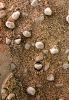
SOL1008-MIC-01.jpgPebbles in the "wet" (?) Martian Sand... - Sol 1008 (True Colors; credits: Dr M. Faccin)58 visiteUn altro SPLENDIDO Lavoro del Dr Faccin, che ci porta - a nostro parere - ancora un pò più vicini alla realtà di Marte. Una realtà che, per innumerevoli motivi e colpe (anche nostre, ovviamente), se ne sta ancora "sotto la sabbia" del Pianeta più famoso del Sistema Solare...
Ma, come vedete bene in questo frame, piano-piano, stiamo "smuovendo" quella sabbia (ci viene da dire "palesemente umida"...) sotto la quale, forse, si cela una grandissima Sorpresa...
Comunque, diamo tempo al Tempo, et procedemus!...MareKromium
|
|
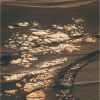
OPP-SOL569-1.jpgRover Tracks and Martian Paving - Sol 569 (True Colors + MULTISPECTRUM; credits: Dr G. Barca & Lunexit)58 visitenessun commentoMareKromium
|
|

SOL1007-MIC-01.jpgWhite Sands, Salt or just Ice Cristals? (True Colors + MULTISPECTRUM; credits: Dr M. Faccin & Lunexit)58 visitenessun commentoMareKromium
|
|
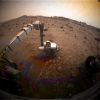
SOL1287-0.jpgRobotic Arm At Work! - Sol 1287 (True Colors; credits: Dr M. Faccin)58 visitenessun commentoMareKromium
|
|

Enceladus-IMG003035.jpgNot for Human Eyes... (by Karl Kofoed)58 visiteCaption NASA:"In this artist's rendering, a distant Sun forms a halo (refracted sunlight by ice crystals) amid streamers of pure water ice particles, which spew into space from cracks in the South Polar surface of Saturn's tiny moon Enceladus". MareKromium
|
|
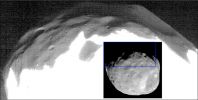
PSP_007769_9015_MarsShine.jpgIn the Mars-Shine... (credits: NASA)58 visiteThis is a close-up and enhanced part of image PSP_007769_9015. In the original image, detail in the black, un-illuminated portion is not apparent. However, seen in enhanced detail here, craters are clearly visible.
This faint illumination is from reflected light off of Mars (“Marsshine”). This is directly analogous to “Earthshine,” where reflected sunlight from our planet illuminates the dark side of the Moon.
The ability to see features on Phobos illuminated by Marsshine demonstrates the high sensitivity of the HiRISE camera.MareKromium
|
|
| 25353 immagini su 2113 pagina(e) |
 |
|
|
|
|
1375 | |
|
|
|
|





